



Healthcare
Most AI projects never get past the demo. The model looks good in a notebook, then stalls on messy data, missing guardrails and no agreed idea of “good enough”. Ailoitte is a custom AI development company that engineers the whole path to production, so your machine learning, generative AI, agent or computer vision system goes live in 4 to 6 weeks, measured against a metric you sign off.
Not sure AI is the right fix? Ask first. If a simpler rule or report solves it, we will say so.
4 to 6 weeks
From kickoff to production
Model-agnostic
Claude, GPT, Gemini, Llama
Zero data retention
No training on your data
Our AI development services cover machine learning, generative AI and RAG, AI agents, computer vision, conversational AI and document intelligence.
Most use cases go live in 4 to 6 weeks. A proof of concept takes 2 to 4 weeks, and enterprise platforms take longer.
AI builds generally start from $17,000, and agentic automation for a single workflow from $8,000. The fixed figure follows discovery.
A named senior architect with ML, data and platform engineers. Every AI-assisted output is reviewed by a senior engineer before release.
Whichever fits each task: Claude, GPT, Gemini, Llama or Mistral, behind an abstraction layer so you can switch later.
The code, models, prompts and evaluation sets. We keep no copy of your data and never train models on it.
AI development services cover the strategy, data engineering, model development, integration, testing and deployment needed to put artificial intelligence into production. That spans machine learning, generative AI, AI agents, computer vision and conversational AI. Each one is built into your products and workflows, not left sitting in a notebook.
Most AI projects do not fail because the model was wrong. They stall for four reasons. The prototype never got a path to production. The data was not ready. Nobody agreed what “good enough” meant. Or a made-up answer reached a customer and trust collapsed. None of those are model problems. They are engineering problems.
So we treat data and integration as the main work, not someone else’s prerequisite. That means cleaning and labelling data, and building retrieval and test sets. It also means connecting the AI to the ERP, CRM and sign-in systems your teams already use. Where the use case is still unclear, we start with AI consulting or an AI strategic discovery workshop.
As an artificial intelligence development company, we deliver AI application development services on a fixed scope and price. You get a named architect, weekly demos and full IP ownership. That applies whether you are a startup proving value to investors or an enterprise rolling AI out across departments.
A short call usually settles which approach fits your problem, and saves weeks of wasted build.
Judge any AI development company on systems that are live, not pilots. Our voice-to-EMR assistant transcribes consultations at 99.2% medical accuracy and gives each clinician 12+ hours back a week. Our WhatsApp AI recruiter cut time-to-hire from 14 days to 48 hours. See every result on our ROI case studies page.
Tell us the problem and the data behind it. A senior AI engineer will tell you whether it can reach production, and how fast.
Founders and product leaders on shipping with our AI and data engineers. Every reference is signed and can be read in full.
Our artificial intelligence development services span the full stack, each one scoped to a business outcome rather than a research goal. Not sure where to start? Begin with AI consulting, or describe the problem and we will tell you.
Custom models for prediction, scoring, classification and forecasting, trained on your data with a documented evaluation harness.
LLM applications grounded in your own content with RAG, so answers are current, cited and specific to your business.
Agents that plan, call tools and run multi-step workflows, with a person approving every action that matters.
Detection, classification, OCR and quality inspection from images and video, on the device or in the cloud.
Support and sales assistants grounded in your knowledge base, with clean hand-offs to people. AI voice agents do the same on phone calls.
Contracts, forms and invoices read, classified and summarised at scale, with structured output you can trust.
Our AI software development services design the path to deployment before the first model is trained: data pipelines, evaluation, guardrails and monitoring. Every AI-assisted output is reviewed by a senior engineer, so judgement stays human while AI speeds up the work.
A demo needs a model. A system your business can rely on needs these four engineering layers around it.
RAG pipelines over your own data, with chunking, embeddings and re-ranking, so answers cite your content instead of inventing it.
Structured output schemas, input and output filters, and confidence thresholds that send uncertain cases to a person.
A labelled test set and automated evals run on every change, so accuracy drops are caught before release, not by users.
Live tracking of accuracy, latency and inference cost, with drift alerts and a retraining cadence agreed up front. See how our team and process work.
Most business problems need the simplest option that meets the accuracy bar, not the most advanced one. Here is how the five main approaches compare. For the generative side in depth, see generative AI development.
We confirm the right approach during discovery, against your data.
| Approach | What it does | Use it when |
|---|---|---|
| Prompting a foundation model | Instructs a model such as Claude or GPT with no extra training or data pipeline. | The task is general, like drafting or summarising, and your own facts are not needed. |
| RAG | Retrieves passages from your own knowledge base at query time and gives them to the model. | Answers must use your facts, stay current and cite a source. This covers most business cases. |
| Fine-tuning | Trains a model further on your examples, which fixes its format and tone. | You need a narrow, repeatable task in a set style. It costs more and its knowledge freezes at training. |
| AI agents | Plans steps, calls tools and APIs, checks the result and repeats until a goal is met. | The work is a multi-step workflow, like triage or reconciliation, with approval before key actions. |
| Classical machine learning | Learns patterns from structured, historical data to predict or score. | You are forecasting, scoring risk or spotting fraud in tables of numbers, not text. |
Tell us the problem, the data you have and the systems it must connect to. Within 12 hours a senior AI engineer sends a feasibility view and a starting price for your AI application development services.
We are measured on systems that go live and stay live, typically within 4 to 6 weeks, not on how good the demo looked.
Fixed price, fixed scope and an agreed success metric. You know the cost and the target before we start.
We pick the right model for each task behind an abstraction layer, so you are never locked to one vendor.
Zero data retention, private deployment where needed, and an ISO 27001 certified process.
Code, models, prompts and evaluation sets are handed over in full. Nothing stays locked with us.
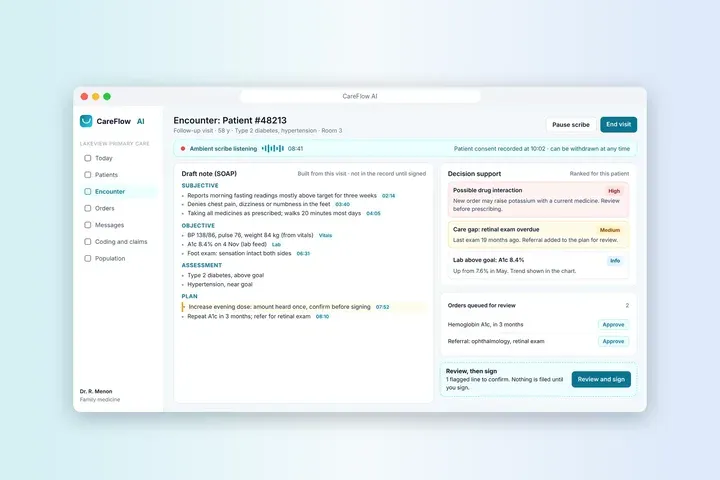
These are the AI app development services we are asked for most often. Healthcare wants clinical documentation, prior authorisation and patient risk scoring. Fintech wants fraud detection, credit scoring and KYC checks. Retail wants recommendations and demand forecasting. Logistics wants route optimisation and proof-of-delivery vision, and HR teams want candidate matching at scale.
We will walk you through a comparable build, the metric it moved, and what it took to reach production.
Each phase ends with something you can test, not a status deck. Delivery runs on Clarity, our delivery framework, with a working demo every week and metrics reported against the success criteria you signed off.
Use cases ranked by value and feasibility, data audited, and the success metric and test set agreed. About AI discovery.
Models chosen per task, retrieval and guardrails designed, and hosting decided: API, private cloud or on-premise.
Data pipeline, vector store and orchestration built, then wired into your product, CRM or internal systems.
Automated evals against the test set, red-teaming for prompt injection, a security review and cost tuning.
A staged rollout with monitoring and drift alerts live, handover documents, then ongoing support.
We are model-agnostic by design, working with Claude, GPT, Gemini, Llama and Mistral. We orchestrate with LangChain, LlamaIndex, LangGraph and MCP, train with PyTorch, TensorFlow and scikit-learn, and search with Pinecone, Weaviate or pgvector. The platforms below are where most of it runs.
AI development generally starts from $17,000 for a focused, production-ready use case. Agentic automation for a single workflow, such as ticket triage, invoice matching or lead qualification, starts from $8,000, depending on the use case.
The exact figure is fixed once discovery is done. Discovery takes up to four weeks and shows what your data, integrations and accuracy bar really need, so the price you sign is one we can keep.
Build cost is one number. What surprises most teams is the monthly inference bill, so we estimate token and hosting costs during discovery and tune them after launch. Our AI Cost Calculator uses the same model we put in client proposals.
Six factors set an AI price, and the model itself is rarely the biggest. Running costs after launch sit under application maintenance.
Clean, labelled data keeps cost down. Cleaning, labelling or migration adds real effort.
A standalone tool costs less than one wired into your CRM, ERP and identity systems.
Moving from good to clinical or financial grade takes far more evaluation work.
Private or on-premise deployment with audit evidence costs more than an API-hosted model.
More users and longer prompts mean a bigger monthly inference bill, which we size up front.
Budget 15 to 20 percent of the build cost a year for monitoring, retraining and model updates.
Our AI app development company offers three routes. Choose by how clear the use case is. If it is not clear yet, start with a four-week AI strategic discovery instead. Each route comes with the same AI software development services and senior team.
Full-scope AI application development services. A senior pod takes one use case live in 4 to 6 weeks on a fixed price. You also get the infrastructure and documents behind it.
For a defined problem with data you can share.
An embedded pod of ML, data and platform engineers working through your roadmap, priced on fixed milestones. See AI Velocity Pods.
For a roadmap of AI features that keeps growing.
Senior AI and ML engineers who join your team with no long onboarding ramp. Hire AI developers.
For teams that already own the architecture.
For workflows too complex for one agent, we orchestrate specialised agents that hand work to each other, with every decision visible.
Each agent gets clear objectives, lasting context and a fixed set of tools, so its behaviour stays bounded.
Supervisor, sequential and parallel orchestration, with MCP for tool access and agent-to-agent messaging.
Policy rules, spend and rate limits, and human approval before any action that cannot be undone.
Every plan, tool call and decision is logged, so you can audit exactly why an agent did what it did.
Retries, fallbacks and escalation paths, so a stuck agent reaches a person instead of looping silently.
Architecture patterns and use cases on our dedicated AI agent development page.
Agentic automation for a single workflow starts from $8,000. In 30 minutes we will tell you which of yours pays back first.
We deliver artificial intelligence development services to clients across the USA, UK, UAE, Australia, Canada and Europe, and AI rules differ by region. In the EU, transparency duties for AI-generated content apply from 2 August 2026, while high-risk system rules now start on 2 December 2027. We map your use case to the EU AI Act, NIST AI RMF, GDPR, HIPAA or India’s DPDP Act during discovery.
Before you share any data, check us out: meet the team, see our awards, and read our ISO 27001 and ISO 9001 certificates.
Headquarters, and home to our in-house ML, data and platform engineers.
L-148, 5th Main Road, Sector 6, HSR Layout, Bengaluru, Karnataka 560102
Our US entity, for contracts, invoicing and AI support in North American hours.
8 The Green, STE R, Dover, DE 19901
AI development services cover the strategy, data engineering, model development, integration, testing and deployment needed to put artificial intelligence into production. That includes machine learning, generative AI and LLM applications, AI agents, computer vision and conversational AI. As an AI development company, we deliver them on fixed-price outcomes with senior engineers, usually live in 4 to 6 weeks.
Our AI app development services cover six areas, each with its own specialist team. They are machine learning, generative AI and RAG, AI agents, computer vision, chatbots and voice agents, and NLP and document intelligence. Where the use case is still open, we start with AI consulting.
Most scoped use cases reach production in 4 to 6 weeks. A proof of concept takes 2 to 4 weeks, and enterprise platforms with several integrations take longer. Speed comes from starting with a scoped use case and a success metric, not open-ended research.
AI development generally starts from $17,000, and agentic automation for a single workflow from $8,000. Where a project lands above that depends on data readiness, integration depth and compliance scope, far more than on the model. We fix the exact price at the end of discovery, which takes up to four weeks, so there are no surprises later.
Only when your data is an unknown. A proof of concept tests one risky assumption in 2 to 4 weeks. Usually that is whether your data can support the accuracy the use case needs. When the pattern is already proven, go straight to a production pilot and save the time.
Yes, and most clients start exactly there. Discovery assesses data readiness first. The build then sets up the data pipeline, vector store, model access, test harness and monitoring. You finish with a working system and everything behind it.
We are model-agnostic: Claude from Anthropic, OpenAI GPT, Google Gemini, and open models such as Llama and Mistral. They run through AWS Bedrock, Azure OpenAI, Vertex AI or direct APIs. An abstraction layer means you can switch models without rewriting the application.
We pick the simplest approach that meets the accuracy bar for your data. RAG suits answers that need your own facts. Fine-tuning suits a narrow task in a fixed style. Agents suit multi-step workflows, and classical ML suits predictions from structured data. The comparison above sets them side by side.
We ground answers in your own data with retrieval, constrain outputs with structured schemas, and route low-confidence cases to a person. An automated evaluation suite runs on every change, so accuracy drops are caught before release rather than by a customer.
Zero data retention, no model training on your information, and ephemeral context windows. We work under NDA with least-privilege access and personal data masked. Private deployment is available where needed, and you keep full IP ownership of code, models, prompts and evaluation sets.
Yes. For regulated or sensitive work, we deploy inside your own cloud or on-premise. We use open models or enterprise endpoints, so no data leaves your environment. Audit logging and access controls provide the compliance evidence your security team will ask for.
Against success metrics agreed in discovery, before the build starts. Typical metrics are accuracy on a labelled test set, the share of support tickets deflected, hours saved per user each week, or cost per case. We report against those, not against model benchmarks.
We build to the EU AI Act and NIST AI RMF, with documented data lineage, human oversight, bias evaluation and audit trails. Transparency duties apply in the EU from 2 August 2026, and high-risk rules from 2 December 2027. We tell you which risk category your use case likely falls into during discovery. See security and compliance.
Yes. We connect AI to ERPs, CRMs, IT service desks, data warehouses, document stores and custom business apps. We use secure APIs and single sign-on, and each user keeps only the permissions they already have. AI has to live where your teams already work.
Yes. In our AI software development services, data work is usually the larger half. We source, clean, structure, annotate and label data, then build the pipelines, semantic layers, vector and hybrid retrieval, and evaluation sets. A model is only as good as the data feeding it.
Yes. We coordinate specialised agents in supervisor, sequential and parallel patterns, using standard protocols such as MCP. Policy guardrails, spend limits, approval gates and full decision logs keep them in check. See AI agent development for patterns and use cases.
We keep it accurate. We watch for drift, update prompts and models as providers ship new versions, and run retraining cycles. We also tune inference spend and provide support under an SLA through application maintenance. We can also modernise existing AI systems, adding RAG or better evaluation without starting from zero.
A senior architect plus governed AI workflows and agentic QA, priced on fixed, outcome-based milestones rather than hours. An agency retainer bills for time and often puts juniors on delivery. A pod is accountable for shipping a working system by an agreed date and price. More on AI Velocity Pods.
Yes. You can hire dedicated AI and ML engineers to join your team for an ongoing roadmap, instead of a fixed-scope build. As an AI app development company, we see startups begin with one focused pilot to prove value. Enterprises usually start with discovery. Both routes use senior engineers only.
Ask how many AI systems they run in production today, not how many pilots they have built. Then check how strong their data engineering is and how they measure accuracy and hallucination risk. Look at their integration record, security and model neutrality. Finally, ask who owns the code, prompts and evaluation sets, and what support comes after launch. Use those questions on any custom AI development company, including us.
Send it with a line about your data, and a senior AI engineer will reply, usually the same day.
Bring us a use case. We will tell you honestly whether your data supports it, then scope it to a fixed price and a production date. That is what a custom AI development company should do before it writes a line of code.
Loading available times…
Response guaranteed within 12 hours.


A senior engineer will review your brief and reply within 12 hours. Want to talk sooner? Pick a time that suits you.
Book a 30-minute call