






Uniting payors, providers, and pharmacies for seamless care.
53M+
Members supported
100%
Compliance Rate
- Strategy
- Web
- App
Ailoitte builds AI document processing pipelines that you own. Invoices, contracts, claims, KYC files and shipping paperwork become clean, validated data in your ERP or system of record. Every field carries a confidence score with its own threshold, every exception lands in a queue with a named owner, and accuracy is measured on your documents, not quoted from ours.
Send a batch that includes your worst scans. Within a week: the straight-through rate that is realistic, where the thresholds should sit, and the fixed price.
Accuracy you can check
Field, document and straight-through rates, on your files.
Affordable by design
Fixed price from $4,000. No per-page license.
Exceptions owned
A named owner and alerts on every queue.
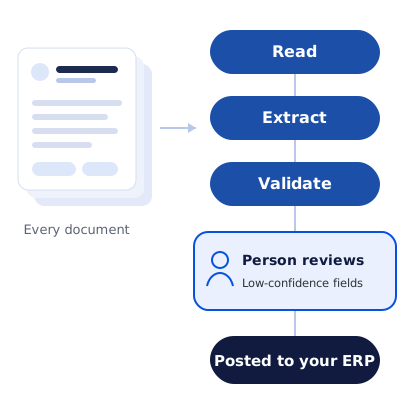
Pipelines that read documents, extract the fields you need, check them against your rules and write clean data into your systems.
Field accuracy, document accuracy and straight-through rate together, measured on a sample of your real documents with the method stated.
A first document type live with exception handling in 6 to 10 weeks, including integration. More types on the same base go faster.
A fixed price per document type, $4,000 to $39,000 by scope and AI complexity, quoted after a free document audit. No per-page license.
Reviews the fields the system is unsure about, in a queue that shows the source document beside the pre-filled form.
Code, models, prompts, settings and test sets, assigned to you on payment. Your team can run it without us.

Sunil Kumar 
Intelligent document processing reads a document the way a trained clerk would: it finds the fields you need, understands what each one means, checks them against your rules and returns structured data with a confidence score on every field. Feed a scanned invoice to plain OCR and you get a wall of text. It cannot tell the tax from the subtotal, the invoice date from the due date, or where the line items start.
Good IDP also copes with what breaks OCR: rotated scans, poor copies, handwritten entries in boxes, and tables that run across a page break. It works on layouts it has never seen, so a new supplier does not mean a new template.
The real difference shows up downstream. OCR output still needs a person to interpret it. A well-built intelligent document processing pipeline writes validated data straight into your ERP and sends a person only the fields it is unsure about.
We can measure what it really delivers on your documents: field accuracy, document accuracy and the share that needs no human touch.
Field accuracy and document accuracy are very different numbers. The gap is arithmetic, not opinion. The table shows the chance that every field on a document is right.
| Field accuracy | 5 fields | 10 fields | 20 fields | 30 fields |
|---|---|---|---|---|
| 99.9% | 99.5% | 99.0% | 98.0% | 97.0% |
| 99.5% | 97.5% | 95.1% | 90.5% | 86.0% |
| 99.0% | 95.1% | 90.4% | 81.8% | 74.0% |
| 98.0% | 90.4% | 81.7% | 66.8% | 54.5% |
| 95.0% | 77.4% | 59.9% | 35.8% | 21.5% |
Assumes errors are independent. Real documents have some linked errors, so read these as indicative. The direction and size of the gap are real.
On a twenty-field invoice, 99% per field means about 82% of documents are fully correct. Roughly one in five still needs a person. At 98% per field it is about two in three.
The share of documents that need no human touch decides your saving. Ask for it with the field count, the document types, the threshold used, and whether the test set was held back from training.
A number measured on someone else's documents tells you nothing about yours. We measure on a sample of your real documents and report all three rates, with the method stated.
Line items across a page break, merged cells, nested subtotals and columns that move between suppliers. On an invoice or manifest the table is the point, so we test it on your worst examples.
No document pipeline is fully automatic. What separates one that works from one that gets abandoned is how it handles the rest. A purchase order number wrong by one digit is an annoyance; a payment amount wrong by one digit is a loss.
A business decision, not a technical one.
The queue that decides whether people trust the pipeline.
The common requirement is enough volume to justify automation and enough consistency for the output to be validated.
Header and line items across hundreds of supplier layouts, three-way matching and posting to your ERP. Usually the fastest payback.
Parties, key dates, renewal and termination terms, obligations, and clauses that differ from your standard positions.
Referrals, intake forms, prior records and faxes read, sorted and routed. Often the worst source quality of any type.
ID documents, proof of address, bank statements and company filings, with validation and duplicate checks.
Bills of lading, packing lists, customs paperwork and delivery notes, where multi-page tables are the whole document.
Orders taken in from varied formats, matched against contracts and reconciled with goods receipts.
Send a mixed batch, including the awkward ones. We will tell you which types are worth automating and which are not.
For common documents, packaged platforms are good, and Gartner published its first Magic Quadrant for the category in September 2025 (Business Wire). But rankings compare products, not your documents. The model is rarely what holds a project back. The rules that catch a plausible but wrong value, the thresholds, the queue and the write into your ERP are.
A first document type live with exception handling in 6 to 10 weeks. The audit and threshold work are planned in from week one, because they decide what can be automated safely. Delivered on Clarity, our delivery method.
Your real documents, including the worst ones. Field count, layout variation and scan quality assessed, your current baseline measured, and an honest read on fit.
Field schema and validation rules defined. Tables and line items tested on their own. The model approach chosen per document type and thresholds drafted per field.
The pipeline runs beside your manual process on real volume. Output compared field by field, all three rates measured, and thresholds tuned on the results.
Clean data written into your system of record. The exception queue goes live with a named owner, alerts and the source document beside every form.
A phased cutover with rollback ready. Automation and exception rates reported together. Then the next document type on the same base.
E-invoicing mandates are spreading, and they change what an invoice pipeline should do. The right design accepts structured e-invoices and scanned PDFs into the same validation, the same exception queue and the same posting step.
The EU adopted its VAT in the Digital Age package on 11 March 2025. Intra-EU business invoices must be electronic from 1 July 2030 (PwC).
Since 1 September 2026 every French business must accept electronic invoices, and large and mid-sized firms must issue them. Smaller firms follow on 1 September 2027 (CMS).
A compliant e-invoice is a structured file, not a picture of one. For those suppliers, there is nothing left to extract, only data to validate and post.
Suppliers outside these rules, receipts, contracts, claims, shipping papers and your archive will still arrive as PDFs and scans for years.
The difference matters most when your volume grows. Personal, financial and health data is handled under GDPR, UK GDPR or HIPAA with a DPA or BAA signed. See security and compliance and private AI deployment.
Compliance files, identity checks and onboarding documents for regulated businesses. Each one is judged on a business number, not on how clever the extraction looks. See ROI case studies.
A document pipeline costs $4,000 to $39,000 per document type, fixed, depending on field count, layout variation and how much AI it needs. A standard invoice type into one ERP sits toward the low end; handwritten forms, multi-page tables or several languages sit toward the top.
Raw extraction is cheap: AWS lists its invoice API at $0.01 a page for the first million pages (AWS pricing). What costs money is everything around it, and that is what we build. You pay usage directly, with no per-page license on top. Larger programs can run as an AI Velocity Pod from about $15,000 a month.
Extracted data lands where the work happens, not in a portal someone has to remember to check. Where no usable API exists, we use middleware or file exchange.
SAP, Oracle, NetSuite, Microsoft Dynamics or Tally.
QuickBooks, Xero or Zoho Books, posted with an audit trail.
SharePoint, Box, Google Drive or your own storage.
Email inboxes, scanners, SFTP, upload portals or an API.
Peppol and national formats taken in beside scanned PDFs.
Cloud extraction services, or open models in your own cloud.
Your data warehouse, as CSV, JSON or direct tables.
Field, document and straight-through rates, with drift alerts.
Software that turns documents into structured, validated data your systems can use. Where OCR turns an image into text, IDP understands it: which number is the total, which is a line item, how a table runs, even on a layout it has never seen.
OCR gives you characters; IDP gives you meaning. OCR returns a wall of text. IDP returns labeled fields, checked against your rules, with a confidence score on each one, and copes with rotated scans, poor copies and tables across page breaks.
Usually per field, which is not per document. At 99% per field on a twenty-field invoice, only about 82% of documents are fully correct, so one in five still needs a person. At 98% it is about 67%.
The straight-through processing rate: the share of documents that need no human touch. Ask for it with the field count, the document types, the threshold used and whether the test set was held back from training.
The one that reaches the highest straight-through rate on your documents, at a cost that still works as volume grows. Analyst reports compare packaged platforms well, but only a test on your own batch, including the worst scans, answers the question.
Because a figure from someone else’s documents tells you nothing about yours. Results depend on layouts, scan quality, languages, field count and supplier variation. We measure on your sample and report all three rates with the method.
Every field has a score, and you set the level at which the system acts alone. We set thresholds per field, because a payment amount deserves a higher bar than a PO number, and tune them on your data during a shadow run.
They go to an exception queue with the data pre-filled and unsure fields highlighted. The source document sits beside the form, so people correct rather than re-key. The queue has a named owner and alerts.
To a degree, and it depends on the document. Handwritten entries in boxes work well; free-form handwriting is much harder. Poor scans and faxes often work with pre-processing, but we test your worst cases rather than assume.
Yes, and tables are where most projects fail quietly. Rows across page breaks, merged cells, nested subtotals and moving columns break simple extraction, so we test tables on their own.
Your ERP, accounting system, document store or data warehouse. SAP, Oracle, NetSuite, Dynamics, Tally, QuickBooks, Xero, SharePoint and Box are common. Without a usable API, we use middleware or file exchange.
No, but they change the invoice part of it. Structured e-invoices arrive as data, so they need validation and posting, not extraction. Receipts, contracts, claims and suppliers outside the rules still need IDP.
Retention, access, encryption and deletion are set at design time. We redact data the next step does not need, sign a DPA or BAA, and can run the pipeline inside your own cloud or on-premise.
A first document type live with exception handling in 6 to 10 weeks. More types on the same base are faster. A program across many types takes 3 to 6 months.
Between $4,000 and $39,000 per document type, fixed, depending on scope and the AI involved. There is no per-page license; you pay usage directly. We quote after a free document audit.
Send it over. A document AI lead replies within 12 hours.
Not your cleanest samples. Include the poor scans, the awkward suppliers and the multi-page tables. A senior architect will tell you what straight-through rate is realistic, where the thresholds should sit, and whether a packaged product would cover it.
Loading available times…

Information Security
Management System

Quality Management
System
Information Security
Management System
Quality Management
System
 India
 Job Portal

"Ailoitte understood our requirements immediately and built the team we wanted. On time and budget. Highly recommend working with them for a fruitful collaboration."

Head of product, Apna
USAEduTech
My experience working with Ailoitte was highly professional and collaborative. The team was responsive, transparent, and proactive throughout the engagement. They not only executed the core requirements effectively but also contributed several valuable suggestions that strengthened the overall solution. In particular, their recommendations on architectural enhancements for voice‑recognition workflows significantly improved performance, scalability, and long‑term maintainability. They provided data entry assistance to reduce bottlenecks during implementation.

CEO, Sanskritly
IndiaFinTech
On paper, Banksathi had everything it took to make a profitable application. However, on the execution front, there were multiple loopholes - glitches in apps, modules not working, slow payment disbursement process, etc. Now to make the application as useful as it was on paper in a real world scenario, we had to take every user journey apart and identify the areas of concerns on a technical end.

CEO, Banksathi
IndiaHealthTech
“Working with Ailoitte was a game-changer for us. They truly understood our vision of putting ‘Health in Your Hands’ and brought it to life through a beautifully designed, intuitive app. From user experience to performance, everything exceeded our expectations. Their team was proactive, skilled, and aligned with our mission every step of the way.”
Director, Dr.Morepen
IndiaRetailTech
“Working with Ailoitte was a game-changer. Their team brought our vision for Reveza to life with seamless AI integration and a user-friendly experience that our clients love. We've seen a clear 25% boost in in-store engagement and loyalty. They truly understood our goals and delivered beyond expectations.”
Co-Founder, Reveza
IndiaHealthTech
“Ailoitte truly understood our vision for iPatientCare. Their team delivered a user-friendly, secure, and scalable EHR platform that improved our workflows and helped us deliver better care. We’re extremely happy with the results.”

CMO, iPatientCare
IndiaEduTech
"Working with Ailoitte was a game-changer for us. They truly understood our vision of putting ‘Health in Your Hands’ and brought it to life through a beautifully designed, intuitive app. From user experience to performance, everything exceeded our expectations. Their team was proactive, skilled, and aligned with our mission every step of the way."
Director, Dr. Morepen


Response guaranteed within 12 hours.




A senior engineer will review your brief and reply within 12 hours. Want to talk sooner? Pick a time that suits you.
Book a 30-minute call