





Uniting payors, providers, and pharmacies for seamless care.
53M+
Members supported
100%
Compliance Rate
- Strategy
- Web
- App
Ailoitte offers recruitment automation software development shaped around the way you hire. For corporate roles, an automated resume screening system that reads every application and ranks it with reasons. For frontline roles, hiring on WhatsApp, SMS or voice that screens, verifies and books interviews in minutes. Your recruiters still make every decision. Fixed price per flow, and the first one live in 4 to 8 weeks.
Tell us your hiring volume and your ATS. Within a week: what to automate first, how, and the fixed price.
Ranks, never rejects
A trained recruiter makes every rejection decision.
Affordable by design
Fixed price from $4,000 per flow. No per-candidate fees.
Built for audits
Bias testing and a decision log from day one.
Software that takes the admin out of hiring: resume screening for office roles, and chat-based hiring for frontline roles at volume. Both write back to the ATS your team already uses.
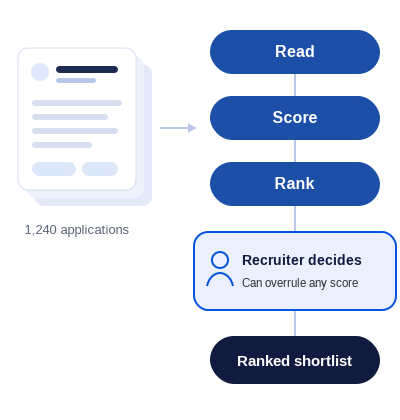
Our automated resume screening system reads each resume, turns it into data you can compare, and scores it against a job-related rubric you approve. It ranks and explains. A recruiter decides.
A first flow for one group of roles goes live in 4 to 8 weeks. Before launch, it runs beside your recruiters on past applications so you can compare.
A fixed price per flow, $4,000 to $39,000 by use case and AI complexity, quoted after a free hiring audit. No license, and no fee per candidate.
Bias tests, decision logs and candidate notices are built in for NYC, EU and US rules. We build the evidence. An independent auditor and your lawyers sign off.
The code, rubric, prompts, test data and logs, assigned to you on payment. Candidate data stays in your systems, in the region your rules require.

Sunil Kumar 
Recruitment automation software handles the repetitive stages of hiring, reading applications, answering candidates, checking documents and booking interviews, so recruiters can spend their time on people. The pressure to automate is real. Gartner found that 6 percent of candidates admit to interview fraud, and it expects one in four candidate profiles worldwide to be fake by 2028. Yet only 26 percent of candidates trust AI to judge them fairly (Gartner, July 2025).
The law has caught up as well. In Mobley v. Workday, a US court let age discrimination claims against a screening vendor go ahead, and in May 2025 allowed a nationwide collective action. The case is still running (case tracker). New York City requires a yearly independent bias audit for automated hiring tools, and the EU AI Act treats hiring AI as high risk.
So our automation in talent acquisition starts with one question: where may the machine decide, and where must a person? We agree that with you first. Then we build the system, the tests and the logs that prove it works that way. A tool that ranks and explains saves your recruiters hours. A tool that silently rejects people is a risk you carry.
We can review how it decides, what it logs and where a person sits in the loop, before an auditor or a candidate asks.
They often get lumped together, and they are not the same build. In office hiring the bottleneck is too many resumes. In frontline hiring there are often no resumes at all, and the bottleneck is speed. Most employers need both for different roles. Good automation in talent acquisition joins them up, so we build one platform with two front doors and one place for recruiters to work.
The problem: 800 applications, 3 recruiters, 1 opening.
The problem: 1,000 roles, 48 hours, few resumes.
None of these steps is a hiring decision. All of them slow hiring down.
| Step | Today | After automation |
|---|---|---|
| Resume screening | A recruiter skims hundreds of resumes per opening, and the last hundred get less attention than the first. | Every resume is read and scored the same way, with reasons. The recruiter starts from a ranked shortlist. |
| First contact | Candidates apply and hear nothing for days. The good ones take another offer. | Candidates get a reply in minutes, answer screening questions in chat and ask their own. |
| Identity checks | Fake profiles and duplicates surface at the offer stage, or after onboarding. | Documents, selfies and phone numbers are checked inside the screening chat, and duplicates are flagged. |
| Interview scheduling | Calendars juggled by email, and many candidates do not turn up. | Candidates book a slot themselves and get reminders, which cuts no-shows. |
| ATS updates | Notes typed in after calls, if at all, so pipeline data is never current. | Scores, transcripts and status changes land on the candidate record automatically. |
Four steps. The one that matters most is the last. Under NYC rules, a tool comes into scope when an employer relies on its output alone, weights it above everything else, or uses it to overrule a person. A system that ranks, explains and leaves the decision with a trained recruiter puts you in a much stronger position. Reading resumes builds on our document processing engine.
Zero-touch hiring on the channel your candidates already use. They apply, answer questions, ask their own, prove who they are and book an interview, all in one chat. Our WhatsApp recruiter for a logistics client cut time to hire from 14 days to 48 hours.
WhatsApp in India, the UAE and Latin America. SMS and voice in the US, UK, Canada and Australia. No app to download.
Questions asked and answered in regional languages, by text or by voice, so nobody drops out over English.
Licenses and IDs captured in the chat, read, matched to a selfie where it is lawful, and duplicates flagged.
Designed for a thousand applicants in a day during peak season, not a steady trickle.
Candidates pick a slot, get reminders and can reschedule in the same chat, which cuts no-shows.
Audio or video interviews scored against the same criteria for everyone, with a report for the hiring manager.
Send your monthly hires, time to hire and recruiter headcount. We will model the hours and spend going into screening today.
A first flow takes 4 to 8 weeks. The shadow run is not optional on hiring work: it is how you learn whether the system agrees with your best recruiters before it meets a single live candidate. Delivered on Clarity, our delivery method.
Your funnel mapped with the recruiters who run it. Volume, time to shortlist and drop-off measured, and the role locations listed, because they decide which laws apply.
A job-related scoring rubric agreed in writing, excluded data listed and justified, the review gate defined, and your ATS connection tested on your own account.
Screening, chat flows and identity checks built into your systems, with candidate notice, opt-out and decision logging in place from the first release.
The system scores real past applications beside your recruiters. Disagreements are investigated, and pass rates compared across groups before anything goes live.
Rolled out one group of roles at a time, with rollback ready, recruiters trained to overrule it, and an audit evidence pack delivered. Then the next flow, or your team takes over.
Hiring AI is regulated in a way most automation is not. Whether a tool ranks or rejects, what it can see and what it logs are engineering choices with legal effects. A platform makes those choices for you. We make them with you, and you keep the evidence.
Federal anti-discrimination law covers automated tools like any other hiring method, and buying a tool does not move the risk to the vendor. Illinois, Texas and California added AI hiring rules in 2025 and 2026 (Epstein Becker Green).
A bias audit within a year of use, a public summary of the results, and notice to candidates 10 business days before the tool is used. The rules follow the role, not your head office (NYC DCWP).
Hiring AI is high risk, with duties for risk management, data quality, records and human oversight from 2 December 2027. It applies wherever the output is used in the EU (Gibson Dunn).
UK GDPR gives candidates rights over automated decisions. Canada, Australia, the UAE and India regulate candidate data. The practical rule: build to the strictest regime you hire under and use it everywhere.
Amazon dropped an internal AI recruiting tool after it taught itself to favor men, because it learned from ten years of mostly male resumes. Reuters reported the story in 2018 (CNBC, Reuters). A model trained on your past hiring will repeat your past hiring, including the parts you would not defend. Automated resume screening software using AI needs controls that prevent this by design. Here are ours. See security and compliance and private AI deployment for screening that must run inside your own infrastructure.
Each one measured on a hiring number: time to hire, automation rate, placements or no-shows. The platforms behind them taught us what hiring at national scale really demands. See ROI case studies.
A hiring flow costs $4,000 to $39,000, fixed, depending on the use case and how much AI it needs. A WhatsApp screening and booking flow sits toward the low end; resume scoring with bias testing, identity checks and ATS integration sits toward the top.
The price moves with the number of role groups, channels, languages and hiring locations. Running costs such as AI usage and WhatsApp or SMS fees are listed separately, and a full two-track platform is quoted after the hiring audit or run as an AI Velocity Pod from about $15,000 a month.
Scores, transcripts and reports land on the candidate record in your ATS, not in a separate portal your team must remember to check.
Greenhouse, Lever, Workday, SAP SuccessFactors, iCIMS, Ashby and Zoho Recruit.
WhatsApp Business, SMS and voice, chosen by market.
Google Calendar and Outlook for interview slots and reminders.
Document reading, selfie matching and phone checks.
Offer and onboarding data passed to your HR system.
Applications pulled in from the boards you post on.
Your choice of provider, or a model inside your own cloud.
Middleware where a system has no usable API.
Software that handles the repetitive, high-volume stages of hiring so recruiters can focus on judgment. That covers reading and screening applications, checking documents, answering candidate questions, booking interviews and updating your ATS. The recruiter still decides who is hired.
In four steps: read, standardize, score and surface. It pulls data from any resume format, makes it comparable, scores it against a job-related rubric you approve, and sends a ranked shortlist with reasons to a recruiter. It ranks rather than rejects, which keeps a person in the decision.
Yes, and it is regulated. US anti-discrimination law applies to automated tools, and the employer stays responsible even for a vendor’s tool. NYC Local Law 144 requires a yearly independent bias audit and candidate notice, and the EU AI Act treats hiring AI as high risk. This is general information, not legal advice.
It can. The rules follow the role, so an employer or agency anywhere can be covered when hiring for a New York City job. The EU AI Act works the same way: it applies wherever the output is used in the EU.
By limiting what the model can see and proving what it did. Only job-related criteria, with protected traits and common proxies removed. A structured rubric, pass rates tested across groups before launch and after, a full decision log, and a recruiter with real power to overrule. The bias audit itself must come from an independent auditor.
Yes, and it is where the gains are largest. Candidates apply, answer questions, get answers, verify their identity and book an interview on WhatsApp, SMS or voice, with nothing to download. Campaigns of a thousand roles in 48 hours are achievable.
No. We use channels candidates already have, mainly WhatsApp, or SMS and voice where WhatsApp is less common. An app install at the top of a hiring funnel is one of the biggest causes of drop-off.
With checks inside the screening flow, not at the offer stage. Documents are captured and read, selfies matched where lawful, phone numbers checked and duplicate applications flagged. Catching fraud at screening costs far less than finding it after onboarding.
Yes. Greenhouse, Lever, Workday, SuccessFactors, iCIMS, Ashby and Zoho Recruit through their APIs, and others through middleware. The automation feeds your system of record rather than becoming a second one.
A first flow for one group of roles is usually live in 4 to 8 weeks. A program across several role groups, channels and an ATS usually runs 3 to 6 months, with each flow live and measured before the next starts.
Between $4,000 and $39,000 per hiring flow, fixed, depending on the use case and how much AI it needs. Running costs such as AI usage and messaging fees are listed separately. We quote after a free hiring audit.
Buy when your process is standard and your volume is moderate. Build when per-candidate pricing gets expensive at your volume, when you need WhatsApp-first frontline hiring, or when you must own the audit trail. We will tell you when buying is the better answer.
Yes. Chat screening runs in many languages, which matters most for frontline roles. Resume reading handles several languages too, but we test accuracy for each one rather than assume it.
Speed and fairness, measured together. Time to first contact, time to shortlist, completion rate, drop-off by stage, cost per qualified candidate and recruiter hours saved, plus pass rates by group. Faster hiring that narrows your candidate pool is not a success.
You do. Code, rubric, prompts, test data, infrastructure as code and documentation are assigned to you on payment. Candidate data stays in your systems under your retention policy and is never used to train outside models.
Send it over. A hiring automation lead replies within 12 hours.
Tell us your hiring volume, where the roles are and which ATS you run. A senior architect will scope your recruitment automation software development: which track you need, what it costs, and where a person must stay in the loop.
Loading available times…

Information Security
Management System

Quality Management
System
Information Security
Management System
Quality Management
System
 India
 Job Portal

"Ailoitte understood our requirements immediately and built the team we wanted. On time and budget. Highly recommend working with them for a fruitful collaboration."

Head of product, Apna
USAEduTech
My experience working with Ailoitte was highly professional and collaborative. The team was responsive, transparent, and proactive throughout the engagement. They not only executed the core requirements effectively but also contributed several valuable suggestions that strengthened the overall solution. In particular, their recommendations on architectural enhancements for voice‑recognition workflows significantly improved performance, scalability, and long‑term maintainability. They provided data entry assistance to reduce bottlenecks during implementation.

CEO, Sanskritly
IndiaFinTech
On paper, Banksathi had everything it took to make a profitable application. However, on the execution front, there were multiple loopholes - glitches in apps, modules not working, slow payment disbursement process, etc. Now to make the application as useful as it was on paper in a real world scenario, we had to take every user journey apart and identify the areas of concerns on a technical end.

CEO, Banksathi
IndiaHealthTech
“Working with Ailoitte was a game-changer for us. They truly understood our vision of putting ‘Health in Your Hands’ and brought it to life through a beautifully designed, intuitive app. From user experience to performance, everything exceeded our expectations. Their team was proactive, skilled, and aligned with our mission every step of the way.”
Director, Dr.Morepen
IndiaRetailTech
“Working with Ailoitte was a game-changer. Their team brought our vision for Reveza to life with seamless AI integration and a user-friendly experience that our clients love. We've seen a clear 25% boost in in-store engagement and loyalty. They truly understood our goals and delivered beyond expectations.”
Co-Founder, Reveza
IndiaHealthTech
“Ailoitte truly understood our vision for iPatientCare. Their team delivered a user-friendly, secure, and scalable EHR platform that improved our workflows and helped us deliver better care. We’re extremely happy with the results.”

CMO, iPatientCare
IndiaEduTech
"Working with Ailoitte was a game-changer for us. They truly understood our vision of putting ‘Health in Your Hands’ and brought it to life through a beautifully designed, intuitive app. From user experience to performance, everything exceeded our expectations. Their team was proactive, skilled, and aligned with our mission every step of the way."
Director, Dr. Morepen