



Uniting payors, providers, and pharmacies for seamless care.
53M+
Members supported
100%
Compliance Rate
- Strategy
- Web
- App
When the Office for Civil Rights investigates a breach, it does not ask for your privacy policy. It asks for your risk analysis, your access logs and your signed business associate agreements. Its twelve most recent enforcement actions all came down to the same missing document, a risk analysis (HHS, 2026). Ailoitte provides HIPAA compliance consulting services and HIPAA compliance application development. We put the Security Rule into your code, your cloud and your evidence, on a fixed price.
No software is HIPAA certified. You get implemented safeguards and documented proof. BAA signed first. Reply within 12 hours.
BAA signed first
Before we see any patient data.
Evidence pack delivered
Risk analysis, policies, test reports.
Cloud under a BAA
AWS, Azure or Google Cloud, US regions.
HIPAA gap assessments and risk analysis. Security Rule controls built into your software. HIPAA compliant cloud and hosting setup, AI under a BAA, and the evidence pack an auditor asks for.
A gap assessment and risk analysis of one product takes 2 to 3 weeks. Closing the gaps takes 6 weeks to 4 months, depending on what the assessment finds.
From about $8,000 for a gap assessment to $100,000 or more to remediate a large platform. Fixed once the assessment is done.
The HIPAA Privacy, Security and Breach Notification Rules, HITECH, 42 CFR Part 2, the FTC Health Breach Notification Rule and state health privacy laws.
Covered entities and business associates in the United States, and software vendors anywhere that sell to US healthcare customers.
All code, infrastructure definitions, policies, the risk analysis and every document in the evidence pack, on payment.

Sunil Kumar 
HIPAA compliant software development means building and running software so that protected health information is seen only by the people who need it. Every access is recorded, data is encrypted, and you can prove all of it. The Security Rule at 45 CFR Part 164 sets out administrative, physical and technical safeguards. The Privacy Rule limits what you collect and share. The Breach Notification Rule sets the clock once something goes wrong.
Enforcement now targets the basics. Since late 2024 the Office for Civil Rights has run a Risk Analysis Initiative. Its twelfth action, in March 2026, settled a breach that exposed 15 million people’s records. The finding was simple: no accurate and thorough risk analysis (HHS). Penalties were raised again on 28 January 2026 and now reach $2,190,294 per provision per year (HIPAA Journal). In June 2026 alone, 66 breaches of 500 or more records were reported (HIPAA Journal).
Our HIPAA compliance consulting starts with that risk analysis. Our engineers then build the controls it calls for into the product, the cloud account and the release process. There is no official HIPAA certification for software, so anyone who sells you one is selling a badge. What you can have is implemented safeguards and the documents that prove them, which is what this page describes. See our security and compliance practices.
The 31 controls we check in every gap assessment, mapped to the Security Rule, in one page. Free, no call needed.
HIPAA is written for compliance officers. Engineers need tasks they can build and test. This is how we translate the provisions that matter most for software into controls, which is the core of our HIPAA compliance application development work.
A proposed update to the Security Rule would make encryption, MFA, yearly pen tests and 72-hour restores a must for everyone. It is not final yet, and HHS is targeting mid 2027 (Pact-One, September 2026). We build to it now, because every control on this list is already expected in an investigation.
| Provision | What it asks | What we build |
|---|---|---|
| 164.308(a)(1) Risk analysis | Find and rank every risk to ePHI, and keep doing it. | A written risk analysis of your product and cloud, updated at every major release. |
| 164.312(a)(1) Access control | Only authorized people reach ePHI. | Unique user IDs, permissions by role, emergency access and automatic logoff. |
| 164.312(b) Audit controls | Record activity in systems that hold ePHI. | Logs of every read, write and export of PHI that cannot be edited, searchable by patient and by user. |
| 164.312(c) Integrity | ePHI is not altered or destroyed improperly. | Checksums and signed records, versioned data, and alerts when a record changes outside the app. |
| 164.312(d) Authentication | Verify that a person is who they claim to be. | MFA, single sign-on with your identity provider, and passkeys where staff can use them. |
| 164.312(e) Transmission security | Protect ePHI in transit. | TLS 1.2 or higher everywhere, encrypted APIs, and no PHI in URLs, emails or push notifications. |
| 164.308(a)(7) Contingency plan | Recover ePHI after an incident. | Encrypted backups in a second region, restore drills, and a tested path back within 72 hours. |
| 164.308(b) Business associate contracts | Vendors who touch ePHI are bound by contract. | A BAA with every vendor in the data flow: cloud, email, analytics, support tools and AI providers. |
| 164.502(b) Minimum necessary | Use and share only the PHI the task needs. | Field-level permissions, analytics with identifiers removed, and masked data in test and support systems. |
| 164.400 to 414 Breach notification | Notify within 60 days of discovery. | Detection, an evidence trail and a notification runbook, so the deadline is met with facts. |
Compliance that lives only in the code cannot be shown to anyone. Every engagement ends with this pack, written for your privacy officer and kept current as the product changes. It is also what a hospital’s vendor security review will ask for before it signs with you.
Every asset that holds ePHI, the threats to it, the likelihood and impact, and the control that answers each risk.
Access, encryption, incident response, workforce and vendor policies, each pointing at the control in the code that enforces it.
An independent test of the application and cloud account, with every finding closed and re-tested.
Where PHI enters, where it is stored, which services and vendors touch it, and where it leaves. The map most audits start with.
Cloud, email, SMS, analytics, support and AI vendors. If a vendor will not sign, it does not see PHI.
Quarterly access reviews with sign-off, plus a record of who completed HIPAA training and when.
Every library and container image in the product, with scan results and how often each is patched.
Roles, the first 24 hours, forensics, the breach risk assessment and the notification timeline, drilled once a year.
The Security Rule is the same for every product, but the controls land in different places. These are the nine kinds of software we bring under HIPAA, as a build from scratch or a fix to what you already run. Our HIPAA compliant software development covers each one end to end.

Patient portals, provider platforms and payer tools with role-based access, session controls and audit logs on every PHI screen.

PHI encrypted on the device, biometric unlock, no PHI in push notifications or screenshots, and secure sync when the signal returns.

Models used under a BAA or hosted in your cloud, de-identification before prompts, and logs of every prompt that carried PHI.

Warehouses with PHI tagged at the column level, de-identified or limited data sets for analysts, and masked copies for testing.

FHIR and HL7 interfaces, payer and clearinghouse connections, with authentication, rate limits and PHI-free logging.

HIPAA compliant cloud services on AWS, Azure or Google Cloud: a BAA, encrypted storage, key management, network isolation and logging.

Older platforms brought under current controls: encryption added, shared logins removed, logs centralized, and a plan for what to retire.

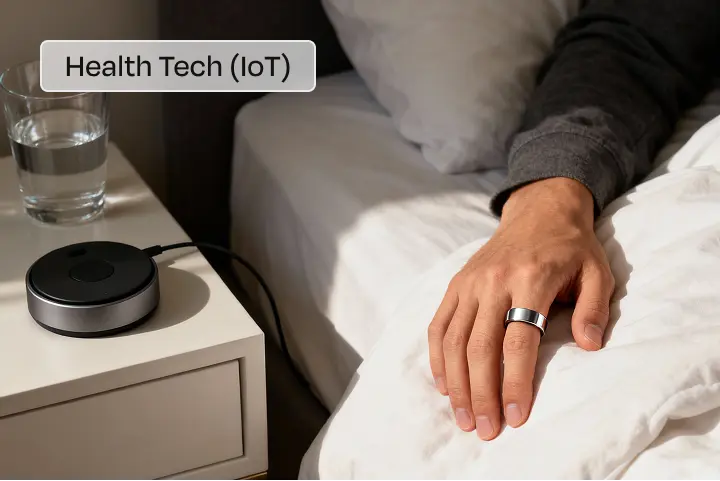
Readings from Bluetooth devices and wearables encrypted on the way in, device identity checked, and PHI kept off the device where the design allows.

Multi-tenant isolation, a BAA you can sign with each customer, and the evidence pack their security review will ask for.
Each card names the safeguards the platform runs on, not just the outcome. Ask any vendor offering HIPAA compliance services to do the same. See all case studies.
Send a link and your cloud provider. You get the three biggest gaps and a fixed price for the assessment.
Signed references from health product leaders, each linked to the case study behind it.


Founder & CEO @Mana
It's fair to say that we didn't just find a development company, but we found a team and that feeling for us is a bit unique. The experience we have here is on a whole new level.


Co-founders @Apuphi
Dependable, reliable and fast. There will always be bugs, but what matters is how fast the team resolves them. When universities asked for a pilot, Ailoitte sorted out the features we needed in 7 or 8 hours, and the officials approved it the next day.


Head Of Product, Apna
We brought Ailoitte in when what we had was an idea rather than a product, and they built the first version from scratch. They understood our requirements immediately and built the team we wanted, on time and on budget. Ailoitte was never a one-project supplier for us. We kept them.


Product Leader, Quantiphi Inc · Boston

Ailoitte helped us ship our MVP in record time, and the launch was a success. Sunil was personally involved throughout to keep execution smooth. What impresses me most is that the team operates as an extension of our own.


Manager @ Dr. Morepen
They truly understood our vision of putting 'Health in Your Hands' and brought it to life through a beautifully designed, intuitive app. Their team was skilled and aligned with our mission every step of the way.


CEO, Banksathi
We had a concept and no product. Ailoitte built it from the first MVP through to the version that found its market. We ran the engagement on a time-and-materials basis, with their engineers working inside our team rather than at arm's length. Their commitment to quality and attention to detail truly set them apart.


Founder & CEO, OpenFactor Technology Group · Johannesburg
We came to Ailoitte with a capacity and skills problem, not an idea problem. Six of their people delivered our digital lending marketplace, the web portal and both mobile apps, to specification. I would rate them eight out of ten on project performance, and we are on our third project with them.


Head of Operations, Koovs.com, at the time of the engagement
I have worked in ecommerce for fourteen years and this was my first seamless experience with a technology team. They built our iOS and Android app and replaced the old one, confirming every milestone without us ever having to chase.


Lead Product Manager, LinkOMed · United Kingdom
Ailoitte were the driving force behind the success of LinkOMed's MVP launch. Their dedication and teamwork were truly remarkable, and I was grateful to witness the seamless collaboration that overcame every challenge during development.


Co-Founder & CEO, Tripeers Tech · Mangaluru
They did not simply build to the specification. Where they disagreed with our technology choices they proposed alternatives with sound reasoning, which we accepted. Commitments were kept almost every time, and where the team hit a blocker they raised it rather than working around it quietly. A great technology partner, and I would recommend them.


Founder & CEO, AI Innovations Hub
Over six months they produced the site, the tools database with search and filtering, user accounts, a CMS with training for our team, SEO and analytics. What stood out was that nobody behaved like a contractor. When we hit problems they would contact third-party support services on our behalf to get things resolved.


CEO, Sanskritly
They executed the core requirements effectively and contributed several valuable suggestions that strengthened the overall solution. Their recommendations on architecture for our voice recognition workflows improved performance, scalability and long-term maintainability.


Co-Founder, Reveza
Their team delivered seamless AI integration and a user-friendly experience that our clients love. We've seen a clear 25% boost in in-store engagement and loyalty.


Co-Founder & CEO, SupDup
A referral brought us to Ailoitte after we had evaluated around five firms. The project started with workshops that gave them a clear view of what we wanted to achieve. Their project management and team spirit are outstanding.
An assessment is a snapshot. These habits are what keep the next release, the next vendor and the next AI feature from undoing it.
We will not estimate remediation until the risk analysis exists. It is the document OCR asks for first, and every control we build traces back to a line in it.
Encryption, permissions, logging and retention are defined in infrastructure code and checked by automated tests. A release cannot quietly switch one off.
We know every field that holds PHI and remove the ones the product does not need. Logs, crash reports and analytics are scrubbed before they leave the system.
Your privacy or security officer reviews the risk analysis and the remediation plan. We build to their decisions and record each one.
Most HIPAA compliance consulting ends with a report and a set of templates. Useful, but OCR fines the gap between the policy and the system. We pair the consulting with the engineers who close that gap, and we leave you with proof that it is closed.
Consulting alone: A gap report, policy templates and a training portal.
Consulting plus engineering: The report, plus the fixes in your code and cloud, plus the evidence pack.
Consulting alone: A questionnaire your team fills in.
Consulting plus engineering: A technical review of the product, the cloud account and the data flow.
Consulting alone: Listed as a recommendation.
Consulting plus engineering: Implemented, tested and documented, with keys you control.
Consulting alone: A list of BAAs you should collect.
Consulting plus engineering: The BAAs collected, and PHI blocked from any vendor without one.
Consulting alone: A policy says what should occur.
Consulting plus engineering: Logs, alerts and a drilled runbook show what did occur, within the 60-day window.
Consulting alone: The report is out of date.
Consulting plus engineering: Controls are still enforced by code and tests, and the evidence is refreshed.
There is no HIPAA tier you can buy. A cloud provider signs a BAA and gives you the tools; the configuration is still your responsibility, and that is where most cloud breaches start. Our HIPAA compliant hosting services set up the account, write the configuration as code and hand you the evidence. See cloud application development and DevOps consulting.
AWS, Microsoft Azure and Google Cloud each sign a BAA for their eligible services. We keep your workloads inside that list and record which ones they are (AWS).
Databases, object storage, backups and queues encrypted at rest with keys in your KMS, and TLS 1.2 or higher for every connection, internal ones included.
Private subnets for anything that holds PHI, no public database endpoints, a web application firewall in front, and access through single sign-on with MFA.
Cloud audit trails, application logs and database access logs shipped to write-once storage and kept for six years, the HIPAA documentation period.
Encrypted backups in a second US region, restores rehearsed on a schedule, and a recovery time you can state with confidence.
HHS allows PHI on servers abroad under a BAA, but notes the added risk (HHS). We default to US regions and document any exception.
We review the account against the BAA-eligible service list and the controls above, and send back a ranked fix list.
HIPAA is the floor for anyone handling US health data, but it is rarely the only rule in the room. We map these alongside it in the gap assessment, so one set of controls answers all of them. For European users, see our GDPR compliance page.
Most AI incidents in healthcare are not model failures. They are PHI pasted into a tool with no BAA, or an agent with more access than its task needs. These six controls are how we add AI to a product and keep it inside HIPAA. Read our guide to HIPAA compliant AI agent development.
PHI only reaches a model endpoint that is covered by a signed BAA. Where the provider will not sign, the model runs inside your own cloud under your BAA.
The 18 Safe Harbor identifiers are stripped or tokenized before text reaches a model, so most AI features never process PHI at all (HHS).
Contract terms and technical settings that stop your PHI, prompts and outputs from training anyone's model, including ours.
Every prompt that carried PHI is logged with the user, the purpose and the output. AI use shows up in the same audit trail as everything else.
AI agents get their own identities and scoped permissions, so an agent that schedules appointments cannot read lab results.
Anything that reaches the medical record or a patient is reviewed by a clinician first. The model drafts, a person decides.
Consumer AI tools with no BAA, agents with write access to the record, and any output a patient sees unreviewed. For data that cannot leave your network, see private AI deployment.
Platforms we built hold records for more than 53 million members and a billion health interactions.
We sign a business associate agreement before we see a single record. It is in our standard contract.
Client data never trains a model, ours or anyone else's. It is written into our security commitments.
Code, infrastructure, policies and the risk analysis are yours. See IP protection.
A HIPAA project is rarely only a HIPAA project. It comes with a new portal, an EHR integration, a cloud move or an AI feature. These are the services we most often deliver alongside it.
Delivered on Clarity, our delivery method, with progress you can check every two weeks. The price for remediation is fixed once the assessment is done, never before.
Code, cloud account, data flows and vendors reviewed against the Security Rule, and the risk analysis written. Learn more.
Gaps ranked by risk and effort, costed at a fixed price, and approved by your privacy or security officer.
Controls implemented in two-week sprints, as code with tests, with the data flow map updated as we go.
An independent pen test, an evidence review of each control with QA, and a restore drill.
Monitoring, quarterly access reviews, vendor checks and a yearly refresh of the risk analysis.
Cloud accounts are built with Terraform so every control is reviewable. Secrets and keys live in Vault or the cloud KMS. Identity runs through Keycloak or Okta with MFA. Datadog carries the audit trail, Snyk scans dependencies, and OWASP ZAP and an independent tester check the application. Data is encrypted with AES-256 at rest and TLS 1.2 or higher in transit.


HIPAA compliance services for a software product usually cost from about $8,000 for a gap assessment and risk analysis to $100,000 or more to remediate a large platform. Fixing a typical web or mobile product costs $20,000 to $60,000. Building the controls into a new product from day one adds about 10 to 15 percent to its build cost.
Market figures run wider. Independent 2026 estimates put a third-party risk assessment at $2,000 to $10,000 for a small practice, and $20,000 to $100,000 for a mid-sized organization. Yearly penetration testing runs from $2,000 to $80,000 (Accountable, 2026). The average healthcare breach costs $7.42 million (IBM, 2025), which is the number to hold the budget against.
Cloud hosting, independent penetration testing and legal review sit outside our price. We list every third-party cost in the proposal.
Each application, database, integration and cloud account adds assessment and fix work.
Shared logins, PHI in logs and unencrypted stores are common in older products and take time to unpick.
Every tool that touches PHI needs a BAA or a replacement, and some replacements are projects.
A BAA with the model provider, removing identifiers and logging prompts all add scope.
A hospital asking for HITRUST or SOC 2 evidence on top of HIPAA widens the work.
Monitoring, access reviews, pen tests and the yearly risk analysis refresh after the project.
Most clients start with the assessment. You can also hire dedicated developers with HIPAA experience to join your own team.
A new product or MVP with the Security Rule controls, the cloud setup and the evidence pack in version one.
For startups and vendors entering US healthcare.
A fixed-price gap assessment and risk analysis, then the engineering to close each gap in risk order.
For live products, inherited codebases and vendor security reviews.
A security engineer who reviews releases, runs access reviews, collects vendor BAAs and refreshes the risk analysis each year.
For products that change every sprint.
HIPAA compliant software development is building software so that only the right people can reach health data, every access is logged, data is encrypted and can be restored, and documents prove it. It follows the safeguards in the Security Rule and the minimum necessary rule in the Privacy Rule. Business associate agreements cover every vendor in the data flow.
No. HHS does not certify software, and no private certificate makes a product HIPAA compliant. Compliance belongs to the organization using the software and depends on how it is configured and run. Vendors can show implemented safeguards, a risk analysis and third-party test results, which is what we deliver.
A gap assessment, a written risk analysis, a remediation plan, policies mapped to controls and the evidence pack. Our HIPAA compliance consulting services differ in one way: the same team then builds the fixes in your code and cloud. The report does not sit in a drawer.
Covered entities and their business associates. Covered entities are health plans, clearinghouses and providers that bill electronically. A business associate is any vendor that handles PHI for them, including software companies and cloud providers. Location does not matter; a vendor in India or Europe serving a US hospital is a business associate.
Yes, if your product stores, processes or transmits PHI for a covered entity or another business associate. The BAA sets out your duties, including breach reporting within 60 days. You also need BAAs with your own vendors that touch PHI, such as your cloud provider, email service and any AI model provider.
Civil penalties range from $145 to $73,011 per violation. The annual cap is up to $2,190,294 per provision, after the 28 January 2026 inflation update. Criminal penalties reach ten years in prison for misuse with intent to harm or profit. OCR also imposes corrective action plans that run for two or three years.
From about $8,000 for a gap assessment and risk analysis to $100,000 or more to remediate a large platform. A typical web or mobile product costs $20,000 to $60,000 to fix, and building controls in from the start adds about 10 to 15 percent to a new build. Hosting, penetration testing and legal review are extra and listed in the proposal.
About 2 to 3 weeks for the assessment and 6 weeks to 4 months for remediation. Older products with shared logins, PHI in logs and many vendors take longest. New builds carry the controls from the first sprint, so they add little time.
A signed BAA with the provider, use of only its BAA-eligible services, and a configuration that encrypts, isolates, logs and backs up PHI. AWS, Azure and Google Cloud all sign BAAs. The provider secures the data center; how your account is set up is on you. That setup is what our HIPAA compliant cloud services and HIPAA compliant hosting services cover.
HIPAA allows it under a BAA, but HHS warns that offshore storage can increase risk, and many hospital contracts forbid it. We default to US regions and document any exception in the risk analysis so the decision is deliberate and defensible.
Yes, with a BAA from the model provider or a model hosted in your own cloud, and with PHI de-identified wherever the feature allows. Prompts that carry PHI are logged like any other access, and no data is used for training. Clinicians review anything that reaches the record or a patient.
A risk analysis is a documented review of every place ePHI lives, the threats to it, and how likely and severe each one is. The Security Rule requires it, and its absence is the finding behind all twelve of OCR’s Risk Analysis Initiative settlements. It should be refreshed yearly and after any major change to the product or infrastructure.
A proposed update, published in January 2025, would make encryption, MFA, yearly pen tests, asset lists and 72-hour restores a must. It is not final as of September 2026, and HHS is targeting mid 2027. We build to the proposed standard now, because each of those controls is already expected in an investigation.
You must assess the breach and notify affected individuals and HHS within 60 days of discovery. Breaches of 500 or more people in one state must also be reported to the media. Business associates notify the covered entity in the same window. Our builds include the logs, alerts and runbook that make that timeline possible.
HIPAA covers health information held by US covered entities and their business associates; GDPR covers all personal data of people in the EU, whoever holds it. GDPR has a 72-hour breach deadline and individual rights such as erasure that HIPAA lacks. A product serving both markets needs one control set that satisfies both, and our HIPAA vs GDPR guide explains how.
Yes. Any software vendor selling to US healthcare customers is a business associate and needs the same controls. We work with teams in the United States, Europe, the Middle East, India and Australia that build for US providers, payers and digital health companies.
You do. Code, infrastructure definitions, policies, the risk analysis and the full evidence pack assign to your company on payment, with no license back to us.
Send it over. A senior security engineer will reply within 12 hours.
Tell us about your product, your cloud provider and your customers. A senior security engineer will scope the gap assessment and fix the price. HIPAA compliance services should end in controls you can show and documents you can hand over, and ours do.
Loading available times…

Information Security
Management System

Quality Management
System
Information Security
Management System
Quality Management
System
 India
 Job Portal

"Ailoitte understood our requirements immediately and built the team we wanted. On time and budget. Highly recommend working with them for a fruitful collaboration."
Head of product, Apna
USAEduTech
My experience working with Ailoitte was highly professional and collaborative. The team was responsive, transparent, and proactive throughout the engagement. They not only executed the core requirements effectively but also contributed several valuable suggestions that strengthened the overall solution. In particular, their recommendations on architectural enhancements for voice‑recognition workflows significantly improved performance, scalability, and long‑term maintainability. They provided data entry assistance to reduce bottlenecks during implementation.
CEO, Sanskritly
IndiaFinTech
On paper, Banksathi had everything it took to make a profitable application. However, on the execution front, there were multiple loopholes - glitches in apps, modules not working, slow payment disbursement process, etc. Now to make the application as useful as it was on paper in a real world scenario, we had to take every user journey apart and identify the areas of concerns on a technical end.
CEO, Banksathi
IndiaHealthTech
“Working with Ailoitte was a game-changer for us. They truly understood our vision of putting ‘Health in Your Hands’ and brought it to life through a beautifully designed, intuitive app. From user experience to performance, everything exceeded our expectations. Their team was proactive, skilled, and aligned with our mission every step of the way.”
Director, Dr.Morepen
IndiaRetailTech
“Working with Ailoitte was a game-changer. Their team brought our vision for Reveza to life with seamless AI integration and a user-friendly experience that our clients love. We've seen a clear 25% boost in in-store engagement and loyalty. They truly understood our goals and delivered beyond expectations.”
Co-Founder, Reveza
IndiaHealthTech
“Ailoitte truly understood our vision for iPatientCare. Their team delivered a user-friendly, secure, and scalable EHR platform that improved our workflows and helped us deliver better care. We’re extremely happy with the results.”

CMO, iPatientCare
IndiaEduTech
"Working with Ailoitte was a game-changer for us. They truly understood our vision of putting ‘Health in Your Hands’ and brought it to life through a beautifully designed, intuitive app. From user experience to performance, everything exceeded our expectations. Their team was proactive, skilled, and aligned with our mission every step of the way."
Director, Dr. Morepen