On this page
- Key Takeaways
- Edge AI Solutions: The Five Layers You Are Buying
- Where Edge AI Development Pays Off First
- How We Ranked These Edge AI Development Companies
- Top 10 Edge AI Development Companies at a Glance
- The 10 Best Edge AI Development Companies in 2026
- Edge AI Companies That Supply the Chips and Platforms
- Edge AI Development Services: Scope, Timeline and Cost
- Edge AI Consulting Services: When to Start Here
- How to Choose an Edge AI Development Company
- Companies to Outsource Edge AI Development: When It Makes Sense
- Edge AI Development Company in India
- Conclusion
- FAQ
Key Takeaways
- Edge AI vendors fall into two groups. Engineering partners such as Ailoitte, Lemberg Solutions, Yalantis, and InTechHouse build your product. Chip and platform vendors such as NVIDIA, Qualcomm, Intel, and Hailo supply the hardware and tools it runs on. Most projects need one of each.
- The market is growing fast. Grand View Research projects the global edge AI market will grow from USD 24.9 billion in 2025 to USD 118.7 billion by 2033, a 21.7% CAGR.
- Match the vendor’s strongest layer to your biggest risk. An edge AI solution spans five layers: hardware, firmware, model and runtime, orchestration, and cloud and apps. Software-led products suit an AI studio like Ailoitte. Certified or hardware-heavy devices suit a hardware-plus-AI house.
- Budget in three stages. Per Lemberg Solutions’ 2026 guide, a proof of concept takes 2 to 3 months and costs under $50,000. An MVP takes 3 to 6 months at $50,000 to $100,000. Certified production takes 6+ months and costs above $100,000.
- Prove the use case before you scale. Start with a short proof of concept on real hardware, measure latency and accuracy, and confirm whether quotes include hardware, firmware, certification, and OTA model updates.
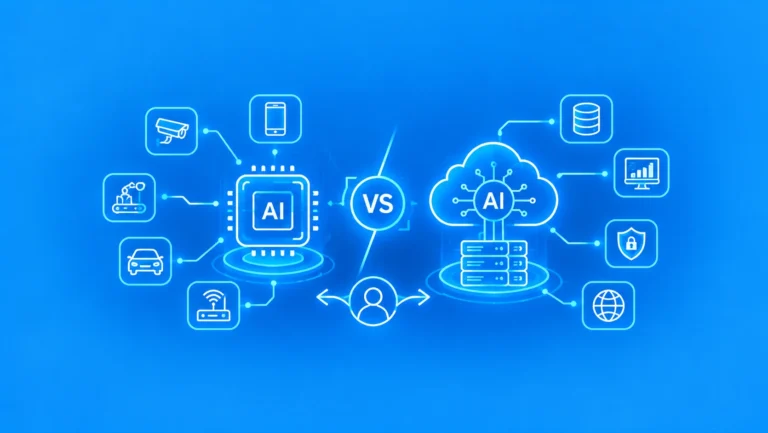
Edge AI development companies design, build, and ship AI models that run on devices, gateways, and local servers instead of a remote cloud. In 2026, they fall into two groups. Engineering partners such as Ailoitte, Lemberg Solutions, Yalantis, and InTechHouse build your product. Chip and platform vendors such as NVIDIA, Qualcomm, and Intel supply the hardware and tools it runs on. This guide ranks ten engineering partners, then maps the platforms they build on.
The market behind the list is growing fast. Grand View Research valued the global edge AI market at USD 24.9 billion in 2025 and projects USD 118.7 billion by 2033, a 21.7% compound annual growth rate (CAGR). Grand View Research also reports that hardware held a 51.8% revenue share in 2025. For chips alone, Spherical Insights (April 2026) estimates USD 21.2 billion in 2025, rising to USD 217.2 billion by 2035 at 26.2% per year. The two reports define the market differently, so compare the trend, not the totals.
In this guide
- What edge AI development companies build
- How we ranked them
- The 10 best edge AI development companies
- Chip and platform vendors to build on
- Services, timelines, and cost
- How to choose, plus FAQs
Building AI that has to run on the device, not just in the cloud?
Ailoitte’s AI engineers take your model from data pipeline to production deployment.
Edge AI Solutions: The Five Layers You Are Buying
An edge AI solution is five layers of work, and most vendors are strong in only some of them. Knowing the layers tells you which kind of company you need.
- Edge hardware. Single-board computers, accelerators, field-programmable gate arrays (FPGAs), and systems-on-chip with a neural processing unit (NPU) or GPU run the model locally.
- Firmware and operating system. A lightweight Linux build or a real-time operating system (RTOS) boots the device and isolates workloads.
- Model and runtime. Teams shrink models with quantization and pruning, then run them on engines such as TensorFlow Lite (now called LiteRT) or ONNX Runtime.
- Orchestration. Over-the-air (OTA) updates, fleet monitoring, and rollback keep hundreds or thousands of devices healthy.
- Cloud and application layer. Dashboards, companion apps, data pipelines, and retraining loops sit around the device.
Hardware houses own layers one and two. AI studios own three and five. The strongest edge AI development companies can cover all five or partner cleanly for the rest.
Where Edge AI Development Pays Off First
Edge AI pays off where a decision must happen in milliseconds, offline, or without sending raw data to the cloud.
- Manufacturing and industrial Internet of Things (IoT): predictive maintenance and defect detection run on the machine. Ailoitte’s guide to enterprise IoT solutions covers the connectivity layer under these systems.
- Healthcare devices: patient monitors and diagnostic tools process sensor data locally for latency and privacy. See Ailoitte’s guide to AI medical device software development.
- Retail: in-store cameras count, track, and detect events without streaming video. Ailoitte covers this in computer vision in retail.
- Automotive and robotics: driver assistance and autonomous machines cannot wait for a cloud round trip.
How We Ranked These Edge AI Development Companies
We scored each firm on five criteria: published edge AI services or case studies, depth of hardware-plus-AI integration, security and quality certifications (such as ISO 27001 and ISO 9001), delivery models, and transparency on locations and pricing.
Two disclosures matter. First, Ailoitte publishes this list and ranks itself first. That reflects Ailoitte’s strength in software-led edge products, where the intelligence lives in models, apps, and cloud around the device. For custom boards or certified hardware, Lemberg Solutions, Yalantis or InTechHouse may be the better first call. Second, team size, rates, and client names for firms 2 to 10 come from Lemberg Solutions’ April 2026 provider comparison and company websites. Confirm rates directly before you budget.
Top 10 Edge AI Development Companies at a Glance
| Company | Type | Best for | |
|---|---|---|---|
| 1 | Ailoitte | AI and IoT product engineering | Software-led edge products and device-connected apps |
| 2 | Lemberg Solutions | Hardware and software co-design | Full-cycle edge AI with regulated-industry experience |
| 3 | Yalantis | Software, hardware and AI | On-device anomaly detection, automotive and logistics |
| 4 | InTechHouse | Hardware, firmware and AI | Certifiable products: medical, aerospace, industrial |
| 5 | Softeq | Embedded, IoT and AI | Connected devices, wearables and robotics |
| 6 | Promwad | Electronics design house | Custom hardware plus embedded software |
| 7 | deepsense.ai | Custom AI and edge services | Vision-led manufacturing and retail |
| 8 | TechAhead | Software engineering with edge AI | Cost-aware builds with India and US delivery |
| 9 | Intera Group | Chip-level embedded AI | FPGA, ASIC and system-on-chip projects |
| 10 | Softweb Solutions | Cloud, data and edge MLOps | Large enterprise rollouts |
The 10 Best Edge AI Development Companies in 2026
-
Ailoitte

Headquarters: Bengaluru, India (US office in Delaware) | Focus: AI product engineering and IoT software for edge deployments
Ailoitte ranks first for teams whose edge AI product is mostly software: the models, the data pipeline, the cloud back end, and the apps around a device. Ailoitte’s AI development services cover the full path from data pipelines and feature engineering through model training, evaluation, and deployment. Its IoT practice adds consulting, IoT cloud development, wearable apps, device integration, and testing. Ailoitte also lists AI/ML and computer vision among its IoT technologies.
Companion apps matter more than most edge buyers expect, because users, installers, and field staff interact with the device through a phone. Ailoitte’s mobile app development services cover that layer. Ailoitte delivers through AI Velocity Pods, which are cross-functional teams of ML, data, and product engineers, or through its hire AI developers model.
For custom printed circuit board (PCB), FPGA, or certified-hardware work, pair Ailoitte with a hardware house such as InTechHouse or Promwad.
| Item | Details |
|---|---|
| Key services | AI product engineering, ML model development, IoT app and cloud development, mobile apps |
| Industry focus | Manufacturing, healthcare, retail, logistics, energy, automotive, fintech |
| Engagement models | Outcome-based delivery, AI Velocity Pods, dedicated AI developers |
| Rate and minimum | $25 to $49 per hour, projects from $10,000 |
| Credentials | ISO 27001:2013, ISO 9001:2015 |
-
Lemberg Solutions

Locations: Ukraine, Germany, the UK, Poland | Focus: Hardware-software co-design for edge AI
Lemberg Solutions combines embedded engineering with AI model design, which is the combination edge projects need. Its scope includes hardware and firmware development, chip selection, model optimization, computer vision, sensor fusion, edge machine learning operations (MLOps) and secure OTA updates. The company works with the NXP, Microchip, and STMicroelectronics ecosystems and holds ISO 27001 and ISO 9001 certifications.
| Item | Details |
|---|---|
| Founded / team | 2007, 200+ employees |
| Industry focus | Industrial IoT, healthcare, automotive, energy, agritech |
| Reported rate | $50 to $99 per hour |
| Named clients | Bosch Rexroth, Astronics, Caltech |
-
Yalantis

Locations: Ukraine (Kyiv, Lviv, Dnipro), Poland, Estonia | Focus: Consulting, firmware and on-device model optimization
Yalantis covers the product lifecycle from hardware design and firmware to AI model optimization. It targets connected devices, sensors and distributed systems, with privacy-first patient monitoring and predictive maintenance among its edge use cases.
| Item | Details |
|---|---|
| Founded / team | 2008, 500+ employees |
| Industry focus | Automotive, logistics, retail, healthcare, industrial, energy |
| Reported rate | $50 to $99 per hour |
| Named clients | RAKwireless, Orbis Systems, Duo Health |
-
InTechHouse

Locations: Bydgoszcz, Poland, and Richardson, Texas | Focus: Edge AI systems for regulated and industrial products
InTechHouse, part of the SoftBlue Group, starts at the silicon and circuit-board level instead of the model level. Its edge AI work includes hybrid FPGA and microcontroller designs, on-device vision for quality inspection, and predictive maintenance on industrial sites. One published example adapted signal filters based on generative AI to run on constrained medical monitoring hardware.
| Item | Details |
|---|---|
| Key services | Hardware design, embedded firmware, FPGA systems, edge AI models, OT/IT data platforms |
| Industry focus | Oil and gas, life sciences, aerospace and defense, industrial automation |
| Credentials | ISO 9001 listed on its website |
-
Softeq

Locations: Texas, Lithuania, Mexico, Germany, the UK | Focus: Embedded and IoT development with AI
Softeq builds smart connected products across AI/ML, IoT, wearables, computer vision and robotics. The company has operated since 1997 and serves consumer electronics, industrial automation, automotive, and energy clients.
| Item | Details |
|---|---|
| Founded / team | 1997, 500+ employees |
| Reported rate | About $80 per hour |
| Named clients | Verizon, Epson, Lenovo, AMD, OMRON |
-
Promwad

Locations: Germany, Lithuania, Poland, Latvia, Serbia | Focus: Electronics design plus embedded software
Promwad is a European electronics design house with more than 20 years of experience. It covers hardware, enclosures, and software for automotive, industrial automation, telecom, and video products. Choose it when the device itself needs designing, not just the model.
| Item | Details |
|---|---|
| Founded / team | 2004, 100 to 200 employees |
| Reported rate | $50 to $99 per hour |
| Named clients | WIKA, Parrot, Dewesoft |
-
deepsense.ai

Locations: Warsaw, Poland, and Palo Alto, California | Focus: Custom AI with edge consulting and deployment
deepsense.ai is a custom AI company that also offers edge services from consulting through production deployment. Its core sectors are manufacturing and industrial automation, retail, logistics, and smart cities. Defect detection and quality control are typical vision use cases.
| Item | Details |
|---|---|
| Founded / team | 2014, 100 to 200 employees |
| Reported rate | $50 to $99 per hour |
| Named clients | Sky, Zebra Technologies, Hexagon |
-
TechAhead

Locations: California, USA, and Noida, India | Focus: Edge-to-cloud applications and model deployment
TechAhead is a software engineering firm whose edge work covers model optimization, computer vision, and predictive maintenance. It lists healthcare, manufacturing, logistics, automotive, and retail among its sectors. It is the lowest-priced option here among firms with US delivery.
| Item | Details |
|---|---|
| Founded / team | 2009, 240+ employees |
| Reported rate | $25 to $49 per hour |
| Named clients | AXA, International Cricket Council |
-
Intera Group

Location: Barcelona, Spain | Focus: Chip-level embedded AI
Intera Group works close to the silicon, with application-specific integrated circuit (ASIC), FPGA and system-on-chip design alongside embedded software and data science. It suits projects where the accelerator itself has to be designed or adapted, in Industry 4.0, smart energy and digital health.
| Item | Details |
|---|---|
| Founded / team | 2006, 50 to 100 employees |
| Rate | Not publicly disclosed |
-
Softweb Solutions

Locations: Texas, Chicago, India | Focus: Cloud, data and edge MLOps at enterprise scale
Softweb Solutions pairs architecture design and AI model development with edge MLOps and system integration, usually on hybrid cloud-edge architectures. It serves manufacturing, healthcare, logistics, and retail, and prices at the top of this list.
| Item | Details |
|---|---|
| Founded / team | 2004, 501 to 1,000 employees |
| Reported rate | $150 to $250 per hour |
| Named clients | NEC, T-Mobile, Texas Instruments |
Edge AI Companies That Supply the Chips and Platforms
Most edge projects combine one engineering partner with one or two of these edge AI companies. They supply the silicon, runtimes, and fleet tools, and rarely build your product for you.
| Vendor | Layer | Best for |
|---|---|---|
| NVIDIA Jetson | Modules and JetPack SDK, from Jetson Orin to Jetson Thor | Robotics, vision AI and generative AI at the edge (NVIDIA) |
| Qualcomm Dragonwing | Chips with native connectivity, plus Edge Impulse tooling after Qualcomm acquired it | Connected industrial IoT devices |
| Intel OpenVINO | Hardware-portable inference toolkit for CPU, GPU and NPU | Teams avoiding single-vendor lock-in |
| Hailo | Low-power accelerators. The Hailo-10H runs large language models (LLMs) and vision-language models at about 2.5 W typical (SiliconANGLE, 2025) | Battery- and thermally limited devices |
| AWS IoT Greengrass | Cloud-to-edge deployment and fleet management | Teams already standardized on AWS |
| Siemens Industrial Edge | Edge platform for SIMATIC controllers and industrial PCs | Factories with existing Siemens automation |
Running language models on devices is now practical for small, quantized models. Ailoitte’s guide to small language model development explains when a compact model beats a large one.
Edge AI Development Services: Scope, Timeline and Cost
Edge AI development services typically include use-case discovery, hardware and chip selection, dataset collection, model training and compression, firmware integration, OTA update design, and field validation. Most vendors price the model work separately from hardware prototyping, certification and firmware, so ask what each quote includes.
Lemberg Solutions’ 2026 guide gives a useful planning frame:
| Stage | Typical duration | Typical budget band |
|---|---|---|
| Proof of concept or feasibility | 2 to 3 months | Under $50,000 |
| MVP with working hardware and models | 3 to 6 months | $50,000 to $100,000 |
| Production with certification and scale | 6+ months | Above $100,000 |
Treat these as one vendor’s estimates, not market averages. Medical or automotive certification pushes timelines and costs up.
Edge AI Consulting Services: When to Start Here
Edge AI consulting services suit teams that have not yet settled the architecture. A consulting phase decides fully on-device versus hybrid design, which accelerator fits the power budget, and whether you need custom hardware at all. Scoping the first release as an MVP development services engagement keeps the architecture choice cheap to reverse.
How to Choose an Edge AI Development Company
Pick the company whose strongest layer matches your biggest risk. Use these six checks:
- Match the type to your product. Software-led products suit an AI studio. Certified devices suit a hardware-plus-AI house.
- Ask for named hardware. A credible vendor can name the chips and boards it has shipped on, not just the models.
- Test model optimization depth. Ask how they handle quantization, pruning, and accuracy loss on your target device.
- Check the update story. Ask what happens when an OTA model update fails at a remote site.
- Verify compliance. ISO 27001 and ISO 9001 are the baseline. Medical and automotive work needs domain standards on top.
- Get the full price. Confirm whether hardware, firmware, certification, and post-launch model updates are included.
Companies to Outsource Edge AI Development: When It Makes Sense
Outsourcing is usually faster when you lack embedded or firmware talent, need hardware-software co-design, or are shipping your first edge product. Keep it in-house when edge AI is your long-term core product, and you already employ AI, embedded, hardware, and DevOps engineers.
Edge AI Development Company in India
India offers lower rates and growing capability. Ailoitte (Bengaluru) and TechAhead (Noida and New Delhi) both appear in this guide and sit in the $25 to $49 hourly band. For a wider view of the market, see Ailoitte’s list of AI-native engineering companies in India.
Prove the edge use case before you fund the full. Start with a scoped MVP that tests latency, accuracy, and cost on real data.
Conclusion
The best edge AI development company is the one whose strongest layer matches your biggest risk. Ailoitte suits software-led edge products. Lemberg Solutions, Yalantis, and InTechHouse suit products where hardware and firmware are the hard part. Chip vendors like NVIDIA, Qualcomm, Intel, and Hailo then set your performance and power ceiling. Start with a short proof of concept on real hardware, measure latency and accuracy, and scale only after it holds up. If your roadmap also includes autonomous workflows, compare the agentic AI development companies on Ailoitte’s sibling list.

Divyesh is a GenAI-powered Content Marketer recognized for producing high-impact content, visuals, and SEO-driven campaigns. He blends AI creativity with data-backed strategies to deliver measurable results.
About Ailoitte