On this page
- What is the difference between edge AI and cloud AI?
- Why is edge AI growing so fast?
- Why does cloud AI still matter?
- Edge AI vs cloud AI: side-by-side comparison
- How do edge AI and cloud AI costs compare?
- Which technology trends are moving AI to the edge?
- When does edge AI win, and when does cloud AI win?
- How do you choose between edge AI and cloud AI?
- Is hybrid AI the future of edge AI vs. cloud AI?
- Summing up
- FAQ
What is the difference between edge AI and cloud AI?
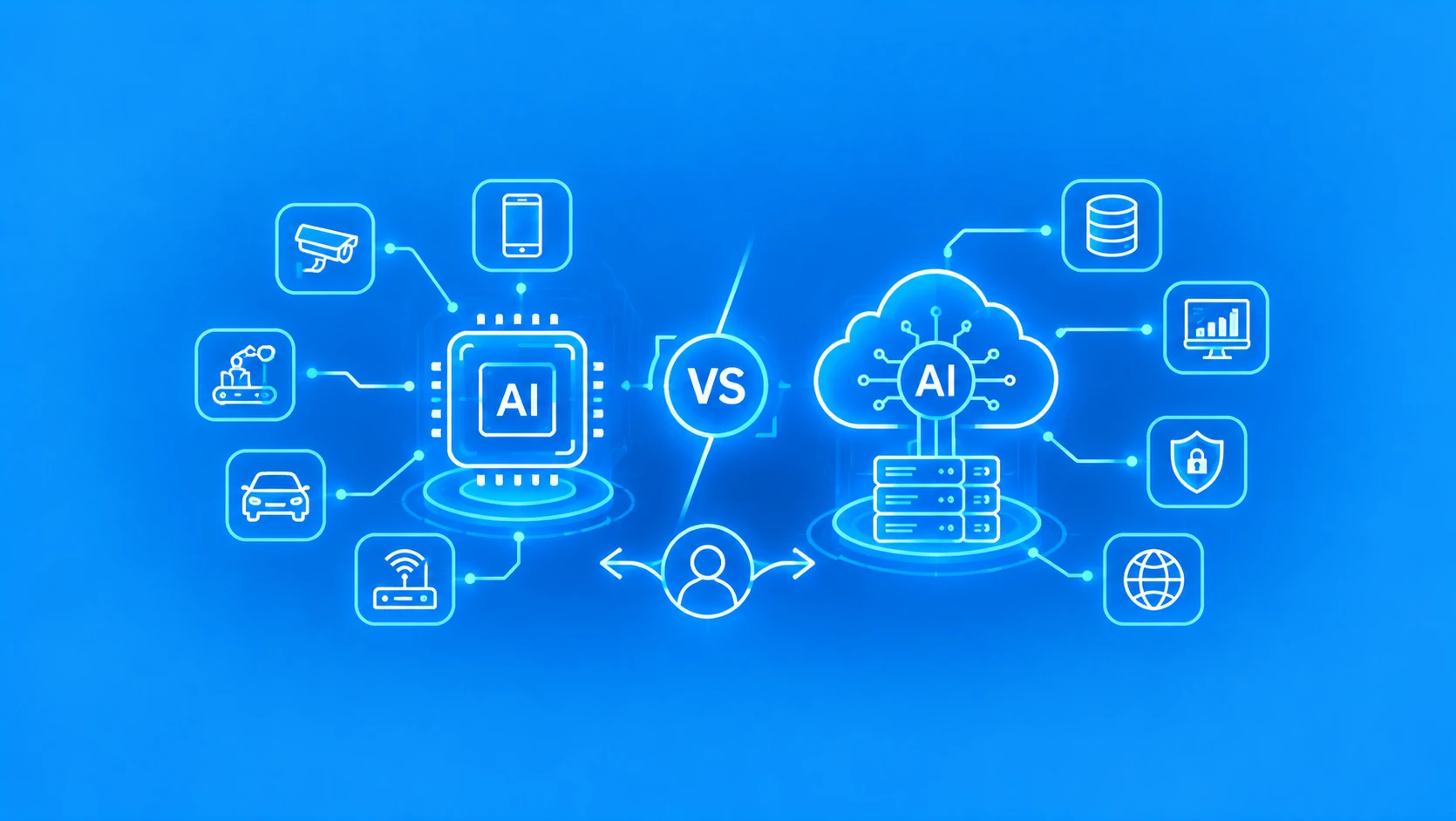
The difference between edge AI and cloud AI is where the model runs. Edge AI runs the model on or near the device that collects the data. Cloud AI sends the data to remote servers, runs the model there, and sends back the result.
That one choice decides how fast your product responds, where user data travels, what the product costs to run, and how large a model you can use. The edge AI vs cloud AI decision is therefore an architecture decision, not only a hosting one.
What is cloud AI?
Cloud AI is artificial intelligence that runs on centralized servers in large data centers. Providers such as AWS, Microsoft Azure, and Google Cloud rent out the GPUs, storage, and tools needed to train and serve models.
Cloud AI powers generative AI apps, recommendation engines, and enterprise AI workflows. Most of these services run on cloud AI platforms that bundle compute, data storage, and model tools. Cloud AI needs a steady internet connection, and every request adds a network round trip.
What is edge AI?
Edge AI is artificial intelligence that runs locally on a device, such as a phone, smart camera, car, or factory robot. Processing data where it is created gives real-time results, keeps raw data private, and reduces dependence on the network.
The edge sits at the outer layer of the network. NIST’s fog computing conceptual model describes edge computing as the network layer that holds the end devices and their users.
Why is edge AI growing so fast?
Edge AI is growing because devices are now powerful enough to run useful models locally, without a round trip to the cloud. Better chips, pressure on cloud bills, and stricter privacy expectations all push in the same direction.
Real-time decisions without lag
Edge AI acts on data the moment it arrives. When milliseconds matter, as in autonomous driving, robotics, or fraud checks at a payment terminal, a cloud round trip is too slow.
Built-in privacy
On-device inference keeps raw data on the device instead of streaming it to a server. That lowers the risk of exposure, makes privacy rules easier to meet, and answers users who want to know where their data goes.
Lower running costs
Edge AI cuts recurring inference bills. Cloud inference is billed per request, per token, or per hour of GPU time, so costs grow with usage. Running a model on hardware the user already owns removes many of those server calls. The trade-off is higher device and engineering cost.
AI chips in everyday devices
Smartphones, laptops, wearables, and cars now ship with neural processing units (NPUs), chips built to run AI models at low power. That lets devices run advanced models without draining the battery. Google’s Gemini Nano runs inside Android’s AICore system service, so apps can use it without a network connection.
Works without a network
Edge AI keeps working when the connection drops. Remote sites, factories, ships, and mines cannot count on stable connectivity, so offline operation matters for safety and uptime.
Faster, smoother user experience
On-device AI removes buffering and “poor network” errors. Features such as live translation, photo editing, and voice commands feel instant because nothing waits on a server.
Why does cloud AI still matter?
Cloud AI still matters because it does the heavy work that edge devices cannot: training large models, serving very large models and learning from data across millions of users.
Compute for training
Training and fine-tuning foundation models take clusters of GPUs or TPUs and very large datasets. That work is not possible on small edge chips, so even most edge models are trained in the cloud first.
Elastic scale
Cloud infrastructure scales up or down on demand. It can absorb 10,000 concurrent requests or a sudden global traffic spike without anyone buying new hardware.
Centralized data and better accuracy
Cloud AI platforms work on aggregated datasets that are easier to clean, store, and analyze. Models trained on that combined data usually improve faster than models that only see fragmented device data. Cross-region tasks such as global fraud detection and supply-chain planning depend on it.
Central model updates
Cloud models are updated in one place. Teams can patch, improve, or roll back a model without touching millions of devices. Edge models must be shipped to every device, which is slower and harder to control.
Very large and multimodal models
Multimodal large language models, 3D vision models and enterprise retrieval-augmented generation (RAG) systems need memory and storage far beyond any edge device. These models live in the cloud and are accessed through an API.
Mature MLOps tools
Cloud platforms bundle monitoring, versioning, experiment tracking, and deployment pipelines. These machine learning operations (MLOps) tools are a big reason enterprises run production AI in the cloud.
Edge AI vs cloud AI: side-by-side comparison
Edge AI wins on latency, privacy, offline use, and cost per request. Cloud AI wins on compute power, scale, model size, and ease of updates.
|
Factor |
Edge AI | Cloud AI |
|---|---|---|
|
Latency |
Milliseconds, processed on the device |
Higher, adds a network round trip |
|
Privacy |
Raw data stays on the device |
Data travels to remote servers |
|
Running cost |
Low per request once hardware is paid for |
Pay as you go, grows with usage |
|
Scalability |
Limited by each device; scale by adding devices |
Near-unlimited, on demand |
|
Compute power |
Small, optimized models |
Large models, LLMs, multimodal AI |
|
Energy use |
Built for low power and battery |
High power use in data centers |
| Offline use | Works without internet |
Needs a stable connection |
|
Personalization |
Instant, from on-device data |
Deeper, from large datasets |
|
Updates |
Pushed to every device | Central, in one place |
|
Best for |
Real-time, private, on-device tasks |
Training, analytics, heavy workloads |
In short, edge AI delivers speed and privacy, and cloud AI delivers scale and depth. The two fill each other’s gaps rather than compete for the same jobs.
How do edge AI and cloud AI costs compare?

Edge AI costs more up front and less per request. Cloud AI costs little up front and more as usage grows. Where the break-even point falls depends on how often the model runs and how heavy it is.
- Edge AI costs: capable device hardware, model compression work such as quantization and pruning, and testing across many device types.
- Cloud AI costs: GPU time or per-token API fees, data transfer and storage, billed every month and rising with traffic.
- Rule of thumb: frequent, simple inference often gets cheaper at the edge, while rare or very heavy inference usually stays cheaper in the cloud.
Which technology trends are moving AI to the edge?
Five trends are moving more AI work to the edge: smaller language models, AI chips in every device, TinyML, federated learning, and faster networks. A sixth, sustainability, adds pressure from the cost and ESG side.
On-device language models go mainstream
Smaller architectures, quantization and distillation now let phones and laptops run compact language models. Apple’s Foundation Models framework gives iOS developers direct access to the on-device model behind Apple Intelligence, and it works without an internet connection.
The anatomy of an LLM explains which parts of a model get shrunk to fit a device. Teams that need a custom compact model can follow the process for small language model development.
- Faster responses
- More privacy
- No dependency on a cloud round trip
NPUs and AI-optimized hardware
Every major chipmaker now builds AI accelerators into its processors. Devices ship with NPUs or dedicated AI cores that run models quickly with little power, so inference happens where the data lives.
TinyML and ultra-low-power AI
TinyML is machine learning that runs on microcontrollers, the small chips inside sensors and appliances, often on battery power. TinyML pushes AI far beyond phones and PCs into devices that never had it.
Federated learning
Federated learning trains a shared model across many devices without collecting their raw data. Each device improves the model locally and sends only a small, encrypted summary of changes, which the cloud averages with updates from other devices. Google Research introduced federated learning in 2017 and tested it in the Gboard keyboard on Android.
- Better personalization
- Stronger privacy
- Lighter cloud workloads
5G and future 6G networks
5G networks lower latency and make connections more stable, so devices can hand tasks between edge and cloud as needed. That supports real-time, high-volume use cases such as AR/VR and connected vehicles. 6G is still in research and standards work.
Sustainability as a decision driver
Sending less raw data to data centers cuts network traffic and the energy used to move and process it. That helps both the cloud bill and ESG targets.
When does edge AI win, and when does cloud AI win?
Edge AI wins when a decision must be instant, private, or offline. Cloud AI wins when a task needs heavy compute, large datasets or one model serving every user.
When edge AI wins
Edge AI is the right choice whenever split-second decisions, low latency, or on-device privacy matter most.
- Autonomous vehicles: Self-driving systems process camera, lidar, and radar data inside the vehicle, because a cloud delay at speed is dangerous.
- Industrial IoT and smart manufacturing: Machines analyze vibration, temperature and performance data on site to catch faults early, without depending on bandwidth.
- Healthcare devices and wearables: ECG monitors, glucose monitors and smartwatches analyze signals on the device to alert users quickly and keep health data private.
- Retail and smart stores: Automated checkouts and shelf cameras process video locally to cut lag and protect shopper privacy.
- AR/VR experiences: Headsets track movement and render frames locally, because any delay breaks immersion.
Factories often run edge models on gateways as part of wider enterprise IoT solutions. In stores, computer vision in retail increasingly runs on in-store hardware. For wearables, a healthcare app development company will usually split the work between the device and a secure backend.
Best for: products that must react in real time, protect sensitive data, or keep running without a network.
When cloud AI wins
Cloud AI is the right choice when you need massive compute, large-scale training, or analytics across all your users.
- Training large AI models: GPU and TPU clusters train LLMs, computer vision models, and complex neural networks on very large datasets.
- Big data analytics: Central storage and compute turn millions of data points into insights faster and at lower cost.
- Enterprise SaaS features: Personalization, automation, and analytics run the same way for every customer, anywhere.
- Global digital services: Content moderation, recommendations, fraud detection, and natural language processing run across regions at scale.
- Team MLOps: Shared pipelines make model deployment, monitoring, and updates a team activity, wherever people work.
Best for: model training, analytics across many users, and heavy models that will not fit on a device.
How do you choose between edge AI and cloud AI?
Choose by workload, not by trend. Ask these six questions about each AI feature, and the answers will point to edge, cloud or both.
- How fast must it respond? If even a short delay hurts the user or creates a safety risk, run it at the edge.
- How sensitive is the data? If raw data is personal, medical, or regulated, process it on the device where you can.
- Will it always have a connection? If not, the core feature must run at the edge.
- How large is the model? If it will not fit in device memory after compression, run it in the cloud.
- How often will the model change? If you retrain often, keep it in the cloud or plan a reliable update path to devices.
- What will it cost at your expected volume? Compare monthly cloud inference fees with device hardware and engineering costs.
For mobile products, test the on-device model on low-end phones, not only flagships. A good mobile app development company will benchmark speed, battery use, and accuracy on real devices before launch.
Is hybrid AI the future of edge AI vs. cloud AI?
Yes. Most AI products are moving to a hybrid setup in which the cloud trains and coordinates models and the edge runs them and reacts. Neither side replaces the other.
- The cloud trains, fine-tunes, and updates the models.
- The edge runs inference and handles real-time, private tasks.
- Devices send back summaries or anonymized signals.
- The cloud uses those signals to improve the next model version.
Phone platforms already work this way. Apple’s on-device model handles everyday requests, and Apple’s developer guidance points to larger server models when a task needs more power. Edge AI keeps growing because users expect instant, private features, and cloud AI stays essential for training and heavy compute.
The real advantage goes to teams that decide early where each intelligence belongs. Match each feature to its place, and the product ends up faster, cheaper to run, and easier to trust.
Summing up
Edge AI vs cloud AI is not a contest with one winner. Edge AI gives you speed, privacy, and offline use, while cloud AI gives you compute, scale, and central control. Decide where each AI feature runs based on latency, data sensitivity, connectivity, model size, and cost. For most products in 2026, the answer is a hybrid approach: train in the cloud and run at the edge.

Divyesh is a GenAI-powered Content Marketer recognized for producing high-impact content, visuals, and SEO-driven campaigns. He blends AI creativity with data-backed strategies to deliver measurable results.
About Ailoitte