On this page
- What is enterprise IoT?
- The enterprise IoT reference architecture
- Enterprise IoT platforms: what they do and how to choose one
- Enterprise IoT connectivity: choosing the right network
- Integrating enterprise IoT with your existing systems
- Enterprise IoT security and governance
- Benefits of enterprise IoT
- Enterprise IoT use cases by industry
- Common enterprise IoT challenges and how to solve them
- How to build and deploy an enterprise IoT solution
- Enterprise IoT cost: what drives the budget
- How to choose an enterprise IoT services partner
- Conclusion
- FAQ
Key Takeaways
- Enterprise IoT is a full software, integration, and security program, not a hardware purchase. The market is shifting fast, with connected devices and enterprise IoT spend both growing double digits annually, and software spend now outpacing hardware.
- Every deployment rests on six layers: devices/sensors, connectivity, edge, platform, analytics/applications, and integration/security. Most teams over-invest in devices and under-invest in the platform, integration, and security layers, where the real cost and risk sit.
- Pick your IoT platform (AWS IoT Core, Azure IoT, Google Cloud IoT, or specialist/open-source options) only after you know your connectivity needs and data volumes; migrating later is expensive. Evaluate on scalability, device management, security, integration, analytics/AI, total cost, and portability.
- Connectivity is rarely one-size-fits-all. Most enterprises blend cellular (NB-IoT, LTE-M, 5G) for mobile/remote assets, LoRaWAN for low-power dense sensing, Wi-Fi for high-bandwidth indoor devices, and wired links for control-critical equipment.
- Integration turns telemetry into business value, via API-led connections, iPaaS, or event streaming, feeding ERP, CRM, MES, and data warehouses instead of sitting in a standalone dashboard.
- Security has to be zero-trust by design: per-device identity, end-to-end encryption, secure OTA updates, network segmentation, and continuous monitoring, budgeted in from day one rather than bolted on later.
- Costs scale with endpoints, edge-vs-cloud split, legacy integration, custom software, data volume, and geographic spread; small/medium builds typically run tens of thousands of dollars, and large multi-site programs several times that.
- The strongest predictor of success isn’t the tech stack; it’s starting with a scoped pilot tied to measurable KPIs and scaling from proven ROI.
Enterprise IoT is the network of connected sensors, devices, gateways, and software that a large organization runs to collect operational data and act on it in real time. It differs from consumer gadgets in scale, security, and integration: a single deployment can span thousands of endpoints, must connect to core systems like ERP and MES, and has to meet the security and compliance bar of a regulated business. This guide is for technical buyers who need to evaluate architecture, platforms, connectivity, cost, and delivery partners before committing budget.
The market backs the urgency. IoT Analytics counted 18.5 billion connected IoT devices at the end of 2024, up 12% year over year. It expects the total to climb 14% to about 21.1 billion by the end of 2025, and to reach 39 billion by 2030. On the spending side, the same firm put the enterprise IoT market at $269 billion in 2023, growing 15% a year, and notes that software spending is set to outpace overall IoT spending. The takeaway for buyers: the hardware is commoditizing, and the value is moving to software, integration, and analytics.
Planning an enterprise IoT build? Get an architecture and cost estimate for your use case.
What is enterprise IoT?
Enterprise IoT is the use of internet-connected devices and sensors across a business to monitor assets, automate processes, and feed operational decisions with live data. The enterprise Internet of Things targets commercial and industrial operations at scale, not smart homes or wearables sold to individuals. A single deployment usually ties physical assets to a cloud platform, layers analytics on top, and pushes insights back into the systems people already work in.
Three terms get used loosely, so it helps to separate them.
| Consumer IoT | Enterprise IoT | Industrial IoT (IIoT) | |
|---|---|---|---|
| Primary user | Individuals | Whole organizations | Plants, factories, field operations |
| Scale | A few devices per home | Hundreds to tens of thousands of endpoints | Thousands of endpoints per site |
| Priority | Convenience, price | Efficiency, integration, governance | Uptime, safety, precision control |
| Security bar | Basic | Enterprise-grade, audited | Safety-critical, OT-hardened |
| Typical data | Comfort, activity | Assets, facilities, logistics, customers | Machine telemetry, control signals |
Industrial IoT is a subset of enterprise IoT focused on production environments. Most enterprise IoT programs include some IIoT, plus facilities, logistics, and customer-facing use cases.
The enterprise IoT reference architecture
Every deployment, regardless of industry, rests on the same six layers. Understanding them is the fastest way to scope a project and spot where cost and risk concentrate.
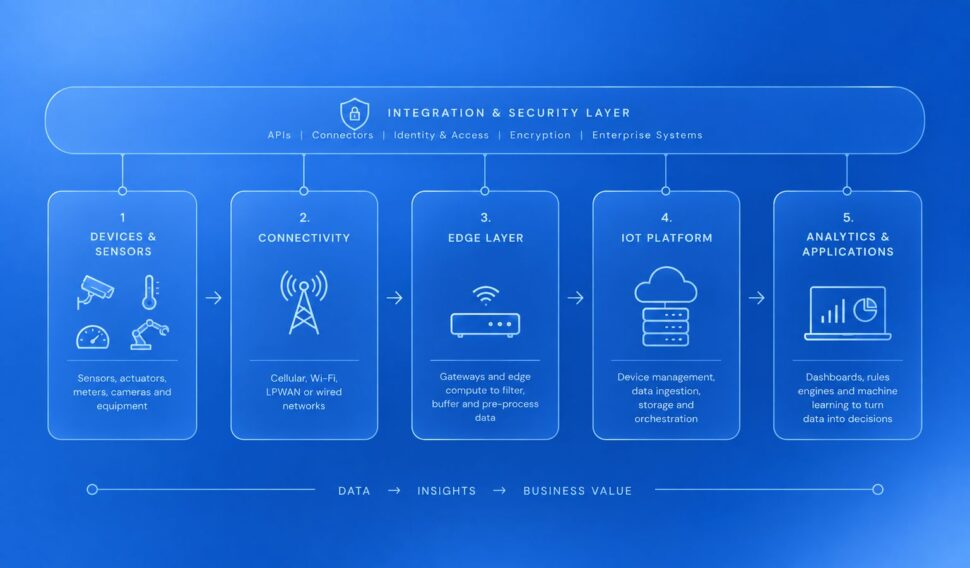
- Device and sensor layer. The physical enterprise IoT devices: sensors, actuators, meters, cameras, and the equipment they are attached to. This layer decides what you can measure and how often.
- Connectivity: The networks that move data from devices to the platform. Choices here (cellular, LPWAN, Wi-Fi, or wired) shape range, battery life, bandwidth, and cost.
- Edge Gateways and edge compute filter, buffer, and pre-process data near the source. Edge AI is a defining trend; IoT Analytics highlights that edge processing reduces latency and enables real-time responses.
- Platform: The IoT platform that handles device management, data ingestion, storage, and orchestration. This is the operational core.
- Analytics and application: Dashboards, rules engines, and machine learning that turn telemetry into decisions. Ailoitte builds this layer with an AI-native approach, and organizations that want dedicated model work often bring in specialist AI development services to move from reporting to prediction.
- Integration and security layer. The connectors, APIs, identity, and encryption that tie the system to enterprise software and keep it secure. This layer runs across all the others.
A common mistake is to over-invest in devices and under-invest in the platform, integration, and security layers, which is where most of the long-term value and risk sit.
Enterprise IoT platforms: what they do and how to choose one
An enterprise IoT platform is the software backbone that connects, manages, secures, and analyzes your device fleet. It handles device onboarding, over-the-air updates, data ingestion, storage, and the rules that trigger actions. Choosing the right platform is the highest-stakes decision in the project, because migrating later is expensive.
The major cloud platforms are AWS IoT Core, Microsoft Azure IoT, and Google Cloud IoT, alongside specialist and open-source options. Rather than ranking a single “best enterprise IoT platform,” evaluate candidates against the criteria that match your deployment.
| Criterion | What to check | Why it matters |
|---|---|---|
| Scalability | Endpoint limits, ingestion throughput, multi-region support | You are buying for the fleet you will have, not the pilot |
| Device management | Onboarding, OTA firmware updates, remote diagnostics | Field visits are the hidden cost of IoT at scale |
| Security | Per-device identity, encryption, certificate management | The platform sets your baseline security posture |
| Integration | Prebuilt connectors, open APIs, event streaming | The platform must talk to ERP, CRM, and data systems |
| Analytics and AI | Edge inference, ML pipelines, streaming analytics | Where insight and ROI come from |
| Total cost | Per-message, per-device, and data-egress pricing | Costs scale with data volume, not just device count |
| Portability | Standards support, data export, vendor lock-in risk | Protects you if you change providers |
Pick the platform after you know your connectivity and data volumes, not before. The right choice depends on how much data you move, how often, and how much you process at the edge versus the cloud.
Enterprise IoT connectivity: choosing the right network
Connectivity is the layer most IoT guides skip, and it’s where deployments quietly fail. The best IoT connectivity solution for enterprise use is the one that matches your range, bandwidth, power, and mobility needs, not the one with the best marketing. Cellular is a large and growing share here: IoT Analytics reports that cellular technologies, from NB-IoT and LTE-M through 5G, account for roughly 22% of global IoT connections.
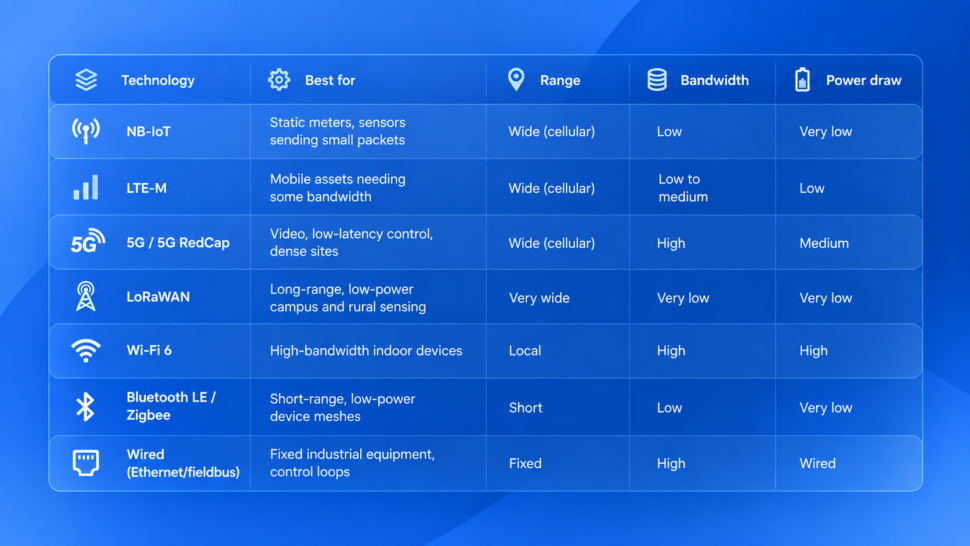
For most enterprises, the answer is a mix: cellular for mobile and remote assets, LPWAN for dense low-power sensing, Wi-Fi for high-bandwidth indoor devices, and wired links for control-critical machinery. Get connectivity wrong, and you pay for it every month in data bills and battery replacements.
Integrating enterprise IoT with your existing systems
The value of IoT platform integration with enterprise systems is that live device data reaches the tools your teams already use. An IoT program that stops at a standalone dashboard creates another data silo. To pay off, telemetry has to flow into ERP for maintenance and inventory, into CRM for service and customer signals, into MES for production, and into your data warehouse for analytics.
There are three practical integration patterns:
- API-led integration. Direct connections between the IoT platform and each target system through documented APIs. Best for a small number of high-value integrations.
- iPaaS (integration platform as a service). A middleware layer that connects many systems through prebuilt connectors. Best when you need to link several enterprise systems and keep them maintainable.
- Event streaming. A message backbone (such as Kafka or a cloud equivalent) that lets many systems subscribe to the same data. Best for high-volume, real-time use cases.
Treat integration as an architectural decision made early, not a task bolted on at the end. Field teams also need the data on the move, which is why many programs pair the platform with purpose-built enterprise mobile app development for technicians, drivers, and floor managers.
Enterprise IoT security and governance
Enterprise IoT security has to protect every layer: the device, the connection, the platform, and the data. Every added endpoint expands the attack surface, so the goal is a zero-trust posture where nothing is trusted by default. Modern platform analyses list device lifecycle management, over-the-air updates, zero-trust device security, edge-to-cloud orchestration, and AI-driven analytics as the capabilities enterprise buyers now expect from a platform.
A workable security baseline includes:
- Per-device: Every device gets a unique cryptographic identity, not a shared password.
- Encryption in transit and at All telemetry is encrypted end to end.
- Secure over-the-air Firmware can be patched remotely and safely, so a known vulnerability does not require a truck roll.
- Network IoT traffic is isolated from core IT, so a compromised sensor cannot reach sensitive systems.
- Continuous Anomaly detection watches for unusual device behavior.
- Governance and Clear data-ownership, retention, and access policies mapped to the regulations that apply to your industry.
Security and governance are not a final phase. Design them into the architecture and budget for them from day one.
Benefits of enterprise IoT
Enterprise IoT solutions deliver measurable operational and financial results, which is why adoption keeps growing despite economic caution. The main benefits:
- Predictive maintenance. Sensors detect emerging equipment issues early, so teams move from scheduled and reactive maintenance to condition-based This cuts unplanned downtime, the single most cited source of IoT ROI in heavy industry.
- Operational: Live visibility into equipment, facilities, and logistics lets managers optimize processes and reduce waste.
- Cost: Energy reductions, lower inventory carrying costs from just-in-time ordering, and less downtime add up quickly.
- Safety: Continuous monitoring flags hazards and documents regulatory conditions automatically.
- New revenue: Connected products enable usage-based billing, subscriptions, and services that were not possible without live data.
The pattern across deployments is consistent: the first wins show up in uptime, then in safety, and finally in energy and process efficiency.
Turn your IoT roadmap into a system that scales securely and plugs into your stack.
Enterprise IoT use cases by industry
IoT solutions for enterprises span nearly every sector. The highest-return use cases cluster where physical assets are expensive, downtime is costly, or safety is regulated. Manufacturing leads adoption; Mordor Intelligence put its share of the market near 27% in 2025, with energy and utilities forecast to grow fastest.
| Industry | Representative use cases | Primary payoff |
|---|---|---|
| Manufacturing | Predictive maintenance, quality monitoring, energy optimization | Higher output, less downtime |
| Logistics | Fleet telematics, cold-chain monitoring, smart warehousing | <Faster, more reliable delivery |
| Energy and utilities | Smart metering, grid monitoring, asset health | Fewer outages, optimized assets |
| Healthcare | Asset tracking, equipment monitoring, connected devices | Safety, care coordination |
| Retail | Automated checkout, shelf and traffic analytics, loss prevention | Better margins and experience |
| Smart facilities | HVAC, lighting, occupancy, leak detection | Energy and space efficiency |
In manufacturing, connected equipment and predictive maintenance are the backbone of modern operations, and many plants adopt them as part of broader it services for manufacturing rather than as a standalone project. In retail, cashierless checkout and shelf analytics depend heavily on computer vision in retail working alongside sensor data. The point is not to chase every use case but to sequence the two or three with the clearest ROI first.
Common enterprise IoT challenges and how to solve them
Enterprise IoT is powerful, but the path to production has predictable obstacles. Naming them early is how experienced teams avoid stalled pilots.
| Challenge | Why it happens | How to solve it |
|---|---|---|
| Data overload | Thousands of sensors produce high-volume, messy streams | Filter at the edge; define the metrics that matter before you collect |
| Legacy integration | IoT must connect to old ERP, CRM, and OT systems | Use iPaaS or event streaming; plan integration in the architecture phase |
| IT/OTmisalignment | IT and operations teams work in silos | Assign shared ownership and a joint governance model |
| Interoperability | Proprietary hardware and protocols do not agree | Favor open standards; standardize on a small set of vendors |
| Security risk | More endpoints mean a larger attack surface | Zero-trust design, per-device identity, OTA patching |
| Unclear ROI | Hard to quantify value before deploying | Start with a scoped pilot tied to measurable KPIs |
| Skills gap | IoT spans hardware, connectivity, data, and security | Partner with a specialist team to build internal capability |
The strongest predictor of success is not technology choice. It is whether the program starts small, proves ROI on a defined use case, and scales from evidence.
How to build and deploy an enterprise IoT solution
This works best as a staged process that ties technology to business goals at every step.
- Define the business: Pick one or two use cases with clear, measurable outcomes. Scope beats ambition here.
- Assess: Confirm the technical and economic viability, gather requirements from operations, IT, and security.
- Design: Decide devices, connectivity, edge-versus-cloud split, platform, and integration approach together, not in isolation.
- Pilot before you validate on a limited footprint. Treating the first deployment as a scoped pilot, delivered through mvp development services, surfaces integration and data issues while the cost of fixing them is low.
- Build and integrate. Develop the platform, connect the devices, and wire the system into enterprise This is where a software development company in usa with IoT and integration experience earns its keep.
- Test and Run integration, load, and security testing, including penetration testing of the device fleet.
- Deploy and roll out in stages, and train operations and IT staff to run the system.
- Monitor and IoT is not a one-time build. Ongoing application maintenance and support services keep devices patched, data flowing, and models accurate as conditions change.
Enterprise IoT cost: what drives the budget
Costs vary by scale, complexity, endpoint count, and required capabilities. Industry sources put small-to-mid AI deployments in the range of roughly $20,000 to $150,000, with large-scale enterprise implementations commonly reaching $150,000 to $500,000 or more, with practical enterprise use cases like analytics tools or chatbots typically falling between $50,000 and $500,000, and the largest multi-system rollouts running into the millions. Rather than fixate on a single number, budget against the factors that actually move it.
| Cost driver | Effect on budget |
|---|---|
| Scope of use cases | More business units and objectives raise cost |
| Number of endpoints | Hardware, connectivity, and data costs scale with sensor count |
| Edge vs. cloud processing | Edge lowers data-transfer cost but adds hardware |
| Legacy integration | More systems to connect means more effort |
| Custom software | Bespoke dashboards, analytics, and automation add cost |
| Data volume and storage | High-frequency data raises cloud storage spend |
| Security requirements | Encryption, hardening, and testing add overhead |
| Geographic distribution | Multi-region rollouts multiply connectivity and support |
The single biggest lever is scope discipline. A focused first deployment costs less, proves value faster, and de-risks the larger rollout.
How to choose an enterprise IoT services partner
The right partner covers the full stack: device selection, connectivity, platform engineering, integration, security, and analytics. Few enterprises have all of these skills in-house, which is why most buyers ask who offers enterprise IoT solutions that can carry a project from pilot to scale. Evaluate partners on real criteria: IoT platform experience, integration track record with ERP and CRM systems, security and compliance depth, and the analytics maturity to turn data into decisions.
Ailoitte builds enterprise IoT solutions as an AI-native software partner. That matters because the value in modern IoT is shifting to the analytics and application layer, where machine learning turns telemetry into prediction. Ailoitte pairs IoT engineering with dedicated ai development company capabilities, so the same team that connects your devices can build the models that make the data useful. The result is IoT solutions for enterprises that are secure, integrated with your existing systems, and designed to deliver measurable outcomes rather than another dashboard.
Conclusion
Enterprise IoT rewards buyers who treat it as a software, integration, and security program, not a hardware purchase. Start with the architecture, choose your platform and connectivity to match real data volumes, design security from day one, and prove ROI on a scoped pilot before you scale. Do that, and enterprise IoT becomes a durable source of efficiency, safety, and new revenue rather than a stalled experiment. When you’re ready to move from plan to build, the right partner turns that roadmap into a system that runs.
Ready to build enterprise IoT solutions that scale securely and integrate with your stack?

Sunil Kumar is CEO of Ailoitte, an AI-native engineering company building intelligent applications for startups and enterprises. He created the AI Velocity Pods model, delivering production-ready AI products 5× faster than traditional teams. Sunil writes about agentic AI, GenAI strategy, and outcome-based engineering.
About Ailoitte