
On this page
- What are IT services for manufacturing?
- Why IT services matter for manufacturers now
- Key components of IT services for manufacturing
- Core use cases of IT services in manufacturing
- Benefits of IT services for manufacturing companies
- Managed IT services vs in-house vs break-fix: which model fits?
- How to implement IT services in manufacturing
- Common challenges (and how to solve them)
- Trends shaping IT services in smart manufacturing (2026)
- What this looks like on the plant floor
- How to choose an IT services partner for manufacturing
- How Ailoitte helps manufacturers
- Conclusion
- FAQ
Key Takeaways
- IT services for manufacturing reduce unplanned downtime, which now costs the sector up to $852 million per week (Fluke, 2025)
- Manufacturing was the most-attacked industry for the fifth year running in 2025, so security is now a core part of plant IT, not an add-on (IBM X-Force, 2026).
- The core services span network and OT security, cloud and ERP, IIoT and data, predictive maintenance, and custom software.
- Managed services convert unpredictable outages into a fixed monthly cost with defined response times.
- The right partner understands the factory floor first and technology second.
IT services for manufacturing are the managed technology, security, cloud, and software support that keep production lines, plant systems, and supply chains running without interruption. They cover the shop-floor network, operational technology, cybersecurity, cloud and ERP, industrial IoT data, and the custom software that connects it all. For a manufacturer, the goal is simple: less downtime, tighter security, and better decisions from plant data.
This guide covers what IT services for manufacturing include, the use cases that matter most, the benefits and costs, how to implement them, the challenges to expect, and the 2026 trends reshaping the plant floor. It’s written for operations and technology leaders who are weighing a partner and want a clear, current picture before committing.
Losing hours to unplanned downtime? Ailoitte manages your plant IT so the line keeps running.
What are IT services for manufacturing?
IT services for manufacturing are the design, delivery, and day-to-day management of the technology a plant runs on. That includes the network, servers and cloud, security, ERP and MES, industrial IoT data, and the applications that tie production to the front office.
What sets it apart from generic office IT is the environment. A plant runs operational technology (OT) such as PLCs, SCADA systems, and machine controllers right next to standard IT systems. These two worlds are converging fast, and most general IT teams aren’t built to secure or support OT. Good IT solutions for manufacturing treat IT and OT as one connected system, with uptime and safety as the first priority.
Manufacturers usually consume these services in one of three ways: a break-fix vendor they call when something breaks, an in-house team, or a managed services partner that runs the stack for a fixed fee. More on those models below.
Why IT services matter for manufacturers now
IT has moved from a support cost to a resilience issue for two reasons: downtime is more expensive than ever, and factories are the top target for attackers.
Unplanned downtime is the most expensive problem in the building. A 2025 survey of more than 600 industrial decision-makers by Fluke found that 61 percent of manufacturers suffered unplanned downtime in the past year, costing the sector up to $852 million every week. At an average of $1.7 million per hour, a single incident can reach up to $42.6 million in losses. The Siemens True Cost of Downtime 2024 report put the toll on Fortune Global 500 firms at a combined $1.4 trillion per year, around 11 percent of revenue. IT services for manufacturers exist to shrink those hours through monitoring, redundancy, and fast recovery.
Security is the second driver. Manufacturing represented 27.7 percent of all cyberattacks in 2025, the highest of any industry, and it has been the most-targeted sector for five straight years, according to IBM X-Force. Exploitation of public-facing applications was the most common entry point, and 40 percent of attacks involved data theft aimed at financial assets and intellectual property. A stopped line creates pressure to pay, which is why attackers keep coming back. Any serious IT services plan for a plant now has to cover OT security, identity, and fast patching.
Key components of IT services for manufacturing
Strong IT solutions for the manufacturing industry bundle several components and connect them, so data flows from the machine to the decision. These are the building blocks a capable partner should cover.
1. Network management and security.
Design and monitoring of secure, high-performance shop-floor and office networks, so production stays online and threats are contained.
2. OT and IT convergence.
Safe integration of PLCs, SCADA, and IoT devices with IT systems, including segmentation between plant and office networks.
3. Cybersecurity.
Endpoint protection, identity and access control, patching, threat monitoring, and a tested incident response plan built for ICS and OT.
4. Cloud and infrastructure.
Migration and management of cloud workloads, servers, and storage, with backup and disaster recovery.
5. ERP and MES support.
Integration and support for the ERP and manufacturing execution systems that run production, inventory, quality, and orders.
6. Industrial IoT and data.
Sensors, edge devices, and data pipelines that turn raw machine signals into dashboards, alerts, and analytics.
7. Custom software and integration.
Bespoke tools and the integrations that connect ERP, MES, IoT, and legacy machines into one system.
8. 24/7 support and monitoring.
A help desk and remote monitoring that catch issues before they stop the line.
Most manufacturers start with the network, security, and support layer, then expand into data, cloud, and custom software as trust builds.
Core use cases of IT services in manufacturing
The clearest way to judge a partner is by the outcomes they deliver on the floor. These are the use cases where manufacturing IT services return the most value.
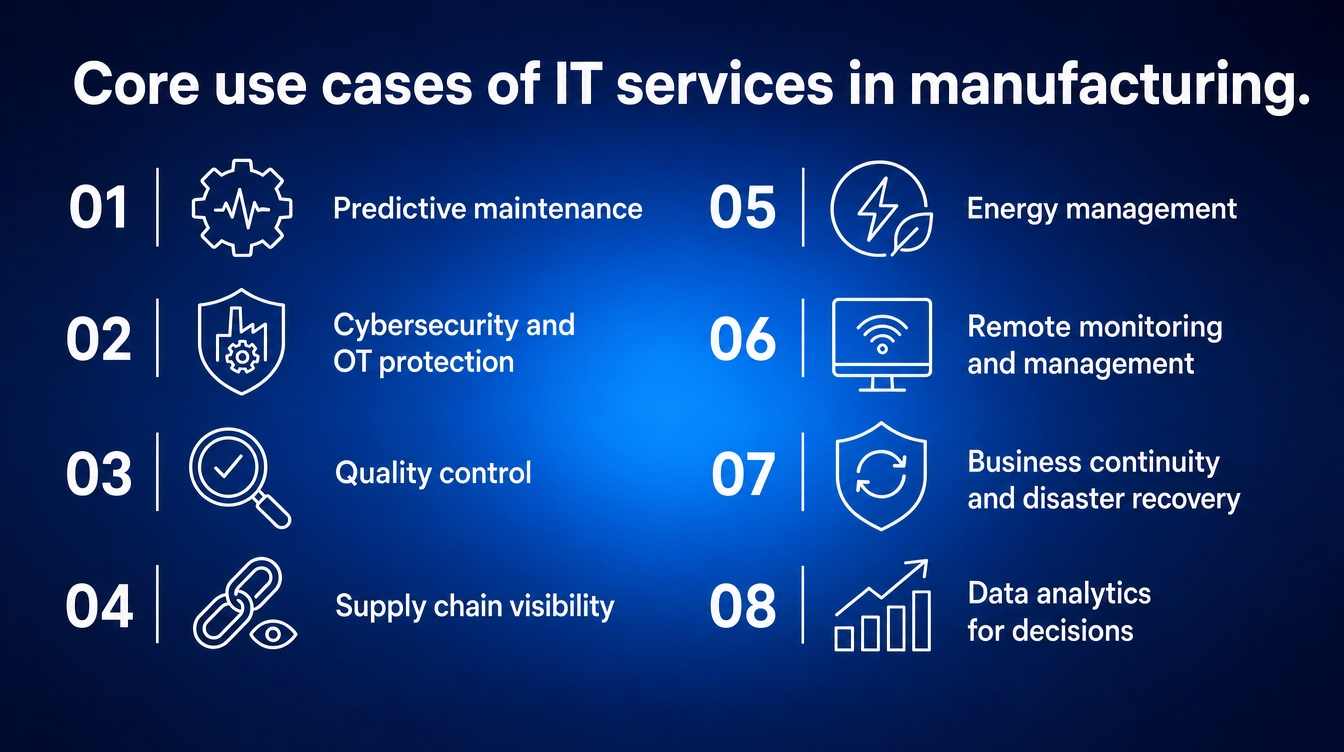
1. Predictive maintenance.
Sensors and machine learning flag a failing motor or bearing before it stops the line. This is the highest-value use case, because it turns unplanned stops into scheduled work.
2. Cybersecurity and OT protection.
Multi-layered defense across endpoints, network segmentation, and identity, tuned for the plant. Given manufacturing’s threat profile, this protects both uptime and intellectual property.
3. Quality control.
Computer vision and analytics catch defects in real time that manual inspection misses, which lowers scrap and rework.
4. Supply chain visibility.
IoT and analytics track inventory, demand, and logistics so teams can plan ahead and cut waste.
5. Energy management.
Smart monitoring finds waste and schedules equipment to lower cost and emissions.
6. Remote monitoring and management.
Teams watch equipment health and network status from anywhere, with automated alerts that reduce on-site visits.
7. Business continuity and disaster recovery.
Backups, redundancy, and tested recovery plans get production back fast after a failure, attack, or outage.
8. Data analytics for decisions.
Dashboards turn production, supply chain, and quality data into decisions on scheduling, staffing, and capacity.
Not sure where your plant’s IT stands? Let Ailoitte’s engineers map the gaps before they cost you.
Benefits of IT services for manufacturing companies
The benefits of IT services for manufacturing companies come down to uptime, security, cost control, and better decisions. Here’s what a well-run engagement delivers.
1. Less downtime.
Proactive monitoring and predictive maintenance catch problems early, so lines run longer between stops.
2. Stronger security.
Continuous monitoring, segmentation, and patching lower the risk of the ransomware and data theft that hit manufacturing hardest.
3. Predictable costs.
A fixed monthly model replaces surprise repair bills and makes IT spend easy to budget.
4. Scalability.
Services expand as you add lines, sites, or regions, without a rebuild each time.
5. Compliance support.
Partners help you meet industry and data regulations and keep audit trails in order.
6. Focus on production.
Offloading day-to-day IT lets your team concentrate on making product, not fixing servers.
These gains compound, and the plants that treat technology as an asset tend to move ahead of the ones that don’t. Rockwell’s 2026 State of Smart Manufacturing research found that 90 percent of manufacturers now see digital transformation as a necessity for holding their competitive position, with leaders directing about 28 percent of their operating budgets toward it.
Managed IT services vs in-house vs break-fix: which model fits?
There are three ways to run plant IT, and the right one depends on your size, risk, and internal skills. Managed IT services for manufacturing suit most mid-size plants, because they turn unpredictable outages into a fixed cost with a defined response time.
1. Break-fix.
You call for help after something breaks. Cheapest on paper, most expensive in practice, because you pay in downtime and no one is working to prevent problems.
2. In-house team.
Full control and deep plant knowledge. The trade-off is cost and coverage. A single manufacturer rarely justifies full-time specialists in OT security, cloud, data, and software all at once, and hiring is hard. The 2026 outlook points to a manufacturing labor gap of roughly 425,000 workers, which makes staffing every skill in-house unrealistic for many plants.
3. Managed services, or a hybrid.
A partner runs the day-to-day and brings specialists on demand, often alongside a lean internal lead. You get 24/7 coverage, security depth, and predictable spend. For most operations leaders, the hybrid wins: keep someone internal who knows the floor, and hand the heavy, always-on, specialized work to a partner.
How to implement IT services in manufacturing
A structured rollout prevents disruption and protects production during the switch. Most successful implementations follow the same path.
- Assess current Audit hardware, software, networks, OT, and data practices to find gaps and risks.
- Define goals and Tie the engagement to outcomes: less downtime, better security, supply chain visibility, or smart-factory readiness.
- Choose the right Look for proven manufacturing and OT experience, not just corporate IT.
- Build a phased Set milestones for integration, data migration, and deployment, with production continuity built in.
- Integrate in Deploy and connect systems in stages so the line keeps running and teams can adapt.
- Train the Give operators and supervisors the training to use new tools with confidence.
- Monitor and Track performance, security, and uptime, and tune the setup as needs change.
- Review Measure uptime, cost savings, and productivity against the goals you set, then adjust.
Common challenges (and how to solve them)
Most manufacturers hit the same obstacles when they modernize plant IT. Naming them early makes them manageable.
1. Legacy systems.
Old hardware and software rarely play well with modern tools. The fix is gradual integration at defined connection points, not a risky full overhaul. Legacy equipment remains the most-cited obstacle to smart-factory progress in the 2026 Manufacturing Leadership Council survey.
2. Data interoperability.
Getting systems to share clean data is now a leading roadblock, rising to 37 percent of manufacturers in 2026 from 22 percent the year before. Common data standards and integration work solve it.
3. Security and compliance.
Sensitive designs, schedules, and process data need protection and regulatory adherence. Continuous monitoring and clear compliance protocols keep both in check.
4. Resistance to change.
Teams used to old workflows may push back. Clear communication and training turn resistance into adoption.
5. Upfront cost.
Modernization takes investment. Scalable, phased engagements spread the cost and let early value fund the next step.
6. Downtime during transition.
Poorly planned rollouts stop the line. A phased approach keeps production running while systems change.
7. Skills gaps.
Few plants have every specialty in-house. A partner fills the gap in OT security, cloud, and data without a hiring spree.
Trends shaping IT services in smart manufacturing (2026)
The role of IT services in manufacturing is expanding from support to strategy. These are the trends leaders are acting on in 2026.
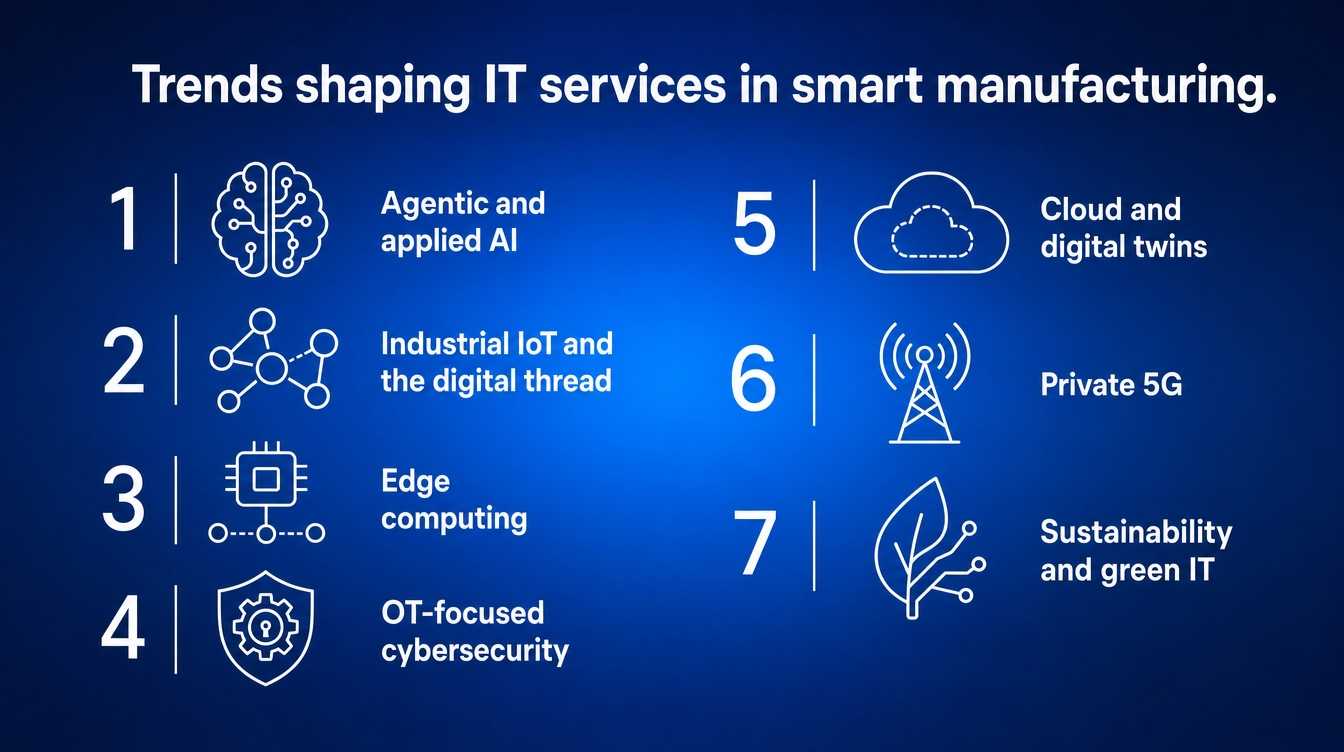
1. Agentic and applied AI.
AI is moving from pilots into production, from predictive maintenance to quality inspection and scheduling. The gap now is execution, not interest. Only about 14 percent of manufacturers have scaled digital transformation beyond pilots, so partners that can operationalize AI have an edge.
2. Industrial IoT and the digital thread.
Connected sensors and edge devices give operators visibility they never had. Deloitte puts IIoT adoption at around 46 percent of manufacturers, and the focus is shifting to a continuous data thread from machine to decision.
3. Edge computing.
Processing data near the machine cuts latency and speeds decisions on the line.
4. OT-focused cybersecurity.
As plants connect more devices, security spend follows. Identity, segmentation, and AI-based threat detection are becoming standard.
5. Cloud and digital twins.
Cloud platforms and virtual replicas of lines let teams simulate and optimize before touching live production.
6. Private 5G.
Fast, low-latency networks support real-time communication between machines and systems at scale.
7. and green IT.
Energy monitoring and efficient infrastructure help plants cut cost and meet environmental goals.
The payoff shows up in hard numbers. The World Economic Forum’s Global Lighthouse Network reports that plants adopting advanced digital technology have achieved productivity gains of 20 to 30 percent and energy reductions of up to 25 percent.
What this looks like on the plant floor
1. A metal fabricator cutting downtime.
A mid-size fabricator adds IoT sensors and predictive maintenance to its critical presses. Instead of waiting for a breakdown, the team schedules repairs during planned stops.
Unplanned downtime drops and output steadies.
2. An automotive supplier hardening security.
A tier-two supplier segments its plant network from its office network, adds identity controls, and sets up 24/7 monitoring. When an attacker probes a public-facing application, the intrusion is contained before it reaches production systems.
The specifics change from plant to plant, but the outcome is the same: fewer stops, tighter security, and better data.
How to choose an IT services partner for manufacturing
The best IT services partner for manufacturing understands production first and technology second. Use this checklist to separate a plant-ready partner from a generic IT vendor.
- Manufacturing and OT Ask for plant work, not just corporate IT. Can they secure a PLC network without stopping the line?
- Uptime commitments in Response and resolution times in the SLA, with penalties. Vague “best effort” language is a warning sign.
- Security OT segmentation, identity, patching cadence, and a tested incident response plan.
- ERP, MES, and integration They should connect your systems, not just host servers.
- Data and AI A partner who can move you from dashboards to predictive maintenance adds value beyond keeping the lights on.
- Multi-site Adding a plant or region shouldn’t mean starting over.
- A roadmap, not a ticket The right partner tells you what to fix next and why, tied to production outcomes.
How Ailoitte helps manufacturers
Ailoitte works as an AI-native software partner for manufacturers. We span managed IT, cybersecurity, cloud, IoT, custom software, and AI and machine learning, and we connect them so your plant data drives decisions. Our focus is proactive management that lowers downtime, secures OT and IT together, and modernizes legacy systems without stopping the line.
If you’re weighing IT services for your manufacturing operation, talk to our team about a plan built around your production, not a generic template.
Conclusion
IT services for manufacturing have moved from a support function to a production and security priority. Downtime now carries seven-figure risk, manufacturing is the most-attacked industry five years running, and the plants pulling ahead treat their technology stack as a competitive asset. The right partner protects uptime, secures OT and IT together, and turns plant data into lower cost per unit. If that’s the outcome you want, the next step is a conversation about your plant, not a template.

Sunil Kumar is CEO of Ailoitte, an AI-native engineering company building intelligent applications for startups and enterprises. He created the AI Velocity Pods model, delivering production-ready AI products 5× faster than traditional teams. Sunil writes about agentic AI, GenAI strategy, and outcome-based engineering.
About Ailoitte




