On this page
- What is Genie 3 by DeepMind?
- How does Genie 3 work?
- What are the key features of Genie 3?
- How does Genie 3 compare with Genie 1 and Genie 2?
- How can you access Genie 3?
- What are the main use cases for Genie 3?
- What are the limitations of Genie 3?
- What does Genie 3 mean for businesses?
- What comes next after Genie 3?
- Summing up
- FAQ
What is Genie 3 by DeepMind?

Genie 3 by DeepMind is a world model: an AI system that predicts how an environment will change in response to actions and then draws that change frame by frame. You describe a world in text, and Genie 3 builds it around you as you move, instead of playing back a fixed video.
Google DeepMind introduced Genie 3 on August 5, 2025, as its first world model that allows interaction in real time. The Genie 3 announcement on the DeepMind blog describes worlds that run at 720p and 24 frames per second and stay consistent for a few minutes.
Genie 3 is a type of generative AI, but it differs from image and video generators in one key way. A video model produces a clip that plays from start to finish. Genie 3 produces the next frame based on what the user just did, so the world reacts to each move.
Why do world models matter?
World models matter because they give AI agents and people a safe place to test actions before trying them in the real world. A robot, a self-driving car, or a game character can practice thousands of scenarios in a generated world at low cost and low risk.
Google DeepMind describes simulating the world as a crucial step toward more general AI, because agents need varied, safe environments to learn in.
World models are related to digital twins, but they are not the same thing. A digital twin is a virtual copy of a specific real system, while a world model like Genie 3 can generate places that never existed.
How does Genie 3 work?
Genie 3 generates each frame autoregressively, which means it predicts the next frame from the frames and actions that came before. The model has to remember what it already showed, so a wall you passed still looks the same when you turn back.
- You write a prompt that describes the world and, in Project Genie, the character you control.
- Genie 3 generates the opening frames of the environment.
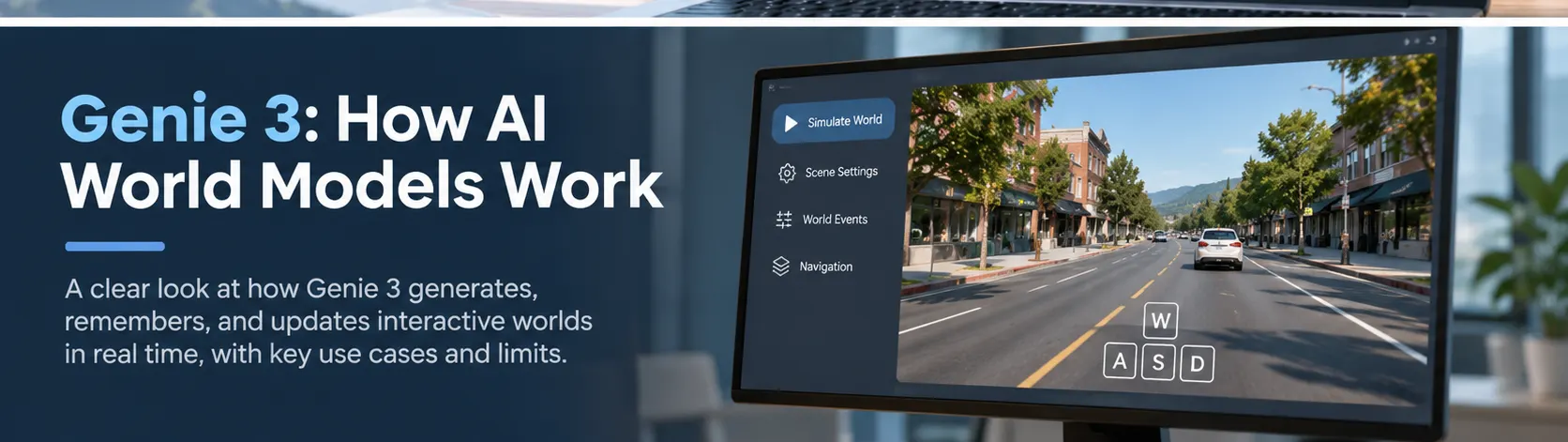
- You move using keyboard controls, and Genie 3 generates new frames based on each action.
- The model checks its recent output, up to about one minute back, to keep the world consistent.
- Promptable world events let you change the scene with text, such as new weather or new objects.
DeepMind says this consistency is emergent. Genie 3 does not build an explicit 3D model of the scene, unlike techniques such as Neural Radiance Fields (NeRFs) or Gaussian Splatting. It learns to keep the world stable from its training data.
What are the key features of Genie 3?
Genie 3’s key features are real-time interaction, a minute of visual memory, and text-based world events. Together, they make a generated world feel explorable rather than watched.
- Real-time generation: worlds respond to user input at 24 frames per second.
- 720p resolution: a clear step up from earlier Genie models.
- Consistency over several minutes: scenes stay stable for a few minutes of continuous play.
- Visual memory: the model can recall what it showed up to about one minute earlier.
- Promptable world events: text prompts can change the weather or add objects and characters during a session.
- Agent training support: DeepMind tested Genie 3 worlds with its SIMA agent, which sent navigation actions to Genie 3 to pursue goals.
How does Genie 3 compare with Genie 1 and Genie 2?
Genie 3 is the first Genie model that runs in real time, and it keeps worlds consistent far longer than Genie 2. Each version expanded what a generated world could do.
Genie 1 arrived in 2024 and generated 2D worlds. Genie 2, announced in December 2024, moved to 3D worlds built from a single prompt image, controlled with keyboard and mouse. Most Genie 2 examples lasted 10 to 20 seconds.
| Feature | Genie 1 | Genie 2 | Genie 3 |
|---|---|---|---|
| Announced | 2024 | December 2024 | August 2025 |
| World type | 2D | 3D | 3D |
| Main input | Image | Single image | Text prompt |
| Real-time play | No | No | Yes, 24 fps |
| Typical consistency | Seconds | 10 to 20 seconds, up to a minute | A few minutes |
How can you access Genie 3?
You can access Genie 3 through Project Genie, a Google Labs prototype for Google AI Ultra subscribers aged 18 and over. There is no public Genie 3 API or SDK for developers.
Access has opened in three stages:
- August 2025: a limited research preview for a small group of academics and creators.
- January 29, 2026: Project Genie launched for US Google AI Ultra subscribers, with 60-second sessions and a gallery for remixing other worlds.
- May 19, 2026: Google began rolling Project Genie out to eligible AI Ultra subscribers worldwide and added Street View grounding for real US locations.
Project Genie combines three Google models. Genie 3 runs the world, Nano Banana Pro creates the preview image you can edit before you enter, and Gemini also powers the experience. Users pick a first-person or third-person view and can download videos of their sessions.
What are the main use cases for Genie 3?
The strongest use cases for Genie 3 today are training AI agents, simulating rare real-world events, and prototyping interactive ideas. Most commercial uses are still experiments, because access is limited and sessions are short.
Training AI agents
Genie 3 can generate endless practice worlds for AI agents. DeepMind used it to give its SIMA agent goals in generated environments, with Genie 3 simulating the result of each action. Teams that build multi-agent AI systems face similar testing problems in software, without the 3D world.
Best for: research labs and teams that need varied environments to train and test agents.
Autonomous driving simulation
Genie 3 already powers a real driving simulator. In February 2026, Waymo introduced the Waymo World Model, adapted from Genie 3, to simulate rare events such as tornadoes, flooded streets, and unusual animals. It outputs both camera and lidar data.
Best for: robotics and autonomous vehicle teams that need edge cases they cannot safely capture on real roads.
Game and interactive prototyping
Game designers can use Project Genie to sketch a level idea and walk through it in seconds. The 60-second limit and loose physics mean it suits early concept work, not finished games. For more on where AI fits in media, see AI in entertainment.
Best for: concept artists, game designers and studios exploring ideas before production.
Education and training
Generated worlds could let students explore a historical street or a science scenario from the inside. Today this is closer to a demo than a classroom tool, but it points to new formats for e-learning app development and immersive training.
Best for: education teams testing immersive learning concepts.
Synthetic data and simulation
World models can create varied training data where real data is scarce or sensitive. The same idea already drives synthetic data in healthcare, where generated records protect patient privacy.
Best for: AI teams that need rare or private scenarios for model training.
What are the limitations of Genie 3?
Genie 3’s main limitations are short sessions, a limited set of actions, weak multi-agent support, and imperfect real-world accuracy. DeepMind lists these openly as research challenges.
- Limited interaction time: the model supports a few minutes of continuous play, and Project Genie caps sessions at 60 seconds.
- Limited action space: users can trigger world events with text, but the agent itself can only take a narrow set of actions.
- Multi-agent interaction: modeling several independent agents together is still an open problem.
- Real-world accuracy: Genie 3 cannot reproduce real places with perfect geographic accuracy.
- Text rendering: clear, readable text usually appears only when it is written into the prompt.
- Control and physics: Google notes that Project Genie worlds may not follow prompts or real-world physics closely, and characters can lag.
Responsible use is another open question. DeepMind released Genie 3 as a limited preview so it could study risks before wider access, and Project Genie remains an experimental prototype.
What does Genie 3 mean for businesses?
For most businesses, Genie 3 is a signal to watch rather than a tool to deploy today. There is no production API, so companies cannot yet build products directly on it.
The practical lessons are still useful. Simulation and synthetic environments are becoming realistic enough to train and test AI. Teams in robotics, mobility, gaming, and training can plan for that shift now, using existing tools such as game engines and AR/VR app development for immersive products.
What comes next after Genie 3?
The next step has already arrived. On October 27, 2026, Google DeepMind announced Genie 4, a successor that adds native audio, including ambient sound, music, and dialogue, and lets users steer scenes in real time with natural language.
Genie 4 is rolling out first to a limited group of trusted testers. Google says it is coming soon to Google AI Ultra subscribers in Project Genie and to early access partners in the Gemini API and AI Studio, which would be the first developer access for a Genie model. Longer sessions, better physics, and multi-agent worlds remain the open problems to watch.
Summing up
Genie 3 by DeepMind turns text prompts into 3D worlds that respond to you in real time, at 720p and 24 frames per second. In 2026, it moved from a research preview to Project Genie for Google AI Ultra subscribers, and it now powers Waymo’s driving simulator. Short sessions and the lack of a public API limit business use today, but with Genie 4 heading to the Gemini API, world models are quickly becoming a serious tool for training and testing AI.

Sunil Kumar is CEO of Ailoitte, an AI-native engineering company building intelligent applications for startups and enterprises. He created the AI Velocity Pods model, delivering production-ready AI products 5× faster than traditional teams. Sunil writes about agentic AI, GenAI strategy, and outcome-based engineering.
About Ailoitte