On this page
- How are MCP and traditional API connectors different?
- How do traditional API connectors work?
- What is the Model Context Protocol (MCP)?
- MCP vs traditional API connectors: side-by-side comparison
- Is MCP faster than a traditional API?
- How does security differ between MCP and APIs?
- When should you use a traditional API connector?
- When should you use MCP instead of a direct API?
- How do MCP and APIs work together?
- What changed in MCP in 2025 and 2026?
- Summing up
- FAQ
How are MCP and traditional API connectors different?
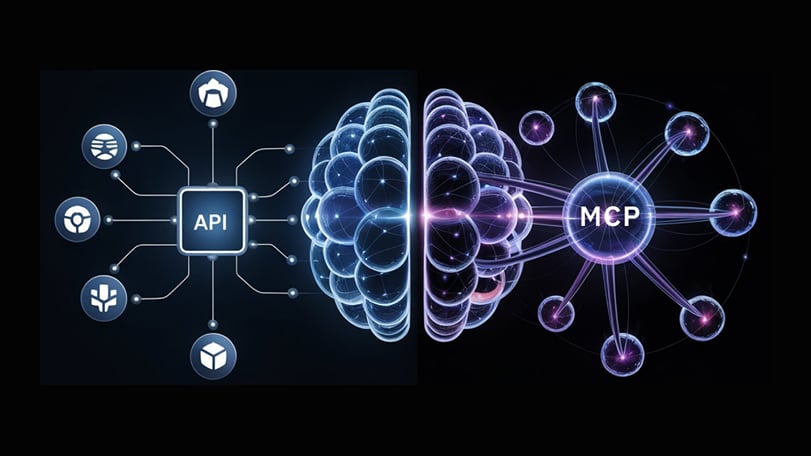
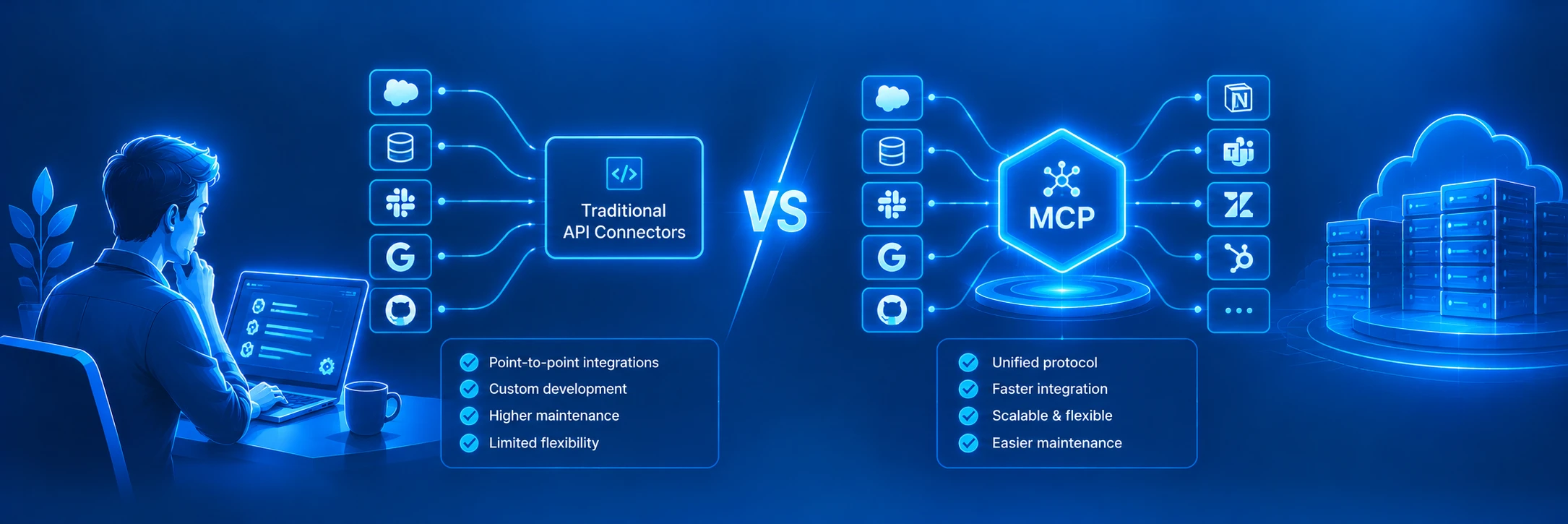
MCP vs traditional API connectors is not a contest between two ways of moving data. A traditional API connector is code written for one service, while MCP is a shared protocol that lets any compatible AI application use any compatible server without new integration code.
The practical difference shows up when you add an AI agent. With traditional connectors, a developer reads each API’s documentation and writes code for every tool the agent might use. With MCP, the agent’s host connects to an MCP server, asks what it can do and gets a machine-readable list of tools with input schemas.
How do traditional API connectors work?
A traditional API connector calls fixed endpoints on a service, using a documented format and its own authentication. The developer decides in advance which endpoints to call and how to handle each response.
- Endpoints: each URL represents one resource or operation, such as /products or /orders.
- Methods: HTTP verbs such as GET, POST, PUT, and DELETE define the action.
- Authentication: each service has its own API keys, OAuth flows, or tokens.
- Contracts: many APIs publish an OpenAPI Specification file, a standard description of HTTP APIs that tools can read.
- Versioning: breaking changes usually ship as new versions, such as /v1/orders and /v2/orders.
Traditional APIs are mature, fast, and well understood. Their weak point for AI is scale: every new tool an agent needs means another connector to build, test, and maintain.
What is the Model Context Protocol (MCP)?
The Model Context Protocol is an open standard for connecting AI applications to the systems where data lives. Anthropic introduced MCP in November 2024 to replace one-off integrations with a single protocol.
MCP solves what is often called the M×N integration problem. Without a standard, M AI applications and N tools need up to M×N custom connectors. With MCP, each application implements the client side once, and each tool implements the server side once.
According to the MCP architecture documentation, MCP has three participants:
- MCP host: the AI application the user works in, such as an IDE or chat assistant.
- MCP client: a component inside the host that keeps a connection to one MCP server.
- MCP server: a program that exposes tools, resources, and prompts to clients.
MCP messages use JSON-RPC 2.0 and travel over one of two transports: stdio for local servers, or Streamable HTTP for remote servers. MCP is model-agnostic and is now supported by major AI products, including ChatGPT, Gemini, Microsoft Copilot, and Visual Studio Code.

How does MCP tool discovery work?
MCP tool discovery lets a client ask a server what it offers at runtime. The client calls tools/list and gets back each tool’s name, description, and input schema, which the AI model uses to decide when and how to call it.
- The client can call server/discover to learn the server’s supported versions and capabilities.
- The client calls tools/list to get the current set of tools.
- The model picks a tool, and the client calls it with tools/call.
- If the server’s tools change, clients that subscribed get a tools list_changed notification and refresh the list.
MCP vs traditional API connectors: side-by-side comparison

MCP wins on discovery, reuse, and AI-readiness, while traditional API connectors win on raw speed, maturity, and fine-grained control. The table compares them on the factors that matter most for AI projects.
| Factor | Traditional API connectors | MCP |
|---|---|---|
| Main user | Developers and apps | AI applications and agents |
| Discovery | Read the docs, hard-code endpoints | Runtime discovery with tools/list |
| Integration effort | New code for every service | One client works with any MCP server |
| Message format | REST, GraphQL, gRPC, and others | JSON-RPC 2.0 |
| State | Usually stateless | Stateless since the 2026-07-28 spec |
| Authentication | Varies by API | Optional; OAuth 2.1 for HTTP servers |
| Speed per call | Fastest, no extra layer | Small extra overhead |
| Maturity | Decades of tooling | New, changing quickly |
| Change handling | Versioned endpoints | Tool list updates and notifications |
| Best for | Fixed, high-volume integrations | Agents choosing among many tools |
Is MCP faster than a traditional API?
No. MCP is not faster than a direct API call, because an MCP server usually sits in front of the same API and adds a protocol step. The speed gain from MCP is in development time, not response time.
Teams save time because one MCP client can work with many servers and because many MCP servers already exist. Anthropic reported more than 10,000 active public MCP servers and over 97 million monthly SDK downloads when it donated MCP to the Agentic AI Foundation.
For simple, predictable, high-volume calls, such as payment processing or product search, a direct API is still the better choice. Measure latency in your own setup before making speed claims either way.
How does security differ between MCP and APIs?
Both approaches can be secure, but MCP adds new risks because an AI model decides which tools to call. MCP does not replace API security; it adds a layer that needs its own controls.
For remote servers, the MCP authorization specification treats a protected MCP server as an OAuth 2.1 resource server. Authorization is optional, but when it is used over HTTP, clients must use PKCE and resource indicators, and servers must publish OAuth protected resource metadata.
- Scope tools tightly: give each MCP server the smallest set of permissions it needs.
- Validate tokens: MCP servers must only accept tokens issued for them.
- Guard against prompt injection: treat tool outputs and descriptions as untrusted input.
- Require approval for risky actions: keep a human in the loop for payments, deletions, and data exports.
- Keep API controls: rate limits, logging and access rules still apply to the APIs behind the MCP server.
When should you use a traditional API connector?
Use a traditional API connector when the integration is fixed, high-volume, and does not involve an AI model choosing what to do. Direct APIs give you the most control and the least overhead.
- Payment, billing, and banking transactions with strict compliance rules.
- High-volume system-to-system sync, such as inventory or order updates.
- Mobile and web apps that call a known set of backend endpoints.
- Integrations where every call path must be fully predictable and audited.
Best for: stable integrations where speed, control, and auditability matter more than flexibility.
When should you use MCP instead of a direct API?
Use MCP when an AI assistant or agent needs to choose among many tools, or when the same tools must work across several AI applications. MCP pays off as the number of tools and AI clients grows.
- AI assistants that read calendars, send emails, and query data across several systems.
- Multi-step agent workflows where the next action depends on the last result.
- Internal tools you want to expose once to several AI apps, such as an IDE assistant and a chat assistant.
- Agent systems that coordinate several tools or agents. For agent-to-agent communication, compare MCP vs A2A before you choose a protocol.
Best for: AI agents and assistants that need flexible, reusable access to many tools.
How do MCP and APIs work together?
MCP and APIs work best together: the API does the work, and the MCP server makes it usable by AI. Most production setups keep their existing APIs and add MCP servers on top for AI use cases.
- Pick the API operations an agent should be allowed to use.
- Wrap each operation as an MCP tool with a clear name, description, and input schema.
- Add authorization so the MCP server only acts with the right user’s permissions.
- Log every tool call and keep human approval for sensitive actions.
- Keep direct API access for apps and services that do not need an AI layer.
For example, a bank can keep its core transaction APIs for its apps and add an MCP server that lets an AI assistant answer spending questions with read-only access. Our guide to MCP server development covers the build in more detail.
What changed in MCP in 2025 and 2026?
MCP changed quickly after launch, so older comparisons are often out of date. These are the changes that matter most for the comparison with APIs.
- March 2025: the 2025-03-26 specification deprecated the old HTTP+SSE transport in favor of Streamable HTTP.
- 2025: authorization was formalized around OAuth 2.1, with MCP servers acting as resource servers.
- December 2025: Anthropic donated MCP to the Agentic AI Foundation under the Linux Foundation, co-founded with Block and OpenAI.
- July 2026: the 2026-07-28 specification made MCP stateless, removing sessions and the initialization handshake, and added server/discover.
The shift to a stateless protocol matters most. Many older articles claim MCP is “stateful” while APIs are “stateless.” That is no longer true of the current specification, so state is not a reason to pick one over the other. Teams that need memory across calls handle it in their own application or with explicit handles.
Summing up
MCP vs traditional API connectors is not an either-or choice. Traditional APIs remain the fastest and most controlled way for software to talk to software. MCP adds a standard layer that lets AI agents discover and use those APIs without custom code for each one. Use direct APIs for fixed, high-volume integrations, and add MCP servers where AI agents need flexible access to many tools.

Sunil Kumar is CEO of Ailoitte, an AI-native engineering company building intelligent applications for startups and enterprises. He created the AI Velocity Pods model, delivering production-ready AI products 5× faster than traditional teams. Sunil writes about agentic AI, GenAI strategy, and outcome-based engineering.
About Ailoitte