On this page
Building AI is one thing. Making it business-ready is another. Most teams reach the RAG vs fine-tuning decision right after their first proof of concept: the large language model works, but it does not know your products, policies or house style.
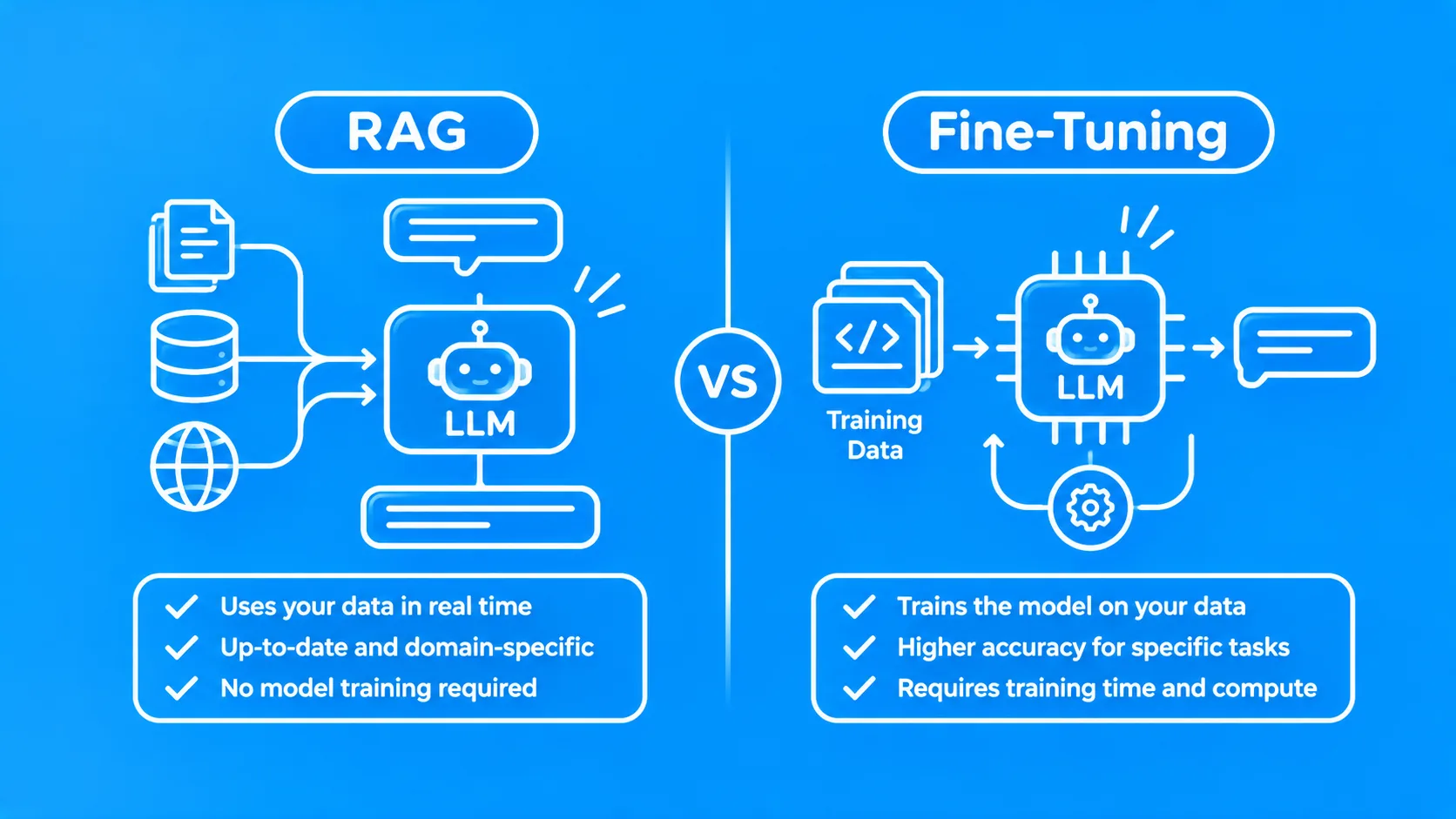
Retrieval-augmented generation and fine-tuning are the two main ways to close that gap. RAG gives the model a knowledge source it can search on demand. Fine-tuning retrains the model so it behaves like an expert in your field.
The choice matters. The right approach gives you accurate answers, sensible costs and a system that grows with your business. The wrong one leaves you with hallucinations, outdated knowledge or rising compute bills. This article explains how each approach works, compares them side by side and gives you a step-by-step way to decide.
What are RAG and fine-tuning?
RAG and fine-tuning are two ways to adapt a general-purpose large language model to a specific business. RAG changes what the model can see when it answers. Fine-tuning changes how the model itself behaves.
What is retrieval-augmented generation (RAG)?
Retrieval-augmented generation (RAG) is a method that connects a language model to an external knowledge source at the moment a question is asked. Instead of relying only on what it learned in training, the model retrieves relevant documents and writes its answer from them.
The approach comes from a 2020 paper by Patrick Lewis and colleagues at Facebook AI Research. Their paper, Retrieval-Augmented Generation for Knowledge-Intensive NLP Tasks, found that RAG models produced more specific and factual text than a model that relied on its trained parameters alone.
A typical RAG system works in four steps:
- Your documents are split into chunks and converted into embeddings, which are numeric vectors that capture meaning.
- The embeddings are stored in a vector database or search index.
- When a user asks a question, the system finds the chunks most relevant to it.
- Those chunks are added to the prompt, and the model writes an answer grounded in them, often with citations.
In simple terms, RAG is AI that knows where to look, which is the first half of any RAG vs fine-tuning comparison.
What is fine-tuning?
Fine-tuning is the process of training a pre-trained language model further on a smaller, task-specific dataset so its weights adapt to your domain. The model learns your patterns, terminology, tone and rules, and it applies them without being told each time.
Fine-tuning comes in two main forms. Full fine-tuning updates every weight in the model and needs more compute. Parameter-efficient fine-tuning (PEFT) freezes the original weights and trains a small set of added ones instead.
The most common PEFT method is LoRA (low-rank adaptation). Hugging Face’s course chapter on LoRA notes that, for GPT-3 175B, LoRA cut trainable parameters by 10,000 times compared with full fine-tuning.
The right method depends on your data, budget and risk level. This comparison of medical LLM fine-tuning shows how the trade-off plays out in a regulated field.
In simple terms, fine-tuning is AI trained to follow your patterns, tone, rules and tasks. That difference is the heart of the RAG vs fine-tuning question.
What is the key difference between RAG and fine-tuning?
RAG pulls information from outside the model at query time. Fine-tuning builds behavior into the model at training time. You can use either one alone or combine them. The right RAG vs fine-tuning choice depends on your goals, the data you have and how often that data changes.
RAG vs fine-tuning: how do they compare?
In a RAG vs fine-tuning comparison, RAG wins on freshness, traceability and speed to launch. Fine-tuning wins on consistent outputs and lower per-query cost for stable, high-volume tasks. The table below shows the main differences.
RAG vs fine-tuning at a glance
| Factor | RAG | Fine-tuning |
|---|---|---|
| Data needed | Existing documents, no labeled set | Curated, labeled examples |
| Keeping knowledge current | Update or re-index documents | Retrain the model |
| Time to first version | Faster, with no training step | Slower: train, test, validate |
| Upfront cost | Lower | Higher |
| Cost per query | Higher, due to retrieval and longer prompts | Lower once deployed |
| Source citations | Yes, answers can point to documents | No built-in citations |
| Best at | Current facts and large document sets | Tone, format and narrow tasks |
Data and setup
On data, the RAG vs fine-tuning gap is clear: RAG works with the data you already have. Manuals, policies, contracts and PDFs can go straight into a retrieval pipeline, even when they are unstructured. Fine-tuning needs curated examples of good inputs and outputs, and building that dataset is often the slowest part of the project.
Freshness and maintenance
On freshness, the RAG vs fine-tuning comparison favors RAG, which is easier to keep current. When a policy or price changes, you update the document and re-index it, and the next answer reflects the change. A fine-tuned model knows only what it saw in training, so new facts mean a new training run.
Accuracy and hallucinations
On accuracy, RAG vs fine-tuning splits by task. RAG is usually more accurate on facts, and fine-tuning is usually more consistent on tasks. A Microsoft research study comparing knowledge injection methods found that RAG consistently outperformed unsupervised fine-tuning. This held for facts the model had seen before and for entirely new ones.
The same study notes that fine-tuning can cause catastrophic forgetting, where a model loses some knowledge it had before training. RAG has its own weak point. If retrieval returns the wrong chunks, the model writes a confident answer from the wrong material, so chunking and search quality matter as much as the model.
Cost and latency
On cost, RAG vs fine-tuning depends on volume. RAG costs less to start, and fine-tuning can cost less to run at high volume. A RAG system needs an embedding pipeline, a vector database and longer prompts on every query, which adds latency and token costs. For a detailed budget view, see this breakdown of RAG system development cost.
Fine-tuning has a higher upfront bill for data preparation and training. Once it is trained, the model needs shorter prompts. A fine-tuned small model can sometimes match a larger general model on one narrow task. That is why small language model development often goes hand in hand with fine-tuning.
Security and compliance
On security, the RAG vs fine-tuning choice matters because RAG keeps sensitive data outside the model, which makes access control and deletion simpler. Documents stay in your own store, permissions can be checked at retrieval time, and a record can be removed from the index the moment it must go.
Fine-tuning writes patterns from the training data into the model’s weights. Language models can sometimes repeat parts of their training data word for word. Removing one record from a trained model is hard. That matters under privacy laws such as the GDPR, which gives people the right to have their personal data erased.
Whichever approach you choose, document the risks. The NIST AI Risk Management Framework gives organizations a voluntary structure for this, and NIST added a Generative AI Profile to it in July 2024. For a sector example, read about RAG in healthcare.
When should you choose RAG?
In the RAG vs fine-tuning decision, choose RAG when your AI must answer from information that changes often, lives in large document sets or must be traced back to a source. RAG gives your model a direct line into your knowledge base, so it does not have to memorize everything upfront.
Your information changes often
RAG saves you from constant retraining when your policies, product catalog, prices, compliance rules or internal processes change regularly. You update the source, and the model uses the new version straight away.
Best for: ecommerce, fintech, healthtech and other policy-heavy sectors.
You have large document repositories
RAG lets a model draw on large libraries of PDFs, manuals, SOPs, contracts and research reports in real time. Fine-tuning on that volume would be slow, and the model would still go out of date.
Best for: customer support, legal teams, research teams and enterprise knowledge portals.
You need accurate, source-backed answers
RAG grounds each answer in retrieved text, so the model fetches facts instead of guessing. Answers can include citations that a user or an auditor can check.
Best for: customer service bots, compliance Q&A, product troubleshooting and medical knowledge retrieval.
You work in a regulated industry
RAG makes it easier to show where an answer came from, which supports audits and transparency. This is why regulated sectors often start with RAG.
Best for: finance, healthcare, government and insurance.
You do not have a large labeled dataset
RAG needs documents, not labeled training examples. If your business knowledge is mostly unstructured text, RAG is the faster route to a working system.
Best for: early-stage products and teams testing a first use case.
Multimodal RAG: retrieval beyond text
Multimodal RAG extends retrieval from text to images, charts, scanned PDFs, engineering diagrams, audio transcripts and video. A single query can draw on several formats at once.
A retail assistant, for example, could match a product photo with its spec sheet and return policy. A healthcare system could read clinical images alongside patient records. For businesses with large stores of mixed-format data, multimodal RAG makes far more of that data usable by AI.
Best for: retail catalogs, manufacturing documentation and clinical records.
When should you choose fine-tuning?
On the other side of the RAG vs fine-tuning decision, choose fine-tuning when you need the model to behave like an expert inside your company, with a consistent style, format and way of reasoning. Fine-tuning teaches the model how to respond, not just what to know.
You need consistent, on-brand outputs
Fine-tuning produces predictable results when voice, tone, structure or internal standards matter. The model follows your style without long instructions in every prompt.
Best for: marketing, content teams and communication-heavy workflows.
Your tasks need deep domain expertise
Fine-tuning helps a model absorb complex jargon, rules and domain logic. It learns how specialists in your field write and reason.
Best for: legal reasoning, medical summarization, financial analysis and engineering workflows.
You have strong, high-quality training examples
Fine-tuning works best when you have clear patterns in past work, such as emails, reports, decisions, annotations or support logs. The quality of those examples sets the ceiling for the model.
Best for: teams with a large archive of reviewed, high-quality work.
You want shorter, simpler prompts
A fine-tuned model already knows how to respond, so long instruction prompts can become short ones. That makes the system faster, cheaper per query and easier for teams to use.
Best for: high-volume internal tools.
Your core knowledge rarely changes
A fine-tuned model gives long-term consistency without constant updates when the knowledge behind a task stays stable. Underwriting rules, legal templates and standard report formats are good examples.
Best for: insurance, legal operations and finance reporting.
You need to run offline or on a device
A fine-tuned model carries its knowledge inside it, so it can work without a connection to an external database. That suits mobile apps, edge devices and secure environments with no internet access.
Best for: on-device assistants and air-gapped systems.
Should you combine RAG and fine-tuning?
Yes, when you need both expert behavior and current facts, the best answer to RAG vs fine-tuning is to use both. In a hybrid setup, fine-tuning shapes the model’s reasoning, tone and domain understanding, while RAG supplies fresh, source-backed information at query time.
A legal assistant is a good example. Fine-tuning teaches it to write in a lawyer’s structure and vocabulary. RAG feeds it the latest statutes and case files, so its analysis cites current law. The same pattern works for clinical documentation, financial analysis and insurance claims, where both accuracy and domain depth matter.
Some teams also fine-tune on examples that include retrieved passages. This teaches the model to use the context it is given and to ignore chunks that are not relevant.
The trade-off is complexity. A hybrid system carries the cost and upkeep of both a training pipeline and a retrieval pipeline. Teams without in-house machine learning engineers often work with an AI development company to set up both pipelines and the evaluation that ties them together.
How do you choose between RAG and fine-tuning?
To settle RAG vs fine-tuning, start with the business problem, then check your data, budget and compliance needs. These steps work for most teams:
- Start with the problem, not the technology. If your use case depends on information that changes often, lean toward RAG; if it needs strict consistency or deep domain reasoning, lean toward fine-tuning.
- Try prompt engineering first. Clear instructions and a few examples in the prompt can solve simple cases without RAG or fine-tuning.
- Assess the state of your data. RAG needs clean, well-organized documents, while fine-tuning needs historical examples the model can learn patterns from.
- Weigh speed and maintenance. RAG gets you running faster and is updated by editing content, while fine-tuning takes longer upfront but stays consistent once the workflow is stable.
- Estimate cost at your expected volume. RAG suits teams that are still exploring, while fine-tuning becomes more cost-effective for mature, repeatable, high-volume tasks.
- Check compliance and risk. If you need clear traceability, RAG ties outputs to sources; fine-tuning can still work but needs stronger governance and oversight.
- Test before you commit. Build a small evaluation set from real user questions and measure answer accuracy, faithfulness to sources and output format for each option.
- When in doubt, plan for a hybrid. Many teams launch with RAG, collect real usage data and add fine-tuning once they know which behaviors to improve.
Which approach fits your situation
| Your situation | Best fit |
|---|---|
| Prices, policies or catalogs change weekly | RAG |
| Answers must cite a source | RAG |
| No labeled training data yet | RAG |
| Outputs must follow a strict format or brand voice | Fine-tuning |
| The model must run offline or on a device | Fine-tuning |
| You need expert tone and current facts | Hybrid |
What mistakes should you avoid?
The most common RAG vs fine-tuning mistake is using fine-tuning to teach a model facts that change. Watch for these mistakes as well:
- Fine-tuning a model on prices, policies or other facts that will be out of date within months.
- Feeding a RAG system messy, duplicated or outdated documents and expecting clean answers.
- Skipping access controls, so a RAG assistant retrieves documents a user should not see.
- Choosing an approach without an evaluation set, which makes it impossible to prove the choice worked.
- Assuming a long context window removes the need for retrieval, even when the knowledge base is larger than the window or changes daily.
Summing up
The RAG vs fine-tuning question is not about which approach is better. It is about which one fits the problem you are solving. RAG suits fast, accurate answers from information that keeps changing, and fine-tuning suits consistency, domain depth and specialized output. Many teams get the best results by choosing the approach that serves their use case today and adding the other as their AI system grows.

Sunil Kumar is CEO of Ailoitte, an AI-native engineering company building intelligent applications for startups and enterprises. He created the AI Velocity Pods model, delivering production-ready AI products 5× faster than traditional teams. Sunil writes about agentic AI, GenAI strategy, and outcome-based engineering.
About Ailoitte