On this page
The biggest AI trends for 2027 are about making AI work in production, not about new demos. AI agents are moving from pilots into daily operations, and companies are building the identity, context and governance layers those agents need. This guide covers the 10 AI trends that matter most next year, what is driving each one, and what it means for your roadmap.
AI is already mainstream. Stanford’s 2026 AI Index reports that generative AI reached 53% adoption within three years, faster than the personal computer or the internet. The same report counted a record 362 documented AI incidents in 2025, up from 233 in 2024. Adoption and risk are rising together, and that tension shapes every trend below.
The 10 AI trends for 2027 at a glance
| Trend | What changes in 2027 | Best for |
|---|---|---|
| 1. AI agents in production | Multi-agent workflows run real processes | Operations, service, IT |
| 2. Agent identity and AI security | Agents get their own access controls | Security and compliance teams |
| 3. Context platforms and RAG | Agents get grounded business context | Any company with private data |
| 4. Multimodal and voice AI | AI reasons over speech, images and video | Customer service, field work |
| 5. World models and physical AI | Machines simulate before they act | Robotics, logistics, automotive |
| 6. Smaller, specialized models | Task-specific and on-device models grow | Cost- and privacy-sensitive apps |
| 7. Governance and sovereign AI | Regulation and data control tighten | Regulated and global firms |
| 8. Measurable AI ROI | Workflow redesign replaces pilots | Leadership and finance teams |
| 9. AI in healthcare | Clinical AI scales with synthetic data | Providers, payers, life sciences |
| 10. Green AI | Energy becomes a design limit | Data-heavy and large-scale AI users |
1. AI agents move from pilots to production
AI agents are the leading AI trend for 2027 because they now complete multi-step work, not just answer questions. An AI agent is a system that plans, uses tools such as APIs and databases, and acts toward a goal with limited human input.
Multi-agent systems are growing fastest. Databricks’ 2026 State of AI Agents report, based on data from more than 20,000 organizations, reports 327% growth in multi-agent workflows. It also found that companies using AI governance tools get over 12 times more AI projects into production, and those using evaluation tools move nearly 6 times more AI systems to production.
Agents also need standard ways to connect to tools and to each other. Protocols such as the Model Context Protocol (MCP) and Agent2Agent (A2A) do this job, and this comparison of MCP vs A2A explains when to use each.
Not every agent project will succeed, so the safest start is one measurable use case with clear limits. Teams working with an experienced AI agent development company often begin with a single workflow, prove the value and then add agents.
Coding agents are a fast-moving subset. The AI Index reports that top models now solve almost all tasks on the SWE-bench Verified coding benchmark, up from about 60% a year earlier. Gartner lists an “agent coding harness”, a control system that checks and governs coding agents across the software lifecycle, among its trends for 2027.
2. AI agent identity and AI-powered security
AI security in 2027 centers on a new problem: agents that act on behalf of people need their own identities and permissions. Static passwords and broad service accounts were not built for software that makes decisions.
In its top strategic technology trends for 2027, Gartner names AI agent identity as a core trend and predicts that by 2028, 25% of enterprise security breaches will trace back to AI agent abuse. The fix is dynamic, policy-based access that links each agent action to a model, a prompt and a credential.
Security teams are also using AI to defend. Gartner’s list includes autonomous exposure remediation, which uses AI to find, prioritize and fix vulnerabilities, including testing and deploying patches. Expect three priorities:
- Just-in-time access and audit trails for every agent.
- Defenses against prompt injection and data leakage in large language models.
- Regular red-teaming of AI systems before and after launch.
3. Context platforms and RAG make AI accurate
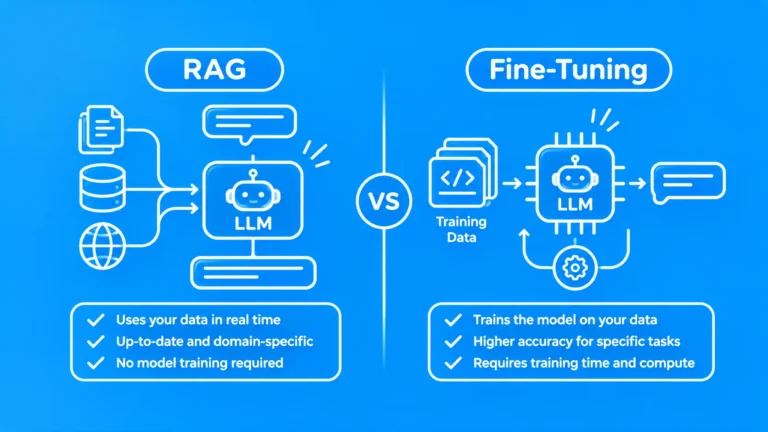
Context decides whether agents can be trusted with business decisions. A model only knows what it was trained on, so companies must feed it their own data, rules and definitions at the moment it answers.
Retrieval-augmented generation (RAG) is the most common method. RAG retrieves relevant documents from a company’s own sources and passes them to the model, so answers are grounded in current, approved information. In 2027, RAG is growing into broader “AI context platforms” that also hold business rules, permissions and shared definitions.
Gartner predicts that by 2027, organizations that prioritize semantics in AI-ready data will increase agentic AI accuracy by up to 80% and cut costs by as much as 60%. Key use cases include:
- Customer service agents that cite product manuals and policies.
- Legal and compliance tools grounded in current regulations.
- Internal search and research assistants with source tracking.
4. Multimodal and voice AI go mainstream
Multimodal AI is AI that understands and generates more than one type of data, such as text, images, audio and video, in a single model. It is now a standard feature of leading AI models rather than an experiment.
Voice is the next step. Gartner highlights speech reasoning models, which reason directly on audio and track context and intent across a conversation. These models can handle complex calls, such as claims, bookings or support, without converting everything to text first.
What it means in 2027:
- Customer service agents that can see a photo, hear a problem and act on it.
- Field workers who get guidance from AI that can view equipment through a camera.
- Clinical tools that combine imaging, notes and patient history.
5. World models and physical AI
World models are AI systems that learn how the physical world behaves, including space, time and cause and effect. They let a robot or autonomous system simulate the result of an action before taking it.
Gartner lists world models among its 2027 trends, driven by investment in robotics, autonomous vehicles and spatial computing. Examples include Google DeepMind’s Genie 3, which generates interactive environments, and NVIDIA’s Cosmos models for physical AI. Expect early impact in warehouse robotics, manufacturing and autonomous driving, where simulation reduces the cost of training in the real world.
6. Smaller, specialized and on-device models
Smaller, specialized models are gaining ground because they are cheaper, faster and easier to control than giant general-purpose models. Many business tasks do not need the largest model available.
Three types stand out:
- Small language models trained or tuned for one domain. This guide to small language model development covers when they beat larger models.
- Large quantitative models, which Gartner describes as models built for numerical and scientific data, where language models face accuracy and compliance risks.
- On-device models that run on phones, laptops and sensors with built-in neural processing units (NPUs).
Edge AI, which runs AI on or near the device that collects the data, keeps sensitive data local, cuts response times and lowers cloud costs.
7. AI governance, regulation and sovereign AI
AI governance is now a business requirement, not a side project. Governance means the policies, tests and records that keep AI systems safe, fair, legal and explainable.
Regulation is moving from text to enforcement. Under the EU AI Act, transparency rules have applied since August 2026, and obligations for high-risk use cases in sensitive areas now apply from 2 December 2027 after the EU’s AI Omnibus changes. In the US, many companies use the NIST AI Risk Management Framework as a voluntary baseline.
Sovereign AI is the other side of governance. Gartner predicts that by 2030, over 75% of non-US organizations will adopt digital sovereignty strategies to reduce geopolitical and vendor lock-in risk. In practice, that means more choice over where models run, who can access data and how easily a company can switch providers.
What changes in 2027:
- Model cards, audit logs and bias testing become standard deliverables.
- Content provenance standards such as C2PA label AI-generated media.
- Procurement teams ask for exit plans and data residency options from AI vendors.
8. Enterprise AI ROI: from pilots to workflow redesign
The question leaders care most about in 2027 is return on investment. Most companies use AI, but far fewer see it in their profit numbers.
McKinsey’s 2026 State of AI survey of 1,719 participants found that nearly nine in ten organizations use AI regularly in at least one business function. Only 44% are scaling AI across the enterprise, and only 37% report enterprise-level EBIT impact. The companies that see results tend to redesign whole workflows around AI instead of adding AI to old processes.
Metrics to track in 2027:
- Hours saved in repetitive workflows.
- Cost per resolved customer request.
- Cycle time in software delivery and testing.
- Revenue from AI-assisted sales or recommendations.
9. AI in healthcare and life sciences
Healthcare remains one of the highest-impact areas for AI, because AI now supports diagnosis, documentation and drug discovery at scale. Hospitals use AI for imaging triage, clinical scribes and patient communication, while life sciences firms use models such as AlphaFold 3 to predict protein structures.
Synthetic data is a key enabler. Synthetic data is artificial data that keeps the statistical patterns of real records without exposing real patients, and it helps teams train and test models under privacy rules. This guide to synthetic data in healthcare explains how it works in practice.
Providers that want to put these tools into production often work with a healthcare software development company that understands HIPAA, interoperability standards such as HL7 FHIR, and clinical workflows.
10. Green AI and energy-efficient computing
Green AI is the practice of building and running AI with less energy and carbon. It matters because AI’s energy use now limits where and how fast companies can scale.
The AI Index reports that AI data center power capacity reached 29.6 GW, and it estimates that training a single frontier model, Grok 4, produced about 72,816 tons of CO2 equivalent. Expect three responses in 2027:
- Low-precision inference, such as 4-bit and 8-bit formats, to cut compute per request.
- Smaller models for routine tasks, with large models kept for hard problems.
- Data centers that use renewable power, liquid cooling and waste-heat recovery.
Gartner’s list even includes “wetware as a service”, early research into biological computing for energy-efficient processing. It is far from mainstream, but it shows how seriously the industry takes the energy limit.
How to prepare your business for these AI trends
The best way to prepare for these AI trends is to pick one or two that match a real business problem and act on them now. Follow these five steps:
- Choose one high-value process, such as customer service or document review, and measure it today.
- Check your data: is it clean, connected and allowed to be used for AI?
- Set governance rules for access, testing and human review before you build.
- Run a pilot of eight to twelve weeks with clear success metrics.
- Scale what works, and retire what does not.
Summing up
The AI trends for 2027 share one theme: AI is moving from experiments to systems that run real work. Agents, context platforms and specialized models make that possible, while identity, governance and energy limits decide how far it can scale. Companies that pick one measurable use case and build the controls around it will see returns first.

Sunil Kumar is CEO of Ailoitte, an AI-native engineering company building intelligent applications for startups and enterprises. He created the AI Velocity Pods model, delivering production-ready AI products 5× faster than traditional teams. Sunil writes about agentic AI, GenAI strategy, and outcome-based engineering.
About Ailoitte