On this page
Key Takeaways
- MCP (Model Context Protocol) connects a single AI agent to tools, APIs, and data.
- A2A (Agent-to-Agent) lets separate agents discover each other and work together.
- They’re complementary, not competing: MCP is vertical (agent to tools), A2A is horizontal (agent to agent), and most production systems use both.
- Start with MCP; add A2A when one agent’s work grows into a team.
MCP vs A2A isn’t a fight between two competing standards. It’s a division of labor. The Model Context Protocol (MCP) connects a single AI agent to tools, APIs, and data. The Agent-to-Agent (A2A) protocol lets separate agents discover each other and work together. In practice, you often use both in the same system: MCP gives one agent its hands, and A2A lets many agents form a team.
That one distinction settles most of the confusion. This guide covers what each protocol does, how they work, where they overlap, and how to choose between them for a real enterprise build. If your teams are moving from single chatbots to multi-agent systems, this is the decision you need to get right early.
Building an agent or multi-agent system? Ailoitte designs MCP and A2A architectures that scale securely.
What is MCP (Model Context Protocol)?
MCP is an open standard that gives an AI agent a structured, secure way to use external tools and data. Anthropic introduced it in November 2024, and it has since become the default way to connect models to the outside world.
Think of MCP as a universal port for AI. Before it, every tool connection was custom work. A model wired to a database, a search API, and a payments system needed three separate integrations, each one rebuilt for each model vendor. MCP replaces that with one common interface. Each tool exposes an MCP server, each agent speaks MCP, and any agent can use any tool without bespoke glue code.
An MCP agent doesn’t need to know how a tool works internally. It reads what the tool offers, calls it in a predictable format, and gets back a structured response.
How MCP works
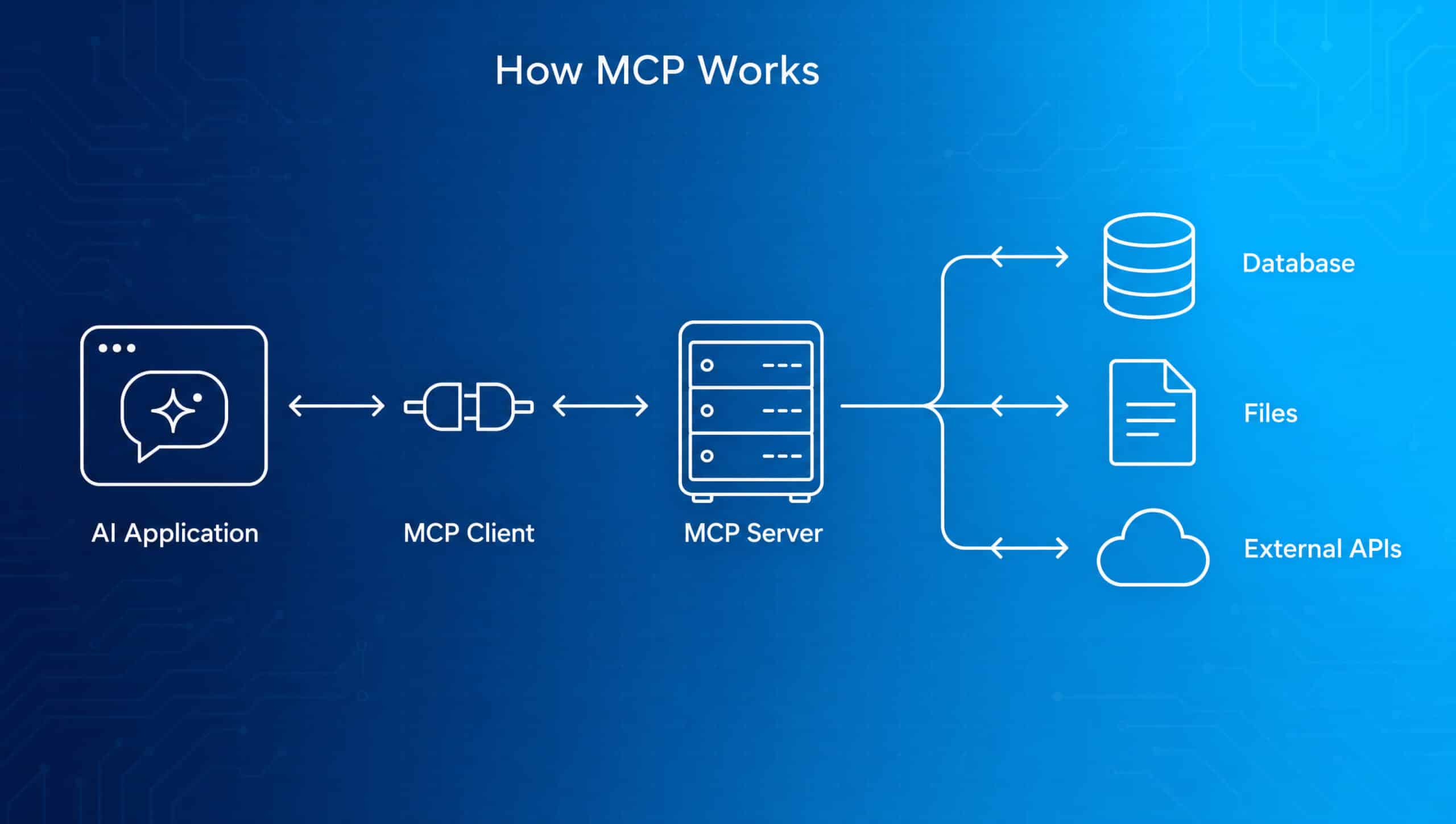
MCP uses a client-server model. The agent runs an MCP client, and each tool or data source runs an MCP server. A typical flow looks like this:
- The user asks for something the model can’t answer on its
- The agent recognizes it needs an external tool or fresh
- The agent sends a structured request to the relevant MCP
- The server checks permissions and returns the
- The agent folds that result into its working context and
The value here is control. Tool access is standardized, auditable, and reusable across models. That’s why MCP matters for regulated work, where you need to know exactly what an agent touched and why.
What is the A2A protocol (agent-to-agent communication)?
The A2A protocol is an open standard for agent-to-agent communication. It lets independent AI agents, often built by different teams or vendors, find each other, share goals, split work, and combine results. Google created A2A and released it in April 2025, then donated it to the Linux Foundation to keep it vendor-neutral.
Where MCP is about one agent using tools, A2A is about many agents cooperating. It turns a set of narrow, specialized agents into a coordinated workforce. A scheduling agent, a research agent, and a compliance agent can each own a task and hand their results to a lead agent that assembles the final output.
How A2A works
A2A agents exchange JSON messages over HTTP, usually through an A2A server. Before they can collaborate, they need a way to trust and discover each other. That’s the job of the Agent Card.
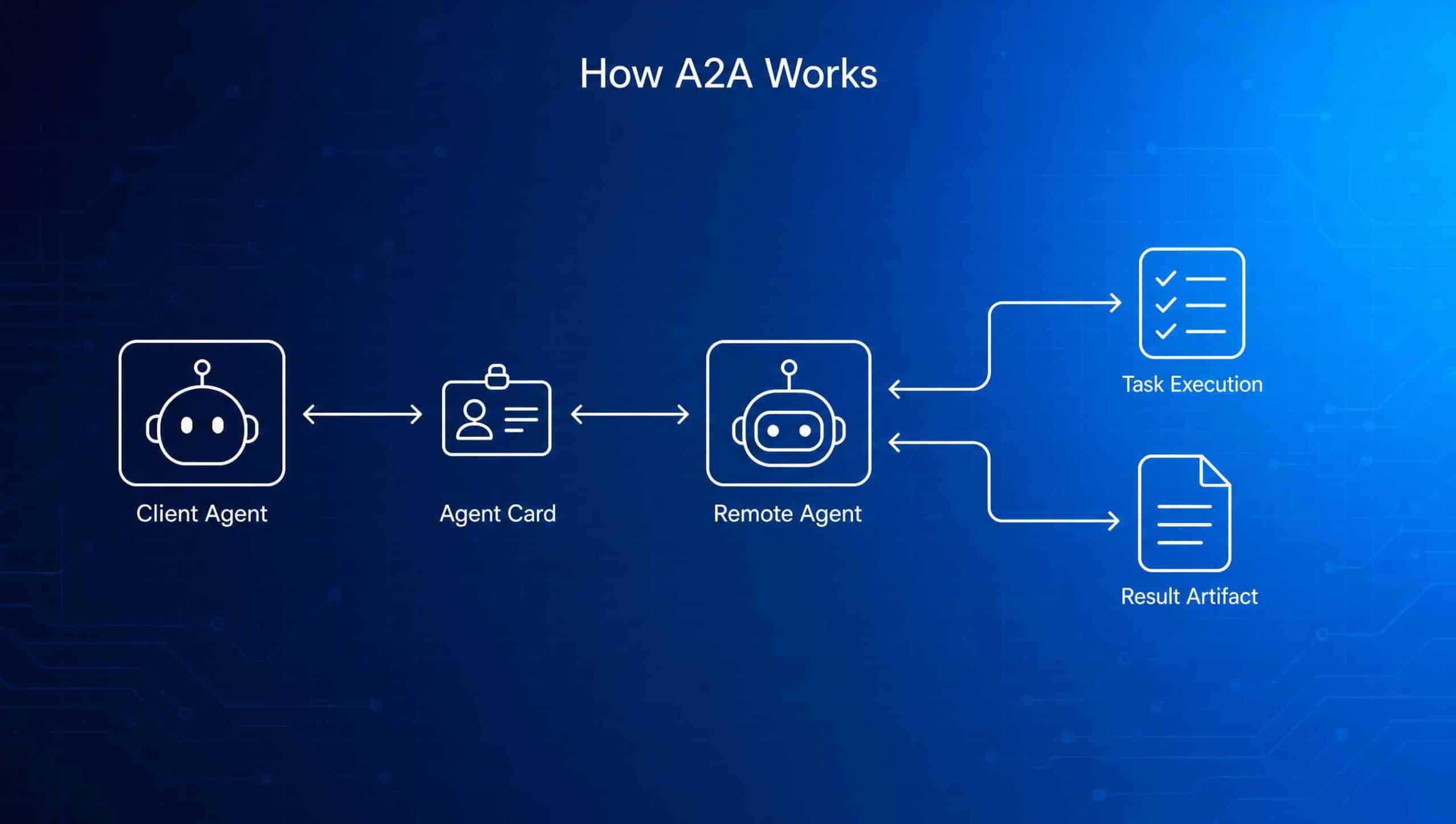
An Agent Card is a public self-description. It states what an agent can do, which protocols it speaks, and what requests it accepts, without exposing sensitive internals. A typical A2A flow works like this:
- A user gives a client agent a complex, multi-step
- The client agent breaks the task into smaller
- It reads other agents’ cards to find the right
- It sends those agents requests, and they work in
- They report progress, return outputs, and ask follow-ups if
- The client agent pulls everything together into one
This design suits large workflows where specialization and parallel work pay off. It’s the backbone of serious multi-agent systems.
MCP vs A2A: the core difference
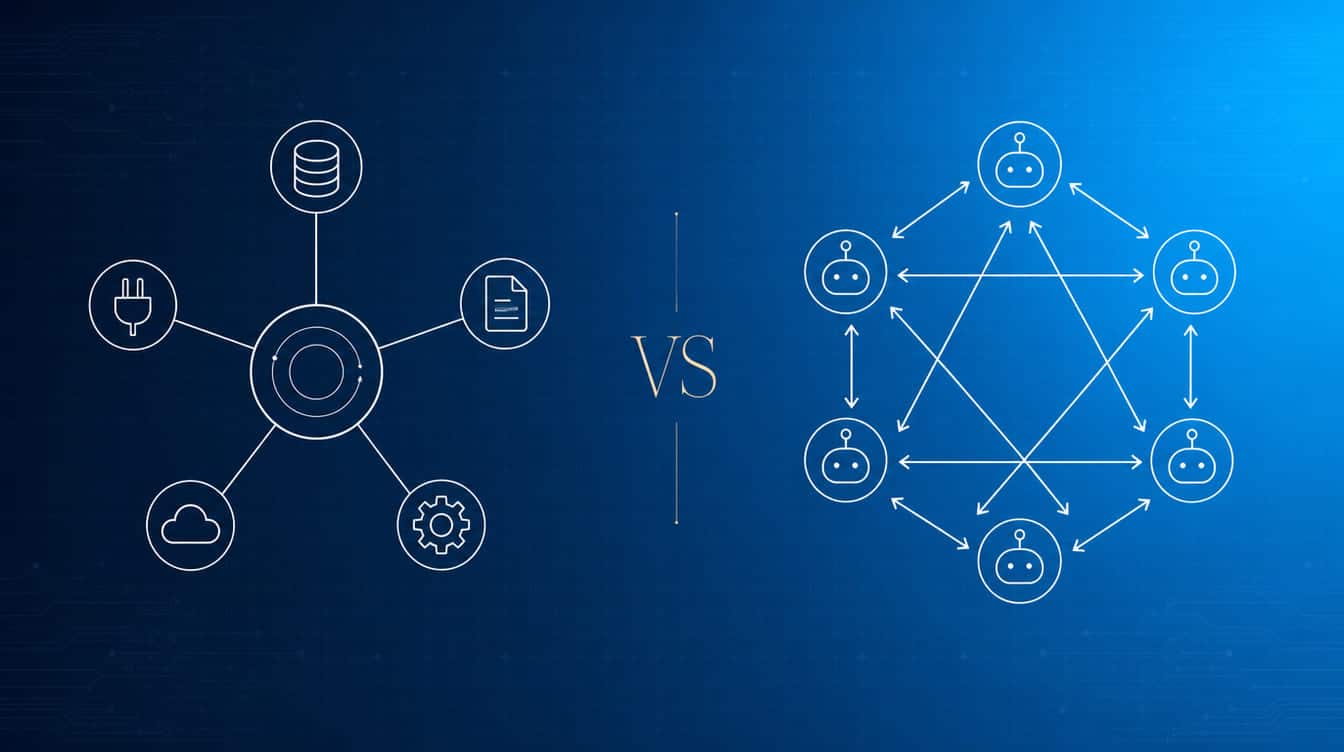
Here’s the simplest way to hold the difference in your head. MCP extends what one agent can do. A2A expands how agents work together. The first is vertical (agent to tools); the second is horizontal (agent to agent).
Here’s the side-by-side view.
| Dimension | MCP (Model Context Protocol) | A2A (Agent-to-Agent) |
|---|---|---|
| Primary purpose | Connect one agent to tools and data | Let multiple agents collaborate |
| Direction | Vertical: agent to tool | Horizontal: agent to agent |
| Core question it answers | What can this agent do? | How do these agents work together? |
| Created by | Anthropic (November 2024) | Google (April 2025) |
| Key building block | MCP client and MCP server | Agent Card and A2A server |
| Transport | Client-server, structured requests | JSON messages over HTTP |
| Best for | Tool use, data retrieval, API access | Task delegation, multi-agent orchestration |
| Governance | Agentic AI Foundation (Linux Foundation) | Agentic AI Foundation (Linux Foundation) |
Read the table and the pattern is clear: these protocols answer different questions. So in most real systems, the honest answer to “MCP vs A2A” is “both, at different layers.”
Not sure whether you need MCP, A2A, or both? Let Ailoitte’s AI engineers map the right architecture for your build.
When should you use MCP vs A2A?
Use MCP when a single agent needs to reach outside itself. Use A2A when the work is too big or too varied for one agent to handle alone. Use both when you’re building a real multi-agent product. Here’s how to decide.
Use MCP when:
- Your agent needs to query a database, call an API, or run a
- You want one standard way to connect tools across different
- You need tight control and audit trails over what an agent can
- You’re starting out and the task fits inside a single, well-scoped
Most teams should reach for MCP first. It solves the immediate problem: connecting an agent to the systems your business already runs on.
Use A2A when:
- One task splits cleanly into sub-tasks that different agents can
- Agents are built by separate teams or vendors and must
- You want agents to coordinate dynamically instead of following a fixed
- You’re scaling from one agent to a network of specialized
A2A earns its place when coordination itself becomes the hard part. If you’re wiring together agents from more than one framework or vendor, A2A gives them a shared language so they can cooperate.
Use MCP and A2A together
The strongest agentic systems combine them. A2A handles the teamwork; MCP handles the tool work. A lead agent delegates across the team through A2A, while every agent on that team pulls data and runs actions through MCP. This is the architecture most enterprise deployments are converging on.
MCP vs A2A in healthcare and fintech
In regulated industries, choosing between MCP and A2A is also a governance choice. Both protocols now sit under neutral, open governance, which matters when auditors and regulators ask who controls the standard your systems depend on.
In fintech, MCP gives a single agent controlled access to core banking APIs, transaction records, and fraud-scoring tools, with a clear record of every call. A2A lets a lending workflow split across agents: one pulls credit data, one runs risk checks, one drafts the decision, and a lead agent assembles the outcome. Financial services is already one of the verticals reporting live A2A deployments.
In healthcare, MCP lets a clinical assistant retrieve records or query a drug-interaction tool through one auditable interface, which supports the access control and traceability that compliance demands. A2A supports care-coordination workflows where an intake agent, a scheduling agent, and a records agent cooperate on a single patient journey.
The common thread: MCP keeps each agent’s data access controlled and observable, while A2A keeps multi-agent workflows coordinated. For regulated software, you usually want both, wired carefully.
Where MCP and A2A stand in 2026
Both protocols have moved from vendor projects to shared industry infrastructure, and they now share a home.
MCP has scaled fast. When Anthropic donated it to the Agentic AI Foundation (AAIF) under the Linux Foundation in December 2025, the protocol had more than 10,000 active public servers and over 97 million monthly SDK downloads. It has native support across Claude, ChatGPT, Gemini, Microsoft Copilot, VS Code, and Cursor.
A2A followed a similar path. Google donated it to the Linux Foundation in mid-2025, the v1.0 specification landed in April 2026, and the project passed 150 supporting organizations with integrations across Google, Microsoft, and AWS. In August 2026, A2A joined the same Agentic AI Foundation that governs MCP, placing both standards under one neutral umbrella.
For buyers, the takeaway is stability. Neither MCP nor A2A is a single-vendor bet anymore. Both are governed in the open, which lowers the procurement risk of building on them. Enterprise interest in agents is climbing quickly alongside this shift.
Build agentic AI systems with the right protocol
Choosing between MCP and A2A is an architecture decision, not a branding one. Get it wrong and you either over-build a single agent that should have been a team, or you scatter a fragile multi-agent system that should have started as one well-scoped agent with good tool access.
Ailoitte builds AI-native software, with deep work in healthcare and fintech, and designs agentic systems around the protocol that fits the job. That usually means MCP for controlled tool and data access, A2A for coordinating specialized agents, and both together for production-grade, auditable workflows.
If you’re planning an agent or a multi-agent system and want it built to scale securely, talk to our AI engineering team.
Conclusion
MCP vs A2A comes down to one line: MCP connects an agent to tools, A2A connects agents to each other. They’re complementary, not competing. Start with MCP to give your agent real capability. Add A2A when the work grows into a team of agents. Combine them when you’re building for production. The companies that treat this as a design decision, not a buzzword choice, will ship agentic AI that actually holds up.

Sunil Kumar is CEO of Ailoitte, an AI-native engineering company building intelligent applications for startups and enterprises. He created the AI Velocity Pods model, delivering production-ready AI products 5× faster than traditional teams. Sunil writes about agentic AI, GenAI strategy, and outcome-based engineering.
About Ailoitte