On this page
- What is agentic AI user experience?
- How is agentic AI different from chatbots and traditional automation?
- 7 ways agentic AI improves user experience
- Why are businesses investing in agentic AI user experience now?
- What are digital humans, and how do they change customer interactions?
- 5 design principles for agentic AI UX
- How to design an agentic AI experience in 5 steps?
- Where does agentic AI improve user experience by industry?
- How do you measure agentic AI user experience?
- What risks should you plan for with agentic AI?
- The future of agentic AI user experience
- Summing up
- FAQ
Agentic AI user experience is the experience people have when an AI system acts on their behalf, not just talks to them. Older chatbots answered questions from a script. AI agents now book, refund, reschedule, and recommend, and digital humans add a face and voice to those agents. This guide explains how agentic AI improves user experience, the design principles that make it work, and the risks to plan for.
What is agentic AI user experience?
Agentic AI user experience is the design of how people delegate goals to an autonomous AI system, follow what it does, and stay in control of the result. The user no longer clicks through every step. The user states an outcome, and the agent works out the path.
Agentic AI is AI that can perceive its context, reason about a goal, plan multi-step actions, and use tools such as APIs, databases, and apps to carry them out. Most agents today run on a large language model (LLM) connected to tools, memory, and business rules.
That shift moves the design problem. A traditional interface is designed screen by screen. An agentic AI experience is designed around trust: what the agent may do alone, when it must ask, and how it reports back.
How is agentic AI different from chatbots and traditional automation?
Agentic AI differs from chatbots and traditional automation because it adapts its plan to the situation instead of following predefined rules. A rule-based chatbot is like a GPS that follows a fixed route and fails at the first detour. An AI agent works more like a self-driving car: it reads the road, decides, and acts.
In his CES 2025 keynote, NVIDIA CEO Jensen Huang described agentic AI as AIs that can “perceive, reason, plan, and act”. That is the step beyond robotic process automation (RPA), which repeats the same clicks a person would make but cannot handle exceptions.
How rule-based automation, chatbots, and agentic AI compare
| Capability | RPA and rule-based automation | Traditional chatbot | Agentic AI |
|---|---|---|---|
|
Handles new situations |
No, breaks on exceptions | Rarely, falls back to a script |
Yes, adjusts the plan |
|
Takes action |
Yes, fixed steps only | Rarely, mostly answers |
Yes, across tools and systems |
|
Uses context and memory |
No | Limited to one session |
Yes, within set permissions |
|
Needs a human |
To fix failures | For anything off-script |
For high-risk or unclear cases |
|
Best for |
Stable, repeatable tasks | Simple FAQs |
Multi-step goals and service |
For a deeper side-by-side view, see this comparison of an AI agent vs. a chatbot, including when a simple chatbot is still the better choice.
7 ways agentic AI improves user experience
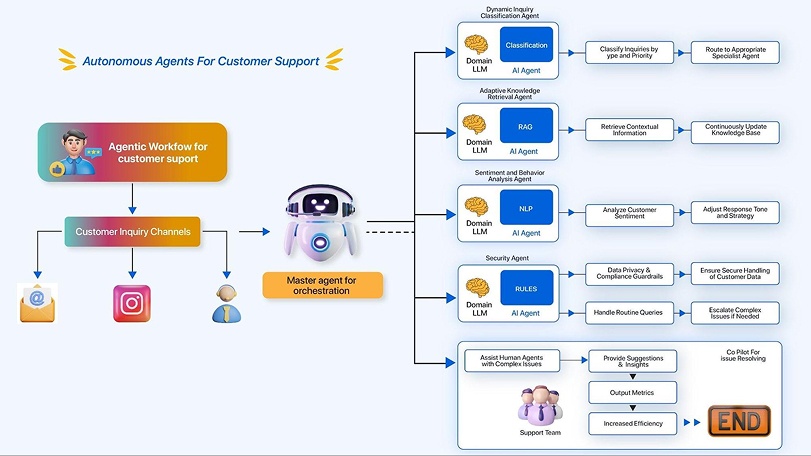
Agentic AI improves user experience in seven main ways, all of which come from the agent’s ability to act, not just respond.
1. Instant help at any hour
An AI agent responds in seconds, 24 hours a day, so users do not wait in a queue for simple requests. Night-time and weekend users get the same service as office-hours users.
2. Proactive issue resolution
Proactive resolution means the agent spots a problem before the user reports it. A delayed delivery, a failed payment, or a missed appointment can trigger a fix and a clear message without the user asking.
3. Action, not just answers
An action-oriented agent completes the task. Instead of explaining the refund policy, it checks eligibility, issues the refund, and confirms the result.
4. Personalization that fits the user
Agentic AI uses AI-driven personalization to adapt recommendations, tone, and next steps to each user’s history and preferences. The user feels understood rather than processed.
5. Support in many languages
Multilingual agents understand and reply in the user’s language, which lets one service team serve customers across many markets without separate scripts.
6. More time for human teams
Agents handle routine work such as status checks, form filling, and rebooking. Human staff then focus on complex, sensitive, or high-value conversations where judgment matters most.
7. Service that scales
Agentic AI scales with demand. A spike in requests does not need a matching rise in headcount, so the experience stays consistent during peaks.
Why are businesses investing in agentic AI user experience now?
Businesses are investing because agentic AI is moving from pilots into customer-facing products, and customer service is the first big target. Gartner predicts that agentic AI will autonomously resolve 80% of common customer service issues without human help by 2029, leading to a 30% cut in operational costs.
Enterprise IT leaders are ready to act. The UiPath 2025 Agentic AI Report, a survey of 252 US IT executives at companies with more than $1 billion in revenue, found that:
- 90% have business processes that agentic AI would improve.
- 93% are extremely or very interested in exploring agentic AI.
- 77% were prepared to invest in agentic AI in 2025.
- 37% already used agentic AI in some form.
Users expect this level of service. McKinsey’s research on personalization found that 71% of consumers expect companies to deliver personalized interactions, and 76% get frustrated when that does not happen.
What are digital humans, and how do they change customer interactions?
Digital humans are AI-powered, human-like avatars that see, listen, and speak with users in real time. A digital human combines speech recognition, a language model or AI agent, text-to-speech, and a rendered face that shows expression. Platforms such as NVIDIA ACE package these parts for developers.
Digital humans change customer interactions by adding emotion and presence to an agent. A digital human can greet a patient, guide a shopper through a product, or coach a learner, and it can read cues such as tone and pace. That makes complex or stressful conversations feel more human than typing into a chat box.
Digital humans are used most in customer service, healthcare, education, gaming, and retail. Analyst forecasts for the digital human market vary widely between research firms, so compare several reports before you build a business case on one figure.
Trust rules apply. The EU AI Act’s transparency rules, in force since August 2026, require that people are told when they are interacting with an AI system, and that AI-generated content such as deepfakes is clearly labelled. A digital human should never pretend to be a real person.
5 design principles for agentic AI UX
The success of agentic AI depends less on the model and more on how people experience it. Design is about people, and five principles keep an AI agent useful and trusted.
1. Transparency
Transparency means users can see what the agent is doing, why, and what data it uses. Show a short plain-language summary of each action, not a raw activity log. Explainable AI methods help the agent give reasons a user can check.
2. User control
User control means people can approve, pause, change, or undo what the agent does. Set approval points by risk: an agent can rebook a meeting alone, but it should ask before it spends money or deletes data. Always offer a clear opt-out.
3. Personalization with consent
Personalization should adapt to each user’s preferences, but only with data the user agreed to share. Tell users what the agent remembers and let them edit or clear that memory.
4. Empathy
Empathy means the agent, and especially a digital human, recognizes frustration or confusion and responds with the right tone. An agent that apologizes, slows down, and offers a person at the right moment builds more trust than a fast but cold one.
5. Clear failure and human handoff
Clear failure handling means the agent says what went wrong, what it already did, and what happens next. When the agent is unsure, it should hand the case to a human with the full context, so the user never has to repeat the story.
How to design an agentic AI experience in 5 steps?
Designing an agentic AI experience starts with what the agent is allowed to do, not with the chat window. Follow these five steps.
- Map the agent’s goals and authority. List every action the agent can take, and mark which ones it may do alone and which need approval.
- Set approval points by risk. Ask for confirmation on payments, data changes, and anything hard to undo, and let low-risk steps run without friction.
- Build a visibility layer. Show progress and results in plain language, with a one-tap way to see more detail.
- Design the return moment. When a user comes back to a long-running task, show what changed, what is waiting for them, and what the agent plans next.
- Test with real users and measure. Watch where people hesitate, override, or give up, and fix those moments first.
Teams that need help with the models, tools, and integrations behind these steps often work with a partner offering AI development services alongside their own product and design teams.
Where does agentic AI improve user experience by industry?
Agentic AI improves user experience most in industries with high request volumes, many repeat tasks, and a strong need for personal service.
Healthcare
In healthcare, agents handle appointment booking, intake forms, reminders, and follow-ups, while clinicians keep control of every clinical decision. Digital humans can guide patients through pre-visit questions in plain language. See how conversational AI in healthcare is already used for patient communication.
Best for: scheduling, intake, and patient follow-up.
Ecommerce and retail
In ecommerce, agents act as personal shoppers. They recommend products, compare options, track orders, and process returns in one conversation.
Best for: product discovery, order tracking and returns.
Banking and fintech
In banking and fintech, agents answer account questions, flag unusual transactions and guide users through applications, with human approval for high-value actions.
Best for: account support, fraud alerts and onboarding.
Travel and hospitality
In travel, agents plan itineraries, rebook delayed flights, and adjust bookings based on each traveller’s preferences.
Best for: disruption handling and trip planning.
Entertainment and media
In entertainment, agents personalize recommendations and power interactive characters that respond to each player or viewer.
Best for: content discovery and interactive experiences.
How do you measure agentic AI user experience?
You measure the success of an agentic experience by tracking whether tasks get done well, not just how many conversations happen. Use these metrics:
- Task completion rate without human help.
- Time to resolution compared with the old process.
- Escalation and handoff rate, and whether context carries over.
- Override and undo rate, which shows where users do not trust the agent.
- Customer satisfaction (CSAT) and repeat contact rate.
- Cost per resolved request.
Review these numbers each month, and pair them with session reviews so you can see why users override or abandon the agent.
What risks should you plan for with agentic AI?
The main risks are cost, unclear value, and weak controls, and each one hurts the user experience as much as the budget. Gartner predicts that over 40% of agentic AI projects will be canceled by the end of 2027 for these reasons. The same Gartner release still expects 33% of enterprise software applications to include agentic AI by 2028.
Plan for these risks from the start:
- Wrong or invented answers from the underlying model, which need grounding in trusted data and clear limits.
- Agents acting beyond their remit, which approval points and permissions prevent.
- Privacy and consent gaps, which need data minimization and clear user notices.
- Agent washing, where vendors rebrand basic chatbots as agents; Gartner estimates only about 130 out of thousands of agentic AI vendors are real.
- Rising running costs from model calls and integrations.
A realistic budget lowers the risk of a canceled project. This breakdown of AI agent development cost shows what drives the price of a production agent.
The future of agentic AI user experience
The future of agentic AI is intelligent, autonomous, and human-centered. Agents will handle more of the work, but people will judge them on whether they feel safe, clear, and helpful. The companies that win will design for trust first and automation second, because the goal is not just automation. The goal is technology that feels more human.
Summing up
Agentic AI user experience goes beyond automation because AI agents complete tasks, adapt to each user, and hand off to people when they should. Digital humans add a face and voice to that experience. The projects that succeed design for transparency, user control, and clear handoffs from day one, and measure results by tasks completed, not conversations held.