On this page
Most customer questions are the same few questions asked thousands of times: where is my order, can I change my booking, what is in stock. When people answer all of them by hand, queues grow, answers vary and costs rise faster than satisfaction.
This guide covers what an AI chatbot for customer service is, the full case study (challenge, solution, five-step rollout, results and technology), where chatbots help most, what customers expect from AI support, and the mistakes to avoid.
What Is an AI Chatbot for Customer Service?
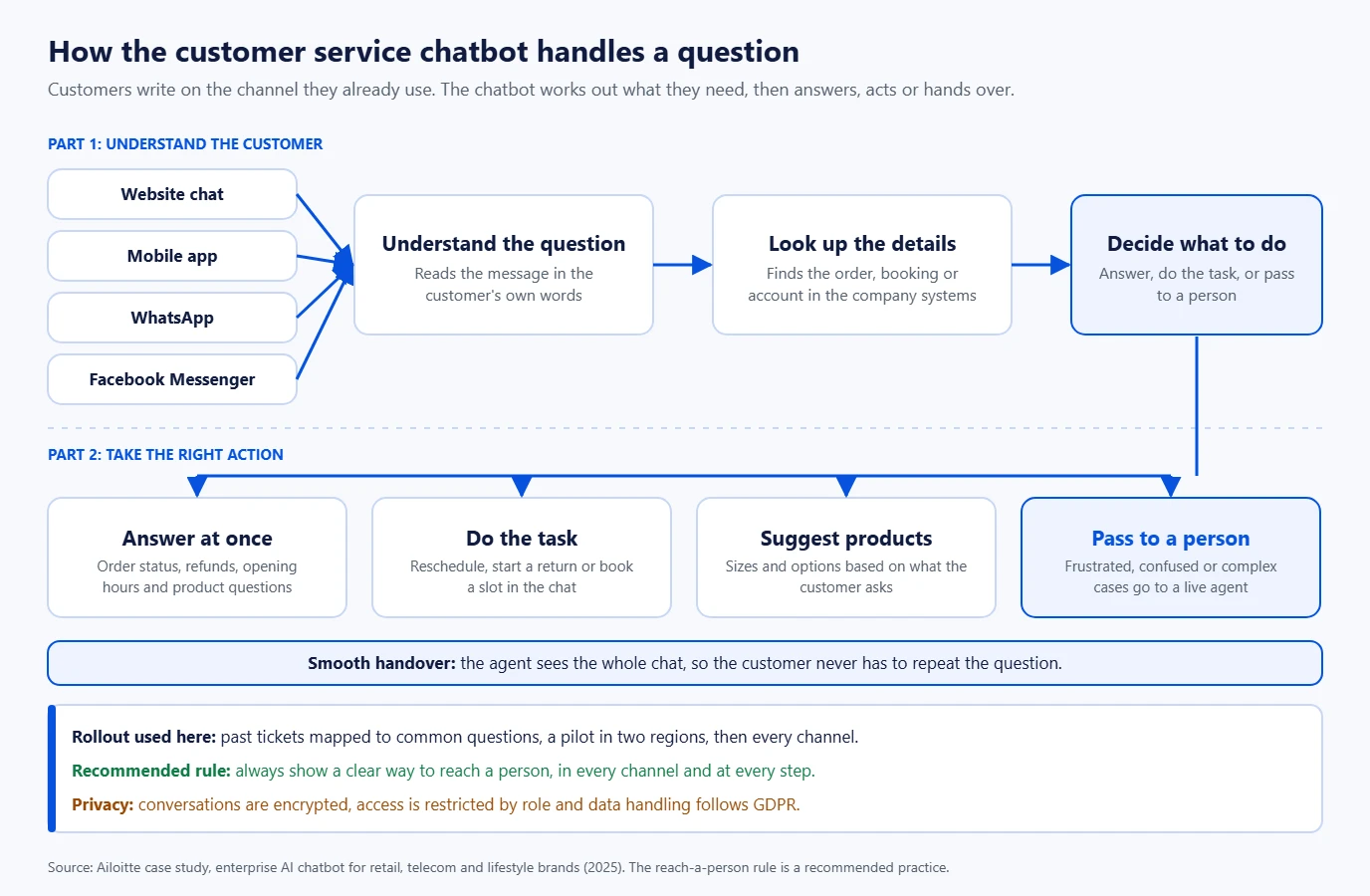
An AI chatbot for customer service is software that answers customer questions in a chat window, app or messaging channel, in plain language and at any hour. Unlike older bots that follow fixed scripts, it uses natural language processing to understand what the customer means, looks up their order or booking, and either solves the problem or passes it to a live agent.
- Understands the question: reads the message in the customer’s own words, typos included.
- Looks up the details: checks orders, bookings and accounts in the CRM and help desk through AI workflow automation.
- Takes action: tracks an order, starts a refund or reschedules an appointment inside the chat.
- Knows when to stop: hands frustrated, confused or complex cases to a person with the full conversation.
The Client: A Multi-Sector Enterprise
A large enterprise operating across retail, telecom and lifestyle brands struggled to manage a constant flow of customer queries. Manual teams answering around the clock could not keep speed and quality consistent as volumes grew, so the company partnered with Ailoitte to build an enterprise-scale AI chatbot system.
The Challenge: Support That Could Not Scale
- High volume of repetitive queries: support teams spent more than 60% of their time on the same questions, such as “What is my refund status?”, “Can I reschedule my appointment?” and “Which products are available?”
- No 24/7 support: with operations spread across time zones, customers outside office hours waited for answers.
- Inconsistent answers: separate teams in different regions varied in tone, accuracy and response time.
- Rising costs: hiring more agents to match query volume, instead of automating customer service, raised costs without improving customer satisfaction.

The Solution: A Multi-Tier AI Chatbot System
Ailoitte built one chatbot system that serves every brand and channel, with knowledge and tone tuned for each business:
- Omnichannel integration: the same chatbot works on the website, mobile app, WhatsApp and Facebook Messenger, so customers get consistent answers wherever they ask.
- Natural conversations: natural language processing lets the chatbot understand context and intent and reply naturally instead of reading static scripts.
- Domain-specific knowledge: in fashion retail the bot answers “Where is my order?” or “What size fits a 6 ft man?”; in healthcare it books appointments, accepts prescription uploads and sends follow-up reminders.
- Human escalation: when the chatbot detects frustration, confusion or a complex need, it hands the conversation to a live agent, using sentiment analysis to spot unhappy customers early.
- Learning from every chat: regular updates based on real conversations keep improving the chatbot’s accuracy and tone.
How It Was Rolled Out in Five Steps
| Step | What happened |
|---|---|
| 1. Map the questions | Past support tickets and chat logs were analysed to find the most common questions and what customers wanted. |
| 2. Design the voice | A chatbot personality was created for each business: friendly and trendy for fashion, calm and formal for healthcare, clear and supportive for education. |
| 3. Train the models | Custom machine learning models were trained on each business’s own data to handle simple requests (“Track my order”) and open-ended ones (“I can’t find my test results”). |
| 4. Pilot in two regions | The chatbot was tested side by side with the existing process in two regions to check performance and gather feedback. |
| 5. Launch and monitor | After the pilots, the chatbot went live on every channel, with real-time dashboards and performance reports. |
The Impact: Faster Answers, Lower Costs
| Measure | Result |
|---|---|
| First-level tickets | 75% fewer, because routine questions were answered at once. |
| Customer satisfaction (CSAT) | 35% higher within three months. |
| Support costs | Up to 40% lower, with less need to add agents. |
| Average response time | From 18 minutes to under 1 minute. |
Client-reported outcomes. Actual results depend on query mix, channels, data quality and how well escalation is designed.
The goal was never fewer people. It was people spending their time on the conversations that need them, while the chatbot handles the questions that only need a fast, correct answer.
Technology Behind the Chatbot
| Layer | What it does |
|---|---|
| Custom AI models | Built with TensorFlow and spaCy to sort messages by intent and write the right reply. |
| Serverless deployment | Runs on cloud infrastructure and scales up automatically during seasonal peaks and back down when traffic is quiet. |
| CRM integration | Works with existing tools such as Salesforce and Freshdesk, so agents keep their workflow. |
| Security | Encrypted conversations, strict access control and GDPR-compliant data handling. |
Where Customer Service Chatbots Help Most
| Industry | Questions the chatbot handles | Tone that works |
|---|---|---|
| Fashion and retail | Order tracking, returns, sizing and product availability. | Friendly and quick |
| Telecom | Plan changes, bill questions, outages and SIM activation. | Clear and patient |
| Healthcare | Appointment booking, prescription uploads and reminders. | Calm and formal |
| Education | Course details, enrolment steps and schedules. | Supportive and simple |
| Travel and hospitality | Booking changes, check-in times and cancellations. | Warm and precise |
What Customers Expect From AI Support
| Source | Finding |
|---|---|
| Gartner customer survey, July 2024 | 64% of 5,728 customers surveyed said they would prefer that companies did not use AI for customer service. The top concern was that AI would make it harder to reach a person. |
| Gartner prediction, March 2025 | By 2029, AI agents are expected to resolve 80% of common customer service issues without human help, leading to a 30% reduction in operational costs. |
Both findings point the same way. AI agents will take on more of the routine work, but customers only accept them when they are fast, correct and never a wall between them and a person. That is why escalation was built into this chatbot from the first version.
How Ailoitte Builds Customer Service Chatbots
Ailoitte builds AI chatbots and voice agents for retail, telecom, healthcare and service businesses, connected to the CRM, help desk and order systems already in place. Every engagement starts with a discovery workshop to map the top questions, channels and the cases that must always reach a person.
- Discover and baseline (2 to 4 weeks): we measure ticket volume, response times, CSAT and cost per contact today.
- Pilot (4 to 8 weeks, fixed price): one channel or region, real customers, and success and stop criteria agreed upfront.
- Build and run: rollout across channels with dashboards, regular model updates and 100% IP transfer to you.
- Security built in: encryption, role-based access and GDPR-ready data handling; Ailoitte is ISO 27001 and ISO 9001 certified.
- Speed: our AI Velocity Pods deliver production-ready AI 3x faster than traditional teams, with the first commit on day 5.
Newer builds can also add a large language model that answers only from your approved help content, so replies stay accurate and on brand. For an early budget view, our AI cost calculator gives an indicative estimate in minutes.
Best Practices and Common Mistakes
| Common mistake | What goes wrong | What to do instead |
|---|---|---|
| No way to reach a person | Customers feel trapped and satisfaction drops. | Show a clear handover option in every channel and at every step. |
| Handover without context | Customers repeat themselves to the agent. | Pass the full chat, order details and the detected issue to the agent. |
| Answers from unapproved content | The chatbot makes up policies or prices. | Answer only from approved help content, and update it when policies change. |
| One tone for every brand | Replies feel wrong for the audience. | Design a voice for each brand or business line. |
| Launching everywhere at once | Problems reach every customer at the same time. | Pilot in one region or channel and compare with the current process. |
| Measuring only deflection | Tickets fall but customers are unhappy. | Track CSAT, first contact resolution and repeat contacts alongside ticket volume. |
Conclusion
An AI chatbot for customer service works when it answers routine questions instantly and hands everything else to a person without friction. For this multi-sector enterprise, it cut first-level tickets by 75%, brought response times from 18 minutes to under 1 minute, raised CSAT by 35% and lowered support costs by up to 40%. Start with your most common questions, keep a person one step away, and measure satisfaction as closely as volume.

Sunil Kumar is CEO of Ailoitte, an AI-native engineering company building intelligent applications for startups and enterprises. He created the AI Velocity Pods model, delivering production-ready AI products 3x faster than traditional teams. Sunil writes about agentic AI, GenAI strategy, and outcome-based engineering.
About Ailoitte









 India
 Job Portal