On this page
Front desks spend their day on the same requests: book, reschedule, remind, answer the same questions. Every minute on hold is a patient who may not turn up. This is where AI in healthcare earns its place first: taking routine conversations off the phone so staff can focus on care.
This guide covers what an AI healthcare chatbot is, the MediChat case study (challenge, solution, four-week rollout, results and technology), where healthcare chatbots help most, the data on admin load and no-shows, safety and compliance, and the failure modes to avoid.
What Is an AI Healthcare Chatbot?
An AI healthcare chatbot is a conversational assistant that handles routine patient requests in plain language, around the clock: booking and changing appointments, sending reminders, answering common questions and routing patients to the right level of care. Unlike older menu-based bots, it understands free text and voice, connects to the hospital’s records and scheduling systems, and hands over to a person when it should.
- Always available: patients get answers during and after clinic hours without waiting on hold.
- Connected: bookings and reminders go straight into the scheduling and records systems.
- Personal: reminders and follow-up tips follow each patient’s own care plan.
- Safe: urgent symptoms and anything clinical go to a nurse or doctor, not a script.
The Client: A Healthcare Provider Modernising Patient Contact
One of the most trusted healthcare providers set out to digitize and automate how it manages appointments, communication and patient data, while keeping its high standards of care.
The Challenge: Admin Overload and Missed Appointments
- Administrative overload: staff time was dominated by tasks such as appointment scheduling, adding to burnout.
- Communication gaps: a 25% no-show rate and 15-minute hold times eroded patient trust and led to missed appointments.
- Compliance and security gaps: existing systems struggled to meet HIPAA and GDPR requirements.
- Negative patient experience: long waits and poor communication hurt satisfaction and the retention of regular patients.
The cost of doing nothing was overworked staff, lower patient satisfaction and lost revenue.

The Solution: MediChat, an AI Healthcare Chatbot
- Automated appointment booking: integration with the hospital’s systems lets patients book, cancel and reschedule appointments in the chat.
- Symptom-based routing: the chatbot asks guided questions about symptoms and directs patients to the right level of care, so urgent cases are seen first and non-urgent ones do not jump the queue. It does not diagnose.
- Medication adherence prompts: personalised reminders help patients follow their treatment plans.
- Healthcare assistance: patients can ask basic health questions at any time, during or after clinic hours.
- Data security: end-to-end encryption and HIPAA and GDPR controls protect sensitive patient information.

Take Maria, for example, a patient with diabetes who used to face long wait times and poor communication. With MediChat she can reschedule an appointment in less than 2 minutes, and she receives timely reminders and follow-up care tips.
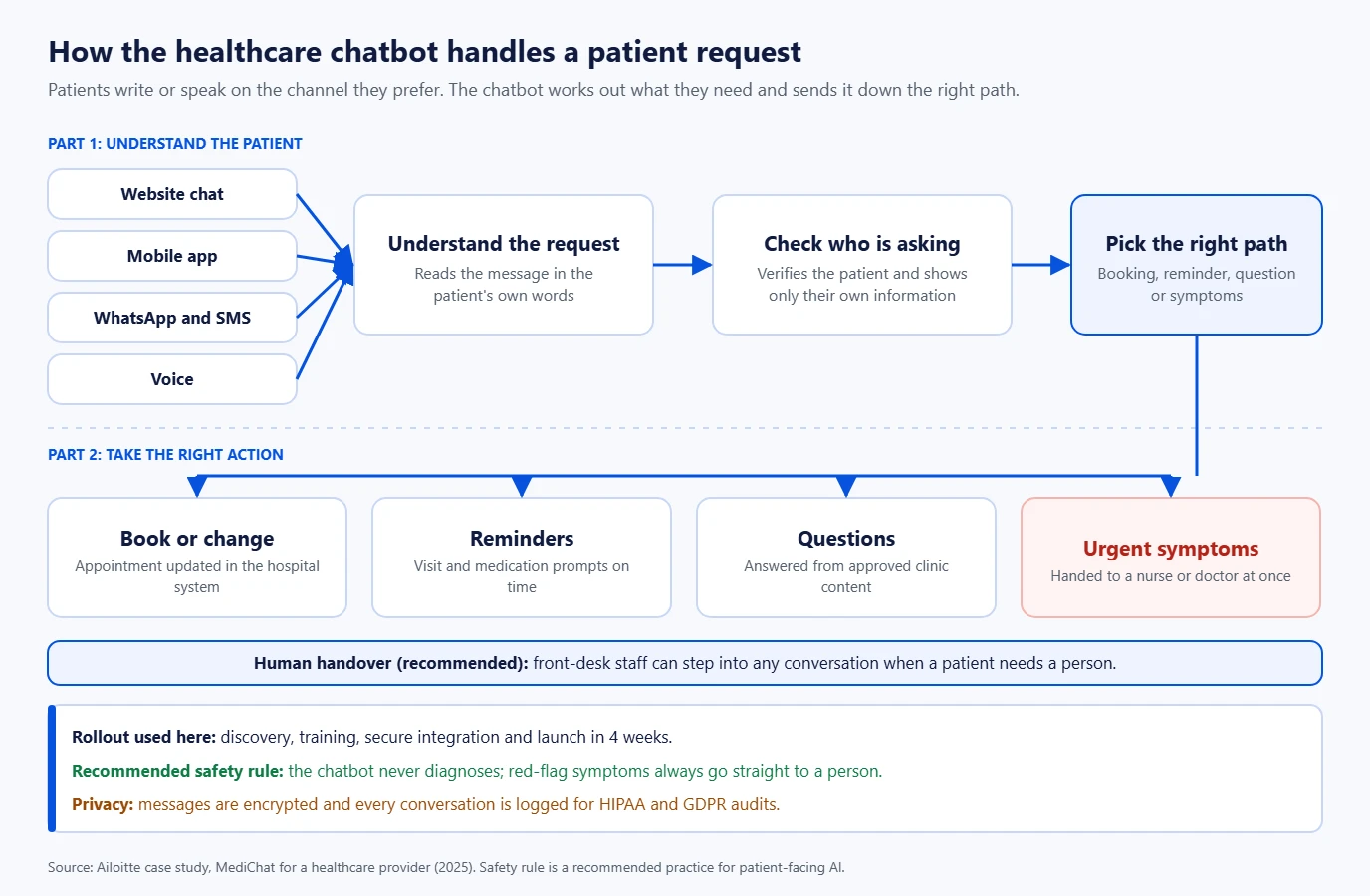
How It Was Rolled Out in 4 Weeks
| Step | What happened |
|---|---|
| 1. Discovery | Discovery and consultation: workflow analysis found and closed the main gaps. |
| 2. AI training | AI training and customisation: models were tuned to follow the provider’s medical guidelines. |
| 3. Integration | Secure integration and deployment: connected to EHRs, telehealth, billing and other tools. |
| 4. Launch and improve | Launch and continuous optimisation: the AI keeps learning to improve performance and satisfaction. |
This approach lets providers move quickly toward more advanced AI workflows.
The Impact: Less Admin, Fewer No-Shows
- 40% reduction in administrative work: more clinical time goes to patient care.
- 70% faster response: higher patient engagement and satisfaction.
- 30% fewer missed appointments: better productivity and revenue.
- 95% patient satisfaction: trust and loyalty through better support and smart call routing.
Client-reported outcomes. Actual results depend on patient mix, channels and how well the chatbot is integrated.

What Sets It Apart from Rule-Based Chatbots
| Capability | What it means for patients and staff |
|---|---|
| Adaptive AI | Answers use the patient’s own context, through natural language processing, instead of fixed menus. |
| Multichannel | The same assistant works on the website, mobile app, messaging apps and voice. |
| Intelligent routing | Urgent matters are handled first and wait times drop. |
| Scale | Cloud infrastructure built to answer more than 10,000 queries an hour. |
| EHR-connected answers | Answers based on clinical business rules use data from the EHR for accuracy. |
Technology Behind MediChat
| Layer | What we used |
|---|---|
| AI and language understanding | TensorFlow, PyTorch, spaCy and custom-trained GPT models. |
| Backend and cloud | Python, Node.js, Docker, Kubernetes, AWS, GCP and Microsoft Azure. |
| Security and compliance | Secured API integrations and encryption, built to HIPAA and GDPR standards. |
| Channels and integrations | EHRs, telemedicine platforms, WhatsApp, Facebook Messenger and SMS. |
Where Healthcare Chatbots Help Most
| Use case | What the chatbot does | What to measure |
|---|---|---|
| Appointments | Books, cancels and reschedules without a phone call. | No-show rate, call volume, time to book. |
| Reminders | Sends visit, test and medication reminders. | Attendance, refill and adherence rates. |
| Patient questions | Answers opening hours, preparation and billing questions from approved content. | Share of questions resolved without staff. |
| Routing | Asks guided questions and sends patients to the right service. | Wait time for urgent cases, correct routing rate. |
| Follow-up | Checks in after a visit or discharge, alongside AI clinical documentation and flags concerns. | Readmissions, follow-up completion. |
| Admin intake | Collects forms, insurance details and consent before the visit. | Front-desk time per patient. |
What the Data Says About Admin Load and No-Shows
| Source | Finding |
|---|---|
| American Medical Association, 2024 data | US physicians work 57.8 hours a week on average, including 13 hours of indirect patient care such as documentation and 7.3 hours of administrative tasks such as prior authorization and forms. |
| BMC Health Services Research, 2016 | Across 10 clinics at a US VA medical center the mean no-show rate was 18.8%, at an average cost of $196 per missed appointment. |
Every hour returned from admin work and every appointment that is kept goes straight back to patient care and revenue, which is why scheduling and reminders are usually the first chatbot use cases to pay back.
Safety and Compliance for Patient-Facing AI
- HIPAA: a Business Associate Agreement with every vendor that handles patient data, encryption, access controls and audit logs.
- GDPR: a clear legal basis and consent for processing health data, data kept in the right region, and patients able to see and delete their data.
- Clinical safety: the chatbot routes and informs; it does not diagnose. Red-flag symptoms always go straight to a nurse or doctor.
- FDA: software that tells patients what condition they have or what treatment to take can be regulated as a medical device. The FDA updated its clinical decision support guidance in January 2026, so check where your features fall before launch.
- EU AI Act: people must be told when they are talking to an AI system, not a person.
For background, see AAMI’s summary of the January 2026 FDA guidance update, and our two guides below.
How Ailoitte Builds Healthcare Chatbots
Ailoitte builds AI chatbots and voice agents for hospitals, clinics and digital health companies, connected to their scheduling, records and messaging systems. Every engagement starts with a discovery workshop to map patient journeys, compliance needs and the requests that take most staff time.
- Discover and baseline (2 to 4 weeks): we measure call volumes, hold times, no-shows and admin hours today, so every result can be compared.
- Pilot (4 to 8 weeks, fixed price): one clinic or department, real patients, and success and stop criteria agreed upfront.
- Build and run: rollout across sites and channels, human handover by design and 100% IP transfer to you.
- Security built in: HIPAA and GDPR controls; Ailoitte is ISO 27001 and ISO 9001 certified.
- Speed: our AI Velocity Pods deliver production-ready AI 3x faster than traditional teams, with the first commit on day 5.
For an early budget view, our AI cost calculator gives an indicative estimate in minutes.
Common Failure Modes and How to Avoid Them
| Failure mode | What goes wrong | How to prevent it |
|---|---|---|
| No human handover | Patients get stuck in a loop and call anyway, angrier. | Offer a person at any point and pass the full conversation over. |
| Answers beyond its remit | The bot drifts into medical advice it should not give. | Limit answers to approved content and route clinical questions to staff. |
| Not connected to scheduling | The bot takes requests that staff still re-enter by hand. | Integrate with the EHR and scheduling system before launch. |
| One channel only | Patients who prefer WhatsApp or phone never use it. | Launch on the channels your patients already use, including voice. |
| Reminders that annoy | Too many messages and patients opt out. | Set sensible timing and let patients choose how often to hear from you. |
| No measurement | Nobody knows whether no-shows or call volumes changed. | Baseline the key numbers first and review them monthly. |
Conclusion
A well-built healthcare chatbot takes the routine work off the front desk and gives patients fast answers on the channels they already use. For this provider, MediChat cut administrative work by 40%, missed appointments by 30% and response times by 70%, with 95% patient satisfaction. Keep it connected, keep a person one tap away, and keep clinical decisions with clinicians.

Sunil Kumar is CEO of Ailoitte, an AI-native engineering company building intelligent applications for startups and enterprises. He created the AI Velocity Pods model, delivering production-ready AI products 3x faster than traditional teams. Sunil writes about agentic AI, GenAI strategy, and outcome-based engineering.
About Ailoitte








 India
 Job Portal