



The cost of NFT marketplace development services has increased as more and more people began tokenizing things like paintings, music, videos, logos, and collectibles. According to The Financial Times, there are around 360,000 people who own NFTs and trade them in NFT marketplaces.
A non-fungible token (NFT) marketplace is a digital platform where creators can store, display, trade, or sell their NFTs. Many investors and creators purchase/sell digital assets as NFTs on these marketplaces, so that various buyers can buy those assets with cryptocurrencies or fiat currencies. Some top NFT marketplace examples are OpenSea, Rarible, NBA, Binance, Nifty Gateway, and SuperRare.
Using this trend as a business opportunity requires an expert understanding of the market requirements and competition as these factors will make it easy for you to create your own NFT marketplace at a price point that doesn’t hurt your financial goals.
How Much Does it Cost to Create an NFT Marketplace?
The NFT marketplace development cost in 2024 depends on several factors listed below.
- Number & Types of Features
- Tech Stack
- NFT Developers
- Development Duration
Here is an average breakdown of the costs involved in building a non-fungible token marketplace like OpenSea:
| Cost Estimation to Build an NFT Marketplace | |
| Development | Cost |
| User Profiles | $2500 to $5000 |
| Search and Filters | $5000 to $10,000 |
| Home Page | $5000 to $10,000 |
| Product Page | $2500 to $5000 |
| Reviews & Ratings | $2500 to $5500 |
| UX/UI Development | $3000 to $6000 |
| Authorization and Security | $4000 to $8500 |
| Inventory Management | $3000 to $6000 |
| Buyer Panel | $3000 to $8500 |
| Shopping Cart | $3500 to $6000 |
| Payments | $3000 to $6000 |
| Notifications | $2000 to $4500 |
| Author Panel | $6000 to $15,000 |
| Admin Panel | $5000 to $10,000 |
| Total | $50,000 to $106,000 |
Essential Features That Affect the NFT Marketplace Development Cost
Every basic or advanced feature you need/add will increase the development cost of your NFT website. We recommend sticking to the core features in the first version to go easy on the development budget.
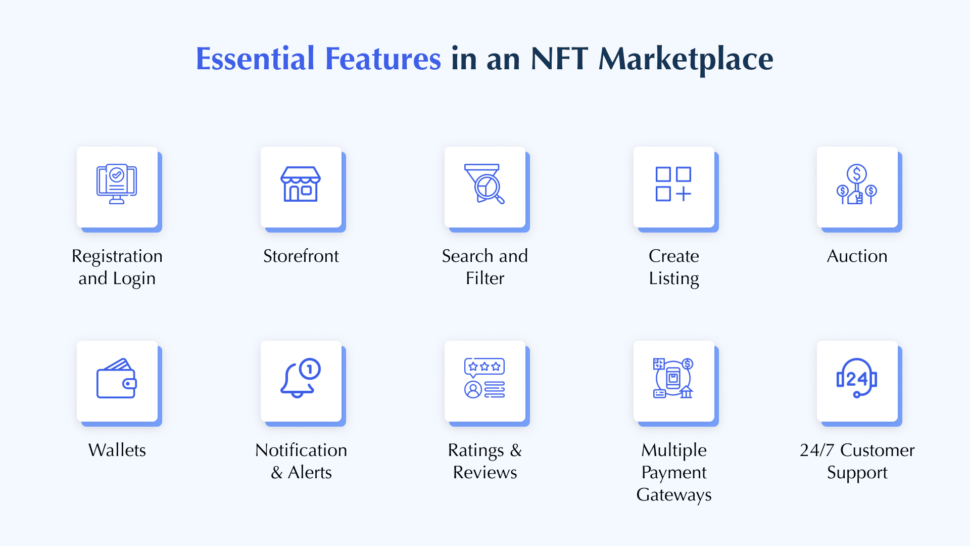
Registration and Login
New users should be able to secure their activities by creating a private account on your non-fungible token marketplace platform. Users can easily log in to the platform to access it once the registration is complete.
Storefront
The storefront feature in the non-fungible token marketplace includes information about NFT owners, bids, previews, rates, NFT descriptions, and price history.
Search and Filter
The search and filter feature will help users find digital assets like collectibles and videos. The filter will further narrow the search and make things more convenient for users, especially if you categorize everything on your NFT website. Filter options can include price, most popular, and exclusive offer factors.
Create Listing
This feature helps users create a listing of digital assets with the title, price, tags, and description.
Auction
The auction feature helps generate more traffic to the digital assets on sales. It provides information about assets like expiration date, tokens, seller name, payment methods, image, number of bids, bid duration, bid amount, and bid status. The real-time auction speeds up the sale of digital assets.
Wallets
Users can use a wallet to store, send, exchange, and receive NFTs and cryptocurrencies on your platform. Providing a wallet removes the need for external payment gateways that can make things inconvenient. You can also integrate popular third-party wallets with your NFT website to make payments easier for a global customer base.
Notification & Alerts
This feature will send personalized notifications/alerts to users about the latest NFTs, upcoming auctions, and new collectibles.
Ratings & Reviews
Both sellers and buyers can benefit from a Ratings and Reviews feature on your non-fungible token marketplace platform. The ratings and reviews of a seller can help provide proof of their credibility. Users can quickly select reliable and trustworthy sellers by checking the ratings and reviews section.
Multiple Payment Gateways
Your NFT marketplace app should provide multiple payment gateways like credit cards, debit cards, PayPal, Crypto wallets, and Stripe.
24/7 Customer Support
A 24/7 customer support service will make every process on your NFT website easy for users. You may also collect valuable user feedback through customer support.
How Custom NFT Marketplace Affects the Development Cost
A custom NFT Marketplace requires a professional team of developers, resources, and a process to meet all business goals. Here is a quick overview of that approach:
Finalizing Business Niche
You must analyze the NFT marketplace business, your business requirements, and market demand to choose a niche that can succeed/survive in the market. This process can take up time and would require the assistance of a business analyst.
Development Team
The right development team is crucial to answering how to create an NFT marketplace that can meet market requirements. You can hire an in-house team, however, that would increase business costs, time, resources, and maintenance, or outsource the development to the best NFT marketplace development company you can find. Outsourcing to offshore NFT developers from India is highly recommended. They provide quality solutions for affordable development rates.
UI/UX Design
User interface and user experience are the most crucial aspects of your NFT marketplace platform. They are the first impression of your platform and determine the user-friendly qualities of your app or website. App design is also responsible for customer satisfaction and retention. You may have to be flexible with the budget during UI/UX design since it is essential for the long-term success of your NFT marketplace website.
Frontend and Backend Development
Your NFT website niche, requirements and resources, business goals, and UI/UX design determine the duration of the front-end and back-end development. It will have a significant impact on the cost.
QA & Testing
The testers are responsible for ensuring that the functionality of your platform meets market expectations. Custom NFT marketplace development will require multiple tests to ensure good functionality. You must prepare your budget for this process as it is necessary for quality assurance.
Launch
Custom NFT marketplace development services should also include a launch strategy with the help of a business analyst and marketing strategist. A strategic launch strategy helps put an unavoidable spotlight on your NFT marketplace platform, and the process may cost a lot.
How Tech Stack Affects the Cost of NFT Marketplace Development
You must plan a development budget for the NFT marketplace tech stack before the development begins. A plan that keeps the tech stack available until the marketplace website succeeds in the market. Some tech stacks you will need for an NFT website are free, and some are paid. You should check the pricing for those tech stacks according to your requirements.
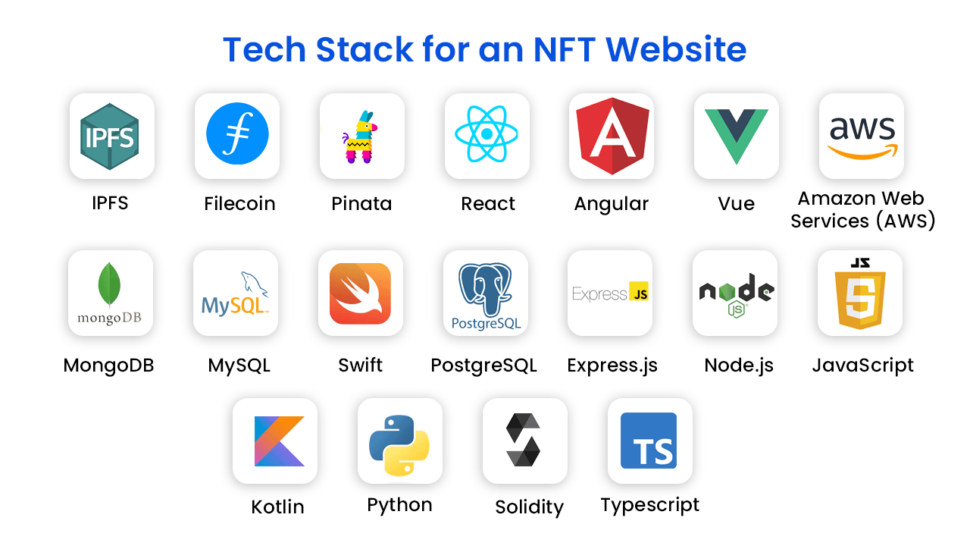
Your NFT Marketplace may need more or less tech stack than mentioned above, and they will increase/decrease the development costs accordingly.
Some tech stacks may be free, but the trained developers using those stacks will cost you if you want it done right. It is best to outsource to an established NFT marketplace application development company. All you have to do is pay their usual development cost for your business requirements, and they will take care of every process (such as planning, tech stack, development, marketing, and launch).
Development Teams Cost for NFT Marketplace
Hiring development teams can require you to spend most of your NFT marketplace development budget. An average salary of a US software developer starts at $73,999 per year and increases to $100,000 and $200,000. You will need a flexible budget to meet such salary requirements. Outsourcing to onshore developers will also bring the same results, but outsourcing to nearshore developers may split the difference.
The best option is outsourcing to offshore developers from Ukraine, Romania, and India.
Here is a cost breakdown of NFT development in these countries:
| Cost Breakdown of NFT Marketplace Development per Hour | ||
| Country | Junior Developers | Senior Developers |
| Ukraine | $20 to $25 | $40 to $50 |
| Romania | $15 to $20 | $30 to $50 |
| India | $15 to $20 | $30 to $50 |
Your NFT marketplace requirements will determine the final cost of development, no matter which development team you choose. Therefore, choose ones with experience, credible portfolios, and fair development costs.
How Development Duration Affects the Cost
Hours required for your NFT marketplace development impact the development budget significantly. You must hire professionals and use the Agile methodology to manage timely deliveries. Although, there will be times when your NFT marketplace project development gets extended, and the costs will increase due to the extended use of the tech stack and developer hours.
| NFT Marketplace Cost Estimation Based on $40 per Hour | ||
| Features | Hours | Cost |
| User Profile | 45 hours | $1800 |
| Homepage | 80 hours | $3200 |
| Authorization & Security | 80 hours | $3200 |
| UI or UX | 80 hours | $3200 |
| Search & Filter | 80 hours | $3200 |
| Product Page | 50 hours | $2000 |
| Notification | 50 hours | $2000 |
| Shopping cart | 50 hours | $2000 |
| Inventory Management | 55 hours | $2200 |
| Payment Gateway | 62 hours | $2480 |
| Ethereum Integration | 100 hours | $4000 |
| Buyer’s Panel | 70 hours | $2800 |
| Author Panel | 125 hours | $5000 |
| Admin Panel | 90 hours | $3600 |
| Total | 1017 hours | $40680 |
Conclusion
You need to analyze your business requirements, determine the type of NFT marketplace, design requirements, number of features, and target audience, and hire a development team to get an approximate development cost for an NFT marketplace.
Share your requirements and goals with NFT development experts like Ailoite to get your project started now. We house an experienced team of developers that can meet your expectations and create a marketplace that can outperform the competition.
Frequently Asked Questions
An NFT marketplace is a blockchain-based digital platform where you can buy, store, exchange, or sell NFTs. Users can buy or sell digital assets like collectibles and videos as NFTs using cryptocurrency or money.
At Ailoitte, our experienced developers and team can quickly analyze your business requirements and develop a lucrative NFT marketplace for you.
NFT marketplace development cost depends on your business requirements, number and types of features, design requirements, development team, and development location. You can know the approximate cost once you have all this information. The average development cost of the NFT marketplace is between $50,000 and $150,000.
Registration and Login, Storefront, Search & Filters, Creating Listings, Wallets, Ratings & Reviews, Auction and Buy, Notification & Alerts, Multiple Payment Gateways, and 24/7 Customer Support.
You can explain the business requirements for the NFT marketplace to multiple development companies when you interview them and choose those who understand those requirements well, present good portfolios and have a fair price range for development. Talk to experts from Ailoitte to get started with your NFT Marketplace.

Share this article:
Leave a Reply






100+
Project Launched

80+
Happy Clients

18+
Countries Served

91%
Returning client base



.png)
.png)
.png)



Leave a Comment