On this page
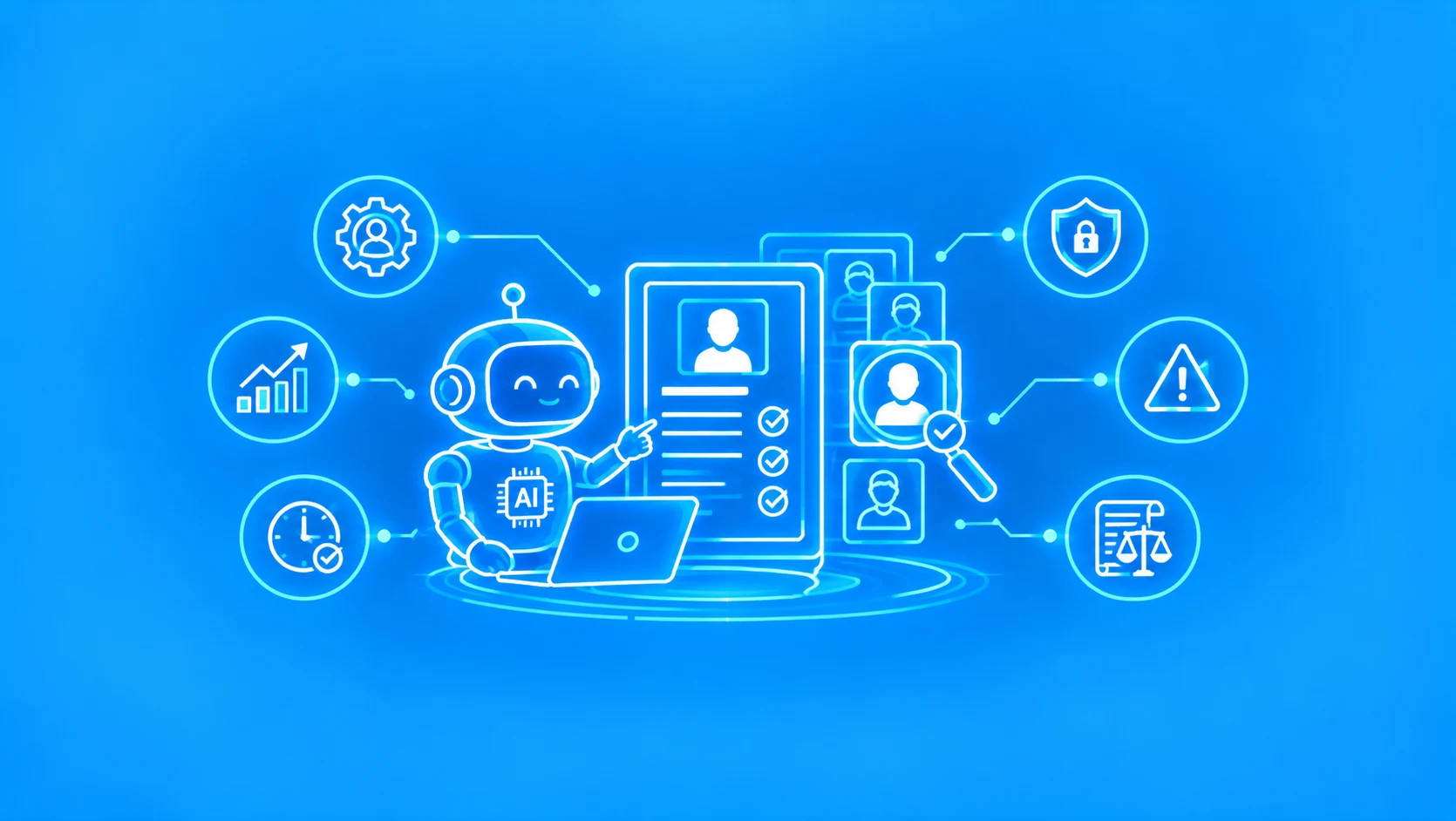
Hiring teams face more applications than ever, and much of the work to sort them is repetitive. AI in the hiring process takes on that work: it reads resumes, matches skills to roles, books interviews, and answers candidate questions at any hour.
Done well, AI shortens hiring cycles and makes screening more consistent. Done badly, it copies old biases at scale and can break new laws. This post covers how AI works at each stage of hiring, its benefits and risks, the laws that apply in 2026-27, real examples, and a step-by-step plan to adopt it.
What is AI in the hiring process?
AI in the hiring process means using software that learns from data to automate or support recruiting tasks. It usually sits inside or alongside an applicant tracking system (ATS), the software most employers already use to post jobs and track applicants.
Four technologies do most of the work. Machine learning (ML) finds patterns in past hiring data to rank and match candidates. Natural language processing (NLP) reads resumes, job descriptions, and chat messages. Generative AI drafts job ads, outreach emails and interview questions.
AI agents are the newest layer. An AI agent chains several steps together, such as screening a candidate, booking an interview and sending reminders, within rules the employer sets. Together, these tools form what many teams call AI talent acquisition.
The goal is not to replace recruiters. It is to remove the manual sorting that fills their week, so they can spend more time talking to the right people.
Why does the hiring process need AI?
Traditional hiring is too slow and too manual for today’s application volumes. Manual resume screening and phone pre-screens create delays, and good candidates accept other offers while they wait.
Recruiters can spend around 23 hours screening applications for a single hire. Many employers also report that qualified candidates are hard to find.
Employers are responding. In SHRM’s State of AI in HR 2026 research, recruiting was the most common use of AI in HR, at 27% of organizations. HR technology followed at 21% and learning and development at 17%.
The most common problems with traditional hiring are:
- Recruiters spend hours on repetitive tasks such as sorting resumes and booking calls.
- Resumes give little insight into soft skills or long-term potential.
- Human bias and fatigue lead to uneven evaluation.
- Slow replies and missing updates create a poor candidate experience.
AI addresses each of these problems. It cuts manual effort, applies the same criteria to every applicant and keeps candidates informed.
Where does AI fit in each stage of hiring?
AI is used at every stage of hiring, from finding candidates to onboarding new hires. Most employers start with resume screening, job ads and interview scheduling, because those steps are high-volume and easy to measure.
Where AI fits in each stage of hiring
| Hiring stage | What AI does | Where humans stay involved |
|---|---|---|
| Sourcing | Searches databases and profiles for people who match the role | Approve target lists and outreach |
| Job ads | Drafts job descriptions and flags biased wording | Check accuracy and tone |
| Screening and matching | Parses resumes and ranks applicants against job criteria | Review shortlists and rejections |
| Assessments | Scores skills tests and work samples | Set criteria and review edge cases |
| Scheduling | Books interviews across calendars and time zones | Handle exceptions |
| Interviews | Transcribes calls and drafts structured notes | Run interviews and decide |
| Candidate questions | Answers FAQs and sends status updates through chatbots | Step in on complex questions |
| Fraud checks | Flags identity mismatches and scripted answers | Verify and decide |
| Onboarding | Guides new hires through paperwork and first tasks | Welcome and mentor |
Where generative AI and AI agents fit
Generative AI creates content, while AI agents complete tasks. A generative AI tool writes a job ad when a recruiter asks for one. An AI agent can screen applicants, book interviews, and send follow-ups with little prompting.
The difference matters when you choose a tool. A simple FAQ chatbot only answers questions, while an agent takes actions inside your systems. This comparison of AI agent vs chatbot explains the trade-offs in more depth.
Because agents act on their own, they need clear limits, audit logs, and a human approval step before any rejection or offer. Teams that want an agent shaped around their own hiring workflow often work with custom AI agent development services rather than buying a generic tool.
What are the benefits of AI in hiring?
The main benefits of AI in hiring are faster hiring, better matches, lower cost per hire, more consistent screening and a better candidate experience. Each benefit depends on clean data and human oversight.
Faster time-to-hire
AI shortens time-to-hire by automating resume filtering, shortlisting, and scheduling. Tasks that took recruiters days can run in minutes, so strong candidates hear back before they accept other offers.
Better candidate matching
AI improves matching by comparing skills, experience, and job requirements across every application, not just the ones a recruiter has time to read. Skills-based matching also surfaces people with non-traditional backgrounds who fit the role.
Lower cost per hire
AI lowers cost per hire by reducing manual screening hours and agency spend. Better matches also cut the cost of bad hires and early turnover.
More consistent screening
AI applies the same criteria to every applicant, which reduces the inconsistency that comes from fatigue and gut feel. It can reduce bias when it scores job-related qualifications rather than demographic signals. It does not remove bias on its own, because a model trained on biased data repeats that bias, so bias testing is still required.
Better candidate experience
AI improves the candidate experience by answering questions instantly and sending regular status updates through chatbots and automated messages. Faster replies mean fewer drop-offs during long hiring processes.
What are the risks of AI in the hiring process?
The biggest risks of AI in the hiring process are algorithmic bias, opaque decisions, privacy breaches, overreliance on automation, candidate fraud and legal liability. Poor implementation can make hiring less fair, not more.
Algorithmic bias
Algorithmic bias happens when an AI model learns unfair patterns from historical hiring data. If past hires skewed toward one group, the model can keep favoring that group.
Amazon learned this the hard way. According to Reuters’ 2018 report on Amazon’s experimental recruiting tool, the system taught itself to penalize resumes that mentioned women, and the company scrapped it.
Lack of transparency
Many AI hiring tools cannot explain why they ranked or rejected a candidate. That gap erodes trust and makes legal challenges harder to defend.
Explainable AI shows the factors behind each score. It helps recruiters check, question, and justify each decision.
Data privacy
AI hiring tools process resumes, test results and sometimes video recordings, all of which are personal data. In the EU, Article 22 of the General Data Protection Regulation (GDPR) gives people the right not to be subject to decisions based solely on automated processing that significantly affect them.
In India, the Digital Personal Data Protection Act, 2023 (DPDP Act) sets rules for notice, consent, and data security. Employers need clear candidate consent and strict access controls in every market.
Overdependence on automation
Relying only on AI removes human judgment from decisions that need it. Qualities such as empathy, leadership potential and team fit still need human assessment. AI should support hiring decisions, not make them alone.
Candidate fraud and AI-written applications
Candidates now use AI too, which makes real ability harder to judge. A Gartner survey of job candidates found that 39% used AI during the application process, and only 26% trusted AI to evaluate them fairly.
Gartner also predicts that by 2028, 1 in 4 candidate profiles worldwide will be fake. Identity checks and at least one live interview step help counter this.
Legal and compliance risk
Employers, and increasingly vendors, can face legal claims when AI hiring tools discriminate. In the US, the Mobley v. Workday case alleges that Workday’s AI screening tools discriminated against applicants by race, age, and disability. Workday denies the claims, and the case remains active.
Regular bias audits, written records of how each tool is used, and human review are the best defense.
What laws govern AI in hiring in 2027?
AI hiring laws now exist in several US jurisdictions and in the EU. Most require some mix of bias testing, notice to candidates and human oversight. The rules differ by location, so employers should check every place they hire.
Key AI hiring laws in November 2027
| Law | Where | What it requires | Status |
|---|---|---|---|
| Local Law 144 | New York City | Annual independent bias audit, public summary, candidate notice | In force since July 2023 |
| HB 3773 | Illinois | No discriminatory AI use, no zip code proxies, notice of AI use | In force since January 2026-27 |
| AI Video Interview Act | Illinois | Notice, explanation, and consent before AI analyzes video interviews | In force since January 2020 |
| SB 26-189 | Colorado | Developer documentation, employer notice, review rights | Takes effect January 2027 |
| AI Act, Annex III | European Union | Risk management, documentation and human oversight for recruitment AI | Applies from December 2027 |
| GDPR Article 22 | European Union | Limits on solely automated decisions with significant effects | In force |
| DPDP Act | India | Notice, consent and security duties for personal data | Rules phasing in |
New York City moved first. Local Law 144 bars employers from using an automated employment decision tool unless it has passed an independent bias audit within the past year. The audit summary must be public, and candidates must get advance notice. The city’s guidance on automated employment decision tools sets out the audit rules.
In the EU, the AI Act (Regulation (EU) 2024/1689) classifies AI used to place job ads, filter applications and evaluate candidates as high-risk. The Digital Omnibus (Regulation (EU) 2026/1744) moved those obligations from August 2026 to December 2027, but it did not remove them. The official text of the EU AI Act lists the employment use cases in Annex III.
In Illinois, HB 3773 has made discriminatory AI use in employment decisions a civil rights violation since January 2026. Colorado replaced its original AI Act with SB 26-189, which takes effect in January 2027.
This section is a summary, not legal advice. Check with employment counsel in each place you hire.
Human and AI: how do you find the right balance?
The right balance is AI for routine work and humans for judgment. Use automation to sort, schedule and update, and keep people in charge of every decision that changes a candidate’s outcome.
- Automate routine tasks such as screening, scheduling and status updates.
- Keep final decisions human-led, especially for soft skills and team fit.
- Review a sample of AI rejections every week, not just the shortlist.
- Train HR teams on what each tool can and cannot do.
- Keep real conversations at the interview and offer stages.
The goal is to use AI to support better decisions, not to remove human insight from hiring.
How do leading companies use AI in hiring?
Large employers use AI to screen high volumes of applicants, match people to roles, and answer candidate questions. These five examples show both the gains and the lessons.
Unilever: video interviews and game-based assessments
Unilever uses AI-scored video interviews from HireVue and online game-based assessments to screen early-career applicants at scale. HireVue’s case study reports a 90% cut in time to hire and a 16% rise in diversity hires.
HireVue stopped analyzing facial expressions after concerns about bias, as SHRM reported in its coverage of HireVue discontinuing facial analysis. The lesson: even proven tools need regular review.
IBM: skills-based matching
IBM uses AI to match candidates and employees to roles based on skills, experience and learning potential, and it gives recruiters real-time recommendations. IBM reports that the approach has improved internal mobility and reduced turnover.
LinkedIn: talent matching and a hiring assistant
LinkedIn uses AI to suggest candidates to recruiters based on job requirements and profile activity, and to predict who is most likely to respond. It has also introduced Hiring Assistant, an AI agent that drafts searches and shortlists for recruiters.
Hilton: recruiting chatbot
Hilton uses an AI chatbot to answer candidate questions, pre-screen applicants, and schedule interviews. The chatbot keeps applicants moving without manual recruiter follow-up.
Apna: AI job matching on mobile
Apna, a job search and networking platform in India, uses an AI recommendation engine to match job seekers to openings by skills, experience, and preferences. In-app chatbots help with applications and interview preparation. This look at how Apna uses AI in recruitment covers the platform in more detail.
How to adopt AI in hiring: 7 steps
The safest way to adopt AI in hiring is to start small, test for bias before launch and keep humans in charge of decisions. These seven steps work for startups and enterprises alike.
- Start with one bottleneck. Pick the step that costs the most time, such as resume screening or scheduling, and set one clear goal, such as time-to-hire or recruiter hours saved.
- Check your data and systems. AI is only as good as its data, so clean your past hiring records and confirm the tool connects to your ATS and HR systems.
- Choose tools that explain their scores. Ask vendors how the model ranks candidates, what data trained it, and whether it has passed an independent bias audit.
- Test for bias before launch. Compare selection rates across groups on historical data, using a measure such as the four-fifths rule, and fix gaps before real candidates are affected.
- Tell candidates and get consent. Explain where AI is used, what it assesses, and how to request a human review, as New York City, Illinois, and the EU require.
- Keep humans on every decision. Let AI recommend, and let people approve every rejection, advancement, and offer.
- Monitor, train, and re-audit. Track outcomes by group, retrain HR teams on each tool, and repeat the bias audit at least once a year.
Step 2 matters more each year, because hiring systems are converging. This look at the ATS and CRM software future explains where these platforms are heading.
Should you build or buy an AI hiring tool?
Buy when an off-the-shelf tool fits your process, and build when your workflow, data or compliance needs are specific. Off-the-shelf tools are faster to start. Custom tools fit your ATS, your criteria, and your audit needs more closely.
The build vs buy AI agent comparison walks through cost, control, and time to value.
How Ailoitte helps businesses hire smarter
Ailoitte is one option for companies that want a custom AI hiring tool rather than an off-the-shelf product. As an AI development company, it designs and builds screening, matching, and scheduling tools around each client’s own workflow.
- Custom AI tools for resume screening, candidate scoring, chatbots, and interview scheduling, built around the client’s hiring workflow.
- Integration with existing HR software, applicant tracking systems and internal databases, so hiring data stays in one place.
- Bias-aware design, with diverse training data, bias safeguards and data privacy controls.
- Recruiter dashboards that track performance, diversity metrics, and process efficiency.
- Ongoing support to tune the tools as hiring needs change.
For candidate-facing recruitment platforms, Ailoitte also offers mobile app development services for job search and application apps.
Summing up
AI in the hiring process works best as an assistant: it sorts, matches, schedules, and answers questions so recruiters can spend their time on people. Its value depends on clean data, explainable tools, regular bias audits, and human decisions at every step that matters. With AI hiring laws in force in New York City and Illinois, and EU rules applying from December 2027, responsible use is no longer optional.

Sunil Kumar is CEO of Ailoitte, an AI-native engineering company building intelligent applications for startups and enterprises. He created the AI Velocity Pods model, delivering production-ready AI products 5× faster than traditional teams. Sunil writes about agentic AI, GenAI strategy, and outcome-based engineering.
About Ailoitte