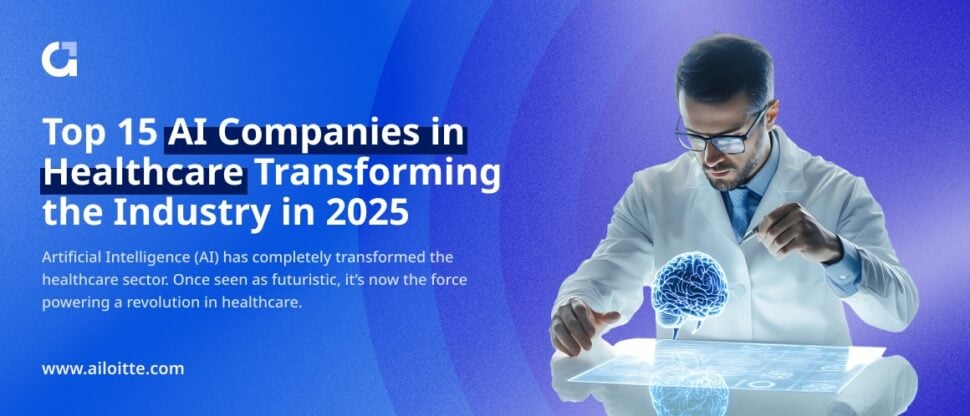
Artificial Intelligence (AI) has completely transformed the healthcare sector. Once seen as futuristic, it’s now the force powering a revolution in healthcare. AI is changing every aspect of the medical ecosystem, from improving hospital workflows and personalizing treatment plans to diagnosing illnesses with fantastic accuracy. What was once experimental is now essential.
AI provides a lifeline in the form of quicker insights, more intelligent decisions, and scalable solutions as global healthcare systems struggle with aging populations, growing costs, and data overload.
The use of AI in healthcare, from natural language processing to machine learning, allows for quicker and more precise analysis of medical data, improving patient outcomes. Both startups and industry giants are pushing the boundaries, transforming not only the way healthcare organizations function but also the way care is provided.
This blog features top 15 AI healthcare companies that are not only developing but also putting important real-world solutions into practice. These organizations are influencing the future of healthcare and establishing new standards for medical innovation.
Why AI Matters in Healthcare?
Artificial intelligence (AI) is a primary force behind the transformation of healthcare and is no longer just a futuristic idea. AI provides solutions that traditional systems cannot match with the growing volume of medical data, patient expectations, and the need for quicker, less expensive care.
- Faster & More Accurate Diagnosis: AI models examine lab data, imaging scans, and patient histories to identify illnesses more quickly and accurately than humans alone.
- Predictive & Preventive Care: AI helps physicians in anticipating health problems, such as cancer, heart attacks, or strokes, before they become serious by identifying risk patterns.
- Drug Discovery & Clinical Trials: AI increases drug development by finding promising compounds, decreasing research time, and improving the effectiveness of clinical trials.
- Operational Efficiency: AI is used by hospitals to automate scheduling, reduce administrative load, and optimize workflows so that physicians can spend more time with patients.
- Personalized medicine: By using AI-driven insights, treatments can be customized to a patient’s genetics, lifestyle, and health information to improve results.
The advantages of AI in healthcare are indisputable, despite obstacles like data privacy, ethical issues, and high implementation costs. It is quickly evolving from a “nice-to-have “to a “mission-critical” necessity for patients, researchers, and providers everywhere.
Now let’s get to the blog’s primary goal, where we will learn about the top 15 AI healthcare companies in 2025.
Top 15 AI Healthcare Companies in 2025
Leading the charge to transform the healthcare sector is artificial intelligence (AI). These ten healthcare AI companies are revolutionizing treatment, diagnosis, and patient care.
1. Ailoitte

Founded: 2017
Regions Served: 20+ Countries.
Top Clients: Apna, BankSathi, Reveza, iPatientCare, EaseCare & AssureCare MedCompass & more.
Office Addresses:
- India: Bengaluru Urban, Karnataka, India – 560102
- USA: Delaware, United States – 19901
Contact Details:
- India: +91 – 7251027270
- USA: +1 – (302) 608-0009
Ailoitte is one of the AI healthcare companies leading the way in AI-powered healthcare innovation. The company offers advanced AI solutions and healthcare software development services that drive the healthcare industry’s digital transformation. Ailoitte uses AI-powered platforms, machine learning models, and predictive analytics to boost operational effectiveness, optimize hospital administration, and improve patient outcomes. Their solutions are used across a variety of healthcare applications, including telemedicine, patient engagement, predictive healthcare analytics, and AI-driven diagnostics.
Key Highlights:
- Healthcare digital transformation solutions powered by AI.
- Prioritize enhancing care delivery, patient engagement, and hospital administration.
- Data analytics tools to predict patient outcomes and improve treatment.
- Strong emphasis on AI-powered patient engagement and telemedicine.
- Smooth integration with the hospital’s current workflows and systems.
Services:
- AI-powered healthcare analytics and predictive tools.
- Hospital management and workflow optimization solutions.
- Telemedicine app development for virtual care and patient monitoring.
- Patient engagement tools to enhance communication and care coordination.
- Integration and implementation support for healthcare organizations.
Want to explore how AI can transform your healthcare business?
2. IBM Watson Health

One of the first AI healthcare companies to offer AI-powered healthcare solutions is IBM Watson Health. The company uses AI and ML to help doctors with precision medicine, drug discovery, and decision-making.
Key Highlights:
- AI-powered decision support systems for healthcare professionals.
- NLP and RAG in healthcare for understanding medical texts and research.
- Data-driven insights for personalized treatment plans.
- Global partnerships with healthcare organizations and pharmaceutical companies.
- Focus on improving patient outcomes and reducing healthcare costs.
Services:
- AI-driven clinical decision support.
- Population health analytics.
- Personalized medicine tools for treatment planning.
- Drug discovery solutions.
- Clinical trial matching platforms.
3. Tempus

As a leader in precision medicine, Tempus uses AI & ML to evaluate clinical and molecular data to customize cancer treatment. To help physicians in making better decisions regarding patient care, the company’s AI platform integrates clinical and genomic data.
Key Highlights:
- AI for genetically based personalized cancer treatment.
- Integration of clinical and molecular data for better decision-making.
- Predictive analytics for identifying high-risk patients.
- Collaboration with major healthcare providers and pharmaceutical companies.
Services:
- Molecular data analysis for cancer treatment.
- AI-driven clinical trial matching.
- Data analytics for precision medicine.
- Genetic testing and diagnostic services.
- Predictive analytics tools for patient outcomes.
4. PathAI

PathAI is one of the leading AI healthcare companies transforming pathology to help pathologists in diagnosing conditions like cancer. To improve patient outcomes, its AI-powered platform examines pathology slides and assists clinicians in making more precise diagnoses.
Key Features:
- Disease detection using AI-powered pathology slide analysis.
- Prioritize increasing the precision of cancer and other condition diagnoses.
- Collaboration with hospitals and research institutions.
- Faster diagnosis through integration with clinical workflows.
Services:
- AI-powered pathology diagnostics.
- Cancer detection and diagnostic support.
- Integration with hospital pathology departments.
- Clinical decision support tools for pathologists.
5. Zebra Medical Vision

Zebra Medical Vision is among the AI healthcare companies specializing in AI-powered medical imaging solutions. Its deep learning algorithms examine radiology scans to identify more than 40 conditions, such as neurological disorders, cancers, and cardiovascular diseases.
Key Highlights:
- AI-powered radiology tools for identifying diseases.
- Focus on neurological, cancer, and cardiovascular conditions.
- Real-time imaging analysis to make diagnoses more quickly.
- Strong alliances with insurance companies and healthcare providers.
Services:
- AI-powered medical imaging analysis.
- Radiology diagnostic tools for disease detection.
- Real-time reporting and decision-making support.
- Customizable imaging solutions for hospitals and healthcare systems.
6. Aidoc

Aidoc is one of the AI healthcare companies that empowers radiologists with real-time AI-powered diagnostic tools. By improving the speed and precision of medical imaging, the platform specializes in assisting in the detection of critical conditions like fractures, hemorrhages, and strokes.
Key Highlights:
- AI-powered real-time diagnosis for serious illnesses.
- Focuses on trauma and stroke detection.
- Smooth interaction with current workflows in radiology.
- Reduces emergency care treatment time.
Services:
- AI-powered diagnostic tools for radiology.
- Real-time imaging analysis for stroke and trauma.
- Support for hospital workflow integration.
- Emergency care diagnostic tools for fast decision-making.
7. Voxello

Voxello is a unique player among AI healthcare companies, focusing on improving communication for patients with speech impairments. Its AI-drive Voiceitt platform is especially useful in critical care environments.
Key Highlights:
- AI-powered voice recognition for patients with speech impairments.
- Focus on improving communication between patients and healthcare providers.
- Designed for use in critical care units and emergency departments.
- Enhances patient engagement and care delivery.
Services:
- Voice recognition software for speech-impaired patients.
- Virtual assistants for patient-provider communication.
- Implementation support for hospitals and care facilities.
- Clinical training and onboarding for healthcare teams.
8. Butterfly Network

Butterfly Network has completely transformed ultrasound technology by developing the Butterfly iQ, a portable ultrasound device driven by AI. Clinicians can perform high-quality scans at the point of care with this device.
Key Highlights:
- AI-powered portable ultrasonography device.
- Allows for real-time diagnostics and imaging analysis.
- Portable and affordable, improving access to ultrasound technology.
- Works seamlessly with existing clinical workflows.
Services:
- AI-powered portable ultrasound devices.
- Point-of-care diagnostic solutions.
- Cloud-based imaging platform for data storage and analysis.
- Training and support for healthcare professionals.
Let’s co-create AI-powered healthcare platforms that improve lives and reduce costs.
9. Cleerly

Cleerly is a digital health company revolutionizing heart disease care. Their artificial intelligence (AI)-powered digital care platform uses coronary computed tomography angiography (CCTA) imaging to detect and characterize atherosclerosis early, allowing physicians to create individualized treatment regimens for patients.
Key Highlights:
- Focuses on coronary artery disease analysis powered by AI.
- Uses non-invasive evaluation with CCTA imaging.
- Gives resources for creating individualized treatment plans.
- Works together to integrate technology with healthcare providers.
Services:
- AI-powered digital health platform for analyzing heart disease.
- Complete measurement of atherosclerosis.
- Support for clinical workflow integration.
- System updates and technical assistance.
- Partnerships with medical professionals.
10. Viz.ai

Viz.ai is an AI-powered emergency care platform with a focus on stroke detection. Better patient outcomes and quicker intervention are made possible by its technology, which automates CT scan analysis and instantly notifies clinicians.
Key Highlights:
- AI-powered CT scan analysis for real-time stroke detection.
- Workflow automation for faster clinical decision-making.
- Focus on emergency care and critical conditions.
- Seamless integration with hospital imaging systems.
Services:
- AI-driven stroke detection and alert system.
- Emergency care workflow optimization.
- Integration with hospital imaging and IT systems.
- Real-time reporting and decision support tools.
11. AIRS Medical

One of the AI healthcare companies with a focus on robotics and AI imaging solutions is AIRS Medical. SwiftMRTM, their flagship product, is an AI-powered MRI enhancement tool that improves image quality and speeds up scan times. In the US, SwiftMRTM has been approved by the FDA under 510(k) to support images with up to 50% scan time reductions.
Key Highlights:
- Focuses on robotics and artificial intelligence solutions for medical imaging.
- Created AI-powered MRI enhancement tool SwiftMRTM.
- The FDA granted SwiftMRTM 510(k) clearance to reduce MRI scan times up to 50%.
- Offices in the US, Europe, Japan, and South Korea.
- Collaborate with medical professionals to incorporate AI into clinical procedures.
Services:
- MRI enhancement solutions driven by AI.
- Support for clinical workflow integration.
- System updates and technical assistance.
- Partnerships with medical professionals.
12. Sensely

Sensely is a well-known name among AI healthcare companies that develop virtual assistants with AI capabilities. Its platform offers real-time symptom assessments, chronic disease management, and interactive dialogues with patients.
Key Highlights:
- AI-powered virtual assistant for healthcare advice.
- Focus on chronic disease management and patient engagement.
- Symptom checker tools for real-time patient assessment.
- Enhances healthcare accessibility and patient interaction.
Services:
- Virtual assistant for symptom assessment and advice.
- Remote patient monitoring tools for chronic conditions.
- Healthcare provider engagement tools.
- Integration support for healthcare systems.
13. GE HealthCare

GE HealthCare is one of the most trusted AI healthcare companies, offering digital healthcare tools, imaging systems, ultrasound equipment, and patient monitoring solutions. With products made for a range of clinical applications, such as radiology, cardiology, and critical care, the company assists healthcare providers.
Key Highlights:
- Offers a large selection of diagnostic and medical imaging services.
- Emphasizes applications in critical care, cardiology, and radiology.
- Provides integrated software, hardware, and support services.
- Collaborates with healthcare providers to streamline processes.
- Broad portfolio that covers a variety of clinical domains.
Services:
- Medical imaging and diagnostics equipment.
- Ultrasound systems for various medical applications.
- Patient monitoring and data analytics tools.
- Training and education for healthcare professionals.
14. CureMetrix

CureMetrix helps radiologists identify breast cancer more precisely and earlier by using AI and computer vision to improve mammography interpretation. Its platform improves diagnostic accuracy by analyzing mammograms and offering extra insights.
Key Highlights:
- AI-powered mammography analysis for breast cancer detection.
- Focus on reducing false positives and false negatives.
- Real-time diagnostic insights to improve clinical decision-making.
- Integration with hospital imaging systems.
Services:
- AI-driven mammography analysis tools.
- Diagnostic support for breast cancer detection.
- Integration with hospital radiology departments.
- Continuous software updates and clinical support.
15. Caption Health

Caption Health is a healthcare technology company focused on developing artificial intelligence solutions for diagnostic ultrasound. The company provides tools designed to guide healthcare professionals in capturing and interpreting ultrasound images, making it possible for clinicians with limited ultrasound experience to perform scans effectively.
Key Highlights:
- AI-driven solutions for ultrasound imaging.
- Real-time guidance for image acquisition and interpretation.
- Designed for use by clinicians in diverse medical settings.
- Partnerships with healthcare organizations for integration.
- Focus on early diagnosis of medical conditions.
- Compatible with existing clinical workflows.
Services:
- Ultrasound guidance software solutions.
- Training and onboarding for clinical teams.
- Integration support for healthcare systems.
- Technical support and software updates.
- Data analytics for clinical insights.
- Assistance with regulatory compliance and implementation.
What makes Ailoitte stand out as a Top AI Healthcare Company?
Ailoitte’s patient-first approach to AI-driven healthcare innovation is what really makes it stand out in AI healthcare. Ailoitte develops modern solutions that seamlessly integrate into hospital workflows and produce measurable improvements in clinical and operational outcomes.
Patient-centric care is highly valued at Ailoitte. Better communication, remote monitoring, and personalized treatment plans are made possible by its AI-driven engagement tools. To protect patient data, the company also takes a proactive approach to data privacy and compliance, integrating its solutions with healthcare laws like HIPAA and GDPR.
Healthcare organizations of all sizes, from big hospitals to small clinics, can use Ailoitte’s AI-powered solutions without worrying about universal standards. Ailoitte helps organizations modernize without replacing their legacy infrastructure, ensuring seamless integration with current EHRs and hospital systems.
Lastly, Ailoitte’s proven expertise in predictive analytics and telemedicine has helped healthcare providers in improving access to care in underprivileged areas. Ailoitte positions itself as a trusted partner driving the digital transformation of healthcare by fusing technical excellence with a dedication to moral and impactful AI.
Conclusion
More than just a trend, the integration of AI in healthcare is a revolutionary movement that is influencing the future of medicine. These companies are leading the way in using AI to improve patient outcomes, streamline processes, and address global health issues. Their efforts not only demonstrate AI’s promise but also inspire faith in its ability to improve healthcare.
Instead of just following the AI trend, the top 15 AI healthcare companies featured in this blog are helping to shape it in their own revolutionary ways.
In 2025 and beyond, AI will play a solid role in improving accessibility, reducing costs, and providing individualized care in response to the growing demand for digital healthcare.
FAQs
Healthcare AI refers to the use of artificial intelligence technologies such as machine learning, natural language processing, and computer vision, to improve medical care. It helps analyze huge amounts of health data, support clinical decision-making, automate administrative tasks, and enhance patient outcomes.
AI is important in healthcare because it helps doctors and hospitals analyze large amounts of medical data quickly, leading to faster and more accurate diagnoses. It improves treatment personalization, predicts disease risks, and enhances patient monitoring.
AI benefits healthcare the most in diagnostics, personalized treatment, drug discovery, and operational efficiency. It helps detect diseases early through medical imaging, customize treatment plans based on patient data, accelerates drug development, and streamlines hospital workflows.
AI can’t replace doctors but can support them. It helps with data analysis and faster decisions, while doctors provide empathy, judgment, and human care.
Healthcare AI companies ensure data privacy by using strong encryption, anonymizing patient data, and following strict regulations like HIPAA and GDPR. They implement secure access controls, regular audits, and compliance frameworks to prevent unauthorized use.
Implementing AI in healthcare comes with challenges like ensuring data privacy and compliance with regulations such as HIPAA and GDPR. Healthcare data is often fragmented and unstructured, making integration difficult.
Yes, there are risks associated with using AI in healthcare. These include potential biases in algorithms leading to inaccurate diagnoses, data privacy and security concerns, and overreliance on technology that may reduce human oversight.
Beyond 2025, AI in healthcare is expected to advance in areas like predictive analytics, personalized treatment plans, and generative AI-assisted diagnostics. Robotics-assisted surgery and AI-powered virtual health assistants will become more common.
The future of AI in healthcare is highly promising, with technologies set to enhance diagnostics, personalize treatments, and improve patient outcomes. AI will enable predictive analytics, faster drug discovery, and more efficient hospital operations.

Discover how Ailoitte AI keeps you ahead of risk

Divyesh Sharma
Divyesh is a GenAI-powered Content Marketer recognized for producing high-impact content, visuals, and SEO-driven campaigns. He blends AI creativity with data-backed strategies to deliver measurable results.
Have a Project in Mind? Let’s Talk.
Explore More


Our Work
We are the trusted catalyst helping global brands scale, innovate, and lead.











Real Stories. Real Success.
-

"It's fair to say that we didn’t just find a development company, but we found a team and that feeling for us is a bit unique. The experience we have here is on a whole new level."
-



“Ailoitte quickly understood our needs, built the right team, and delivered on time and budget. Highly recommended!”

Priyank Mehta
Head Of Product, Apna

"Ailoitte expertly analyzed every user journey and fixed technical gaps, bringing the app’s vision to life.”

Jitendra Dhaka
CEO, Banksathi

“Working with Ailoitte brought our vision to life through a beautifully designed, intuitive app.”
“Ailoitte brought Reveza to life with seamless AI, a user-friendly experience, and a 25% boost in engagement.”
 India
India Job Portal

"Ailoitte understood our requirements immediately and built the team we wanted. On time and budget. Highly recommend working with them for a fruitful collaboration."
Priyank Mehta
Head of product, Apna
Ready to turn your idea into reality?
- India
- FinTech

On paper, Banksathi had everything it took to make a profitable application. However, on the execution front, there were multiple loopholes - glitches in apps, modules not working, slow payment disbursement process, etc. Now to make the application as useful as it was on paper in a real world scenario, we had to take every user journey apart and identify the areas of concerns on a technical end.
Jitendra Dhaka
CEO, Banksathi
Ready to turn your idea into reality?
- India
- HealthTech
“Working with Ailoitte was a game-changer for us. They truly understood our vision of putting ‘Health in Your Hands’ and brought it to life through a beautifully designed, intuitive app. From user experience to performance, everything exceeded our expectations. Their team was proactive, skilled, and aligned with our mission every step of the way.”
Saurabh Arora
Director, Dr.Morepen
Ready to turn your idea into reality?
- India
- RetailTech
“Working with Ailoitte was a game-changer. Their team brought our vision for Reveza to life with seamless AI integration and a user-friendly experience that our clients love. We've seen a clear 25% boost in in-store engagement and loyalty. They truly understood our goals and delivered beyond expectations.”
Manikanth Epari
Co-Founder, Reveza
Ready to turn your idea into reality?
- India
- HealthTech

“Ailoitte truly understood our vision for iPatientCare. Their team delivered a user-friendly, secure, and scalable EHR platform that improved our workflows and helped us deliver better care. We’re extremely happy with the results.”

Dr. Rahul Gupta
CMO, iPatientCare
Ready to turn your idea into reality?
- India
- EduTech

"Working with Ailoitte was a game-changer for us. They truly understood our vision of putting ‘Health in Your Hands’ and brought it to life through a beautifully designed, intuitive app. From user experience to performance, everything exceeded our expectations. Their team was proactive, skilled, and aligned with our mission every step of the way."
Saurabh Arora
Director, Dr. Morepen
Ready to turn your idea into reality?

Quality Management
System



Information Security
Management System
Information Security
Management System
Quality Management
System




















Share Your Thoughts