On this page
A connected device can switch off your lights, track a delivery truck, or reorder groceries. When the same kind of technology monitors a patient’s heart, the stakes change. A delay, a data error, or a security gap no longer affects operations; it affects a person’s health. That is the core of the IoT vs IoMT question, and it shapes how each one is designed, regulated, and secured.
What is the difference between IoT and IoMT?
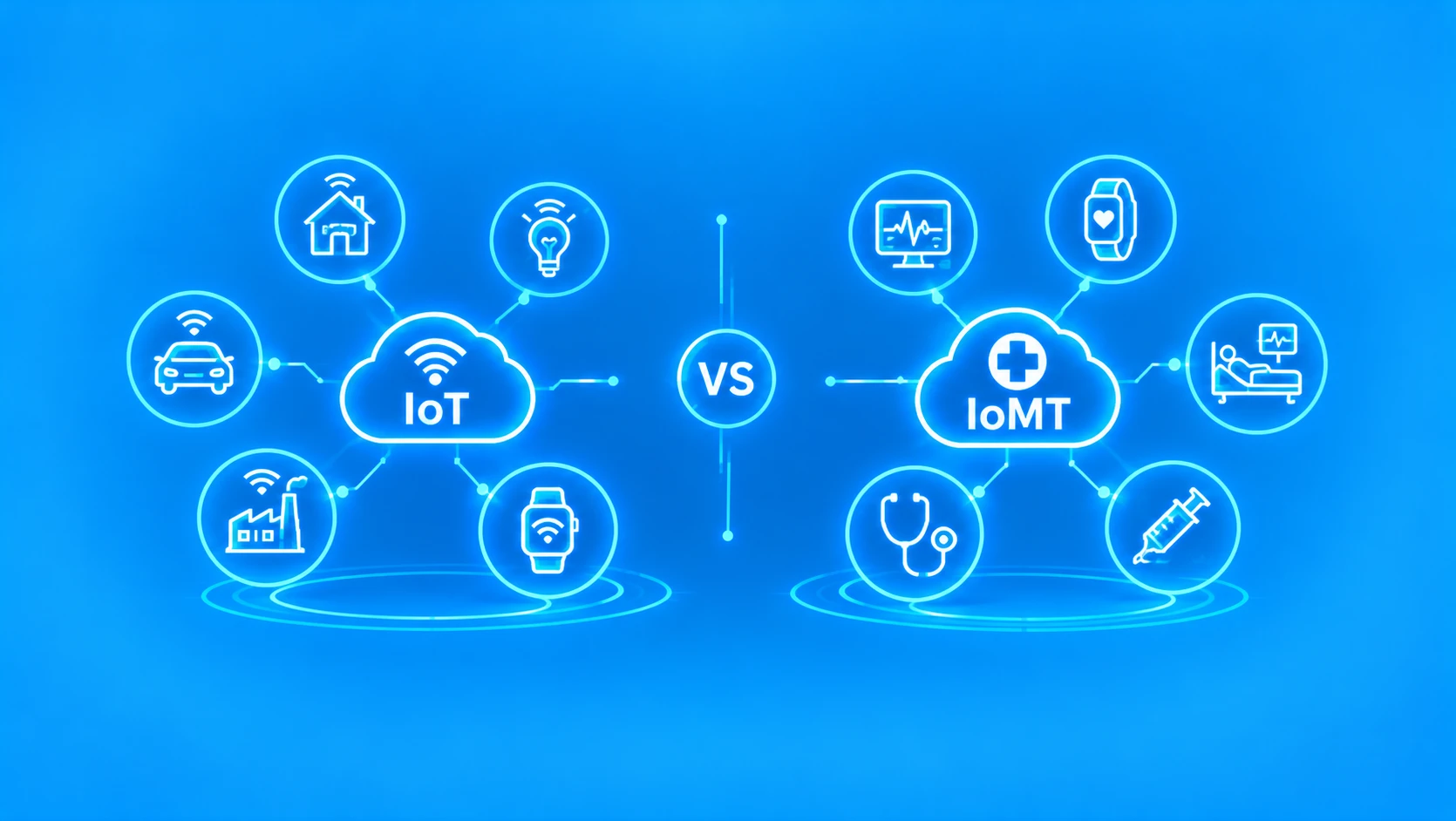
The difference between IoT and IoMT is purpose and risk. IoT connects everyday devices to automate tasks and improve efficiency. IoMT connects medical devices and health software to patient care, so it handles protected health data, often falls under medical device rules, and must meet stricter security and interoperability standards.
IoMT is a subset of IoT. Every IoMT device is an IoT device, but very few IoT devices are IoMT devices. A smart thermostat and a connected glucose monitor both send data over a network, but only one can affect a clinical decision.
What is IoT?
The Internet of Things (IoT) is a network of physical devices, such as sensors, machines, vehicles and smart appliances, that collect and exchange data over the internet. IoT is used to automate tasks, monitor equipment, and reduce manual work.
AI in IoT lets these devices analyze data, spot patterns, and trigger actions with little human input. Many IoT systems now process data on the device or at the network edge to reduce delays and cloud costs.
Key characteristics of IoT:
- Focus on connectivity, automation, and efficiency.
- Data is usually operational rather than personal health data.
- Used across manufacturing, logistics, agriculture, energy, and smart cities.
- Failures usually cause downtime or cost, not physical harm to a person.
Common IoT use cases:
- Smart homes and buildings.
- Industrial automation (IIoT) and predictive maintenance.
- Fleet and asset tracking.
- Environmental and energy monitoring.
What is IoMT?
The Internet of Medical Things (IoMT) is the network of connected medical devices, health software, and clinical systems that collect, analyze, and share patient data. IoMT data feeds directly into diagnosis, treatment, and patient monitoring.
Unlike general IoT, IoMT systems can influence clinical decisions and patient outcomes. That is why many IoMT products are regulated as medical devices, and why they must protect patient data under health privacy laws.
IoMT devices fall into four broad groups:
- Personal and home devices, such as connected blood pressure cuffs, glucose monitors and medical-grade wearables used for remote patient monitoring (RPM).
- In-hospital devices, such as infusion pumps, bedside monitors and smart beds that connect to clinical systems.
- Connected diagnostic devices, such as mobile ECG sensors and imaging systems that send results to clinicians.
- Implantable devices, such as pacemakers and insulin pumps that share data with a clinic or an app.
Common IoMT use cases:
- Remote patient monitoring for chronic conditions such as heart failure and diabetes.
- Hospital asset and patient tracking.
- AI-powered IoMT diagnostics that flag early warning signs.
- Medication adherence and smart dispensing.
IoT vs IoMT: key differences at a glance
The main IoT vs IoMT differences are in data sensitivity, risk, regulation, interoperability, and security. The table below compares them side by side.
IoT vs IoMT compared
| Aspect | IoT | IoMT |
|---|---|---|
| Primary focus | Automation and connectivity | Patient care and clinical decisions |
| Data type | Operational, sometimes personal | Protected health information (PHI) and clinical data |
| Risk if it fails | Downtime or financial loss | Delayed treatment or patient harm |
| Regulation | General privacy and product laws | Medical device rules (FDA, EU MDR) and health privacy laws (HIPAA, GDPR) |
| Interoperability | Optional, vendor-specific | Expected with EHRs, often through HL7 FHIR |
| Accuracy | Approximate is often fine | Must be clinically validated |
| Security | Standard IoT security baselines | Medical device cybersecurity rules, SBOMs and patching plans |
| Typical buyers | Manufacturers, cities, consumers | Hospitals, clinics, payers, patients |
Is every IoMT device a regulated medical device?
No, not every IoMT device is a regulated medical device. Regulation depends on the product’s intended use. A device or app intended to diagnose, treat, monitor, or prevent a disease is usually a medical device, while a general wellness product, such as a step counter, usually is not.
In the US, the FDA regulates software that meets the definition of a device. The FDA’s examples of device software functions it regulates include software that processes data from connected bedside or cardiac monitors, mobile ECG software that uses a sensor connected to a phone, and software that analyzes wearable data to predict heart failure hospitalization.
In Europe, medical devices fall under the EU Medical Device Regulation (MDR), which sets rules for safety, clinical evidence, and post-market surveillance. General IoT devices do not face these medical rules, although they still follow consumer protection, product safety and data protection laws.
Security and compliance: where IoMT raises the bar
IoMT security protects people, not just systems. A breach can expose health records or, in the worst case, interfere with a device that a patient depends on.
Medical device cybersecurity rules
Connected medical devices in the US face specific cybersecurity requirements. Under section 524B of the FD&C Act, a “cyber device” is a device that includes software, can connect to the internet, and could be vulnerable to cyber threats. The FDA’s cybersecurity FAQs explain that premarket submissions for these devices must include:
- A plan to monitor, identify, and address vulnerabilities after launch, including coordinated vulnerability disclosure.
- Processes that keep the device cybersecure, with updates and patches made available after launch.
- A software bill of materials (SBOM) listing commercial, open-source, and off-the-shelf components.
These requirements apply to submissions made from March 29, 2023.
Health data privacy
IoMT systems that handle patient data in the US must protect it under HIPAA. The HIPAA Security Rule requires administrative, physical, and technical safeguards for electronic protected health information. In the EU, GDPR treats health data as a special category with stricter rules.
General IoT security
General IoT products follow broader baselines. The NIST Cybersecurity for IoT Program publishes guidance such as NISTIR 8259 Rev. 1, which helps manufacturers plan IoT security from design through post-market support.
In practice, an IoMT solution needs:
- Secure device identity and authentication.
- Encryption of data at rest and in transit.
- Role-based access control and audit trails.
- Regular penetration testing and a patching process.
This overview of cybersecurity in healthcare covers the wider threat picture for providers.
Interoperability: why IoMT must talk to clinical systems
IoMT data is only useful when it reaches the clinician’s workflow. A reading that stays inside a device app cannot support a care decision, so IoMT systems must connect to electronic health records (EHRs), care platforms, and alerting tools.
FHIR is the HL7 standard for exchanging health data between systems, and it is the most common way to connect IoMT data to EHRs. FHIR R4 is the version most widely used in production, and R5 is the latest published release.
Getting this right is often the hardest part of an IoMT project. This guide to a FHIR integration solution shows how health apps connect to clinical systems. Teams building the platform layer, such as data pipelines, dashboards, and EHR integrations, often work with a healthcare software development company for that part of the stack.
For a full view of how these pieces fit together, see the healthcare software development guide.
IoT vs IoMT in the age of AI
AI turns IoMT from data collection into decision support. Models can read continuous streams from wearables and bedside monitors to flag early signs of deterioration that a periodic check would miss.
AI-enabled IoMT supports:
- Early detection of conditions such as arrhythmia or sepsis risk.
- Predictive alerts for heart failure and other chronic diseases.
- Personalized treatment based on continuous data.
- Clinical decision support that ranks patients by risk.
AI in IoMT carries extra duties. If the AI is part of a medical device, it usually needs regulatory clearance and ongoing monitoring of model performance. This guide to AI medical device software development explains how teams plan for that from the first version.
How to build an IoMT solution: 6 steps
Building an IoMT solution starts with intended use and regulation, not with hardware. Follow these six steps:
- Define the intended use and decide whether the product is a regulated medical device.
- Choose devices and connectivity, such as Bluetooth Low Energy for wearables or cellular for home hubs.
- Design security from day one, including device identity, encryption, SBOM, and a patching plan.
- Build HIPAA and GDPR controls into data storage, access, and audit trails.
- Integrate with EHRs and care platforms through FHIR APIs.
- Validate clinical accuracy, then plan post-market monitoring and updates.
Many teams start with a companion mobile app. This guide to HIPAA-compliant healthcare app development covers how to connect Bluetooth medical devices to a secure app. An experienced healthcare app development company can help with the device, app, and compliance layers together.
Common IoMT challenges
The biggest IoMT challenges are security, interoperability, and regulation, and all three cost more to fix late than to plan early.
- Legacy hospital devices that cannot be patched or easily secured.
- Devices from many vendors that use different data formats.
- Regulatory timelines that slow product launches.
- Battery life and connectivity limits for wearables.
- Clinician alert fatigue when devices send too many low-value alerts.
- Patient adoption and correct use of home devices.
The future of IoT and IoMT
IoMT will keep growing as a regulated, safety-critical branch of IoT rather than a separate technology. Care is moving from hospitals into homes, and that shift depends on connected devices that clinicians can trust.
Organizations that understand the technical, regulatory, and clinical differences between IoT and IoMT will build products that clear review faster, connect to care teams, and keep patients safe.
Summing up
The IoT vs IoMT difference comes down to risk. IoT automates everyday tasks, while IoMT supports patient care, so it must meet medical device rules, strict cybersecurity requirements, health privacy laws, and EHR interoperability standards. Teams that plan intended use, security, and FHIR integration from day one build IoMT products that clear review and earn clinicians’ trust.

Sunil Kumar is CEO of Ailoitte, an AI-native engineering company building intelligent applications for startups and enterprises. He created the AI Velocity Pods model, delivering production-ready AI products 5× faster than traditional teams. Sunil writes about agentic AI, GenAI strategy, and outcome-based engineering.
About Ailoitte