On this page
- What is an FDA-cleared app?
- Does your app need FDA clearance?
- How does the FDA classify a health app?
- 510(k) vs De Novo: which pathway fits your app?
- How to launch an FDA-cleared app: 7 steps
- Examples of FDA-cleared apps
- Which FDA programs can speed up review?
- 6 mistakes that delay FDA clearance
- Summing up
- FAQ
What is an FDA-cleared app?
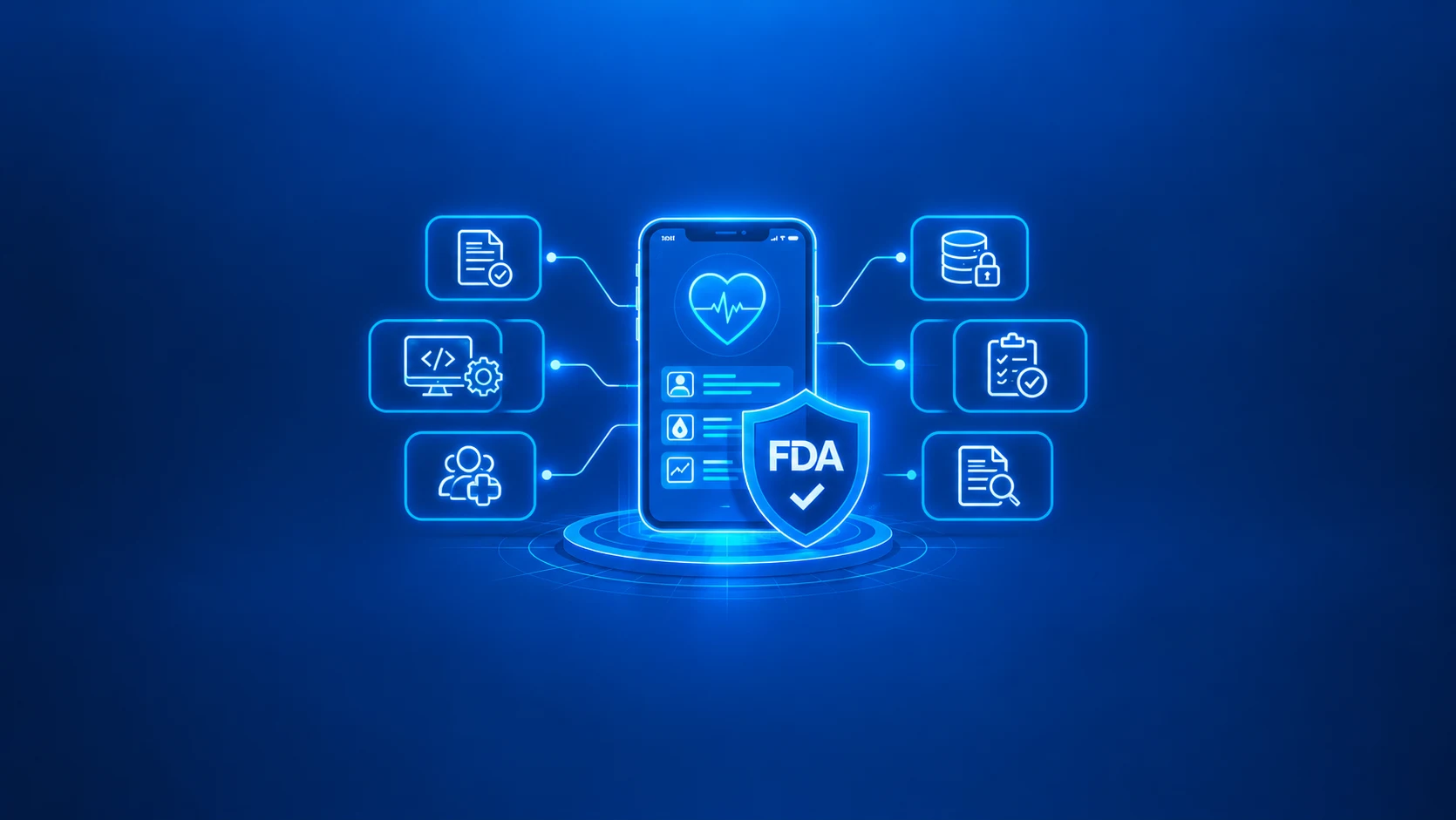
An FDA-cleared app is a mobile or web application that the US Food and Drug Administration (FDA) has authorized for marketing as a medical device. The app makes a medical claim, such as treating insomnia or detecting atrial fibrillation, and the FDA has reviewed evidence that it is safe and effective for that claim.

Most FDA-cleared apps fall into two groups. Software as a Medical Device (SaMD) performs a medical purpose on its own, such as a therapy app on a smartphone. Accessory apps work with a regulated device, such as an app that displays and analyzes readings from a glucose monitor.
Digital therapeutics (DTx) are a large subset of FDA-cleared apps. A digital therapeutic delivers a treatment through software, such as cognitive behavioral therapy for substance use. The ISO technical report on digital therapeutics describes them as health software that treats or relieves a disease by delivering an intervention with a demonstrable therapeutic effect.
FDA cleared vs FDA approved vs De Novo granted
FDA cleared, De Novo granted, and FDA approved describe three different review pathways, not three levels of quality. People often say “FDA approved app” for all three, but the FDA uses each term for one pathway only.
What does each FDA term mean for an app?
| Term | Pathway | What the FDA decided |
|---|---|---|
| FDA cleared | 510(k) premarket notification | The app is substantially equivalent to a legally marketed predicate device. |
| De Novo granted | De Novo classification request | The app is a new low- to moderate-risk device type with its own special controls. |
| FDA approved | Premarket approval (PMA) | A high-risk Class III device has shown reasonable assurance of safety and effectiveness. |
How does an FDA-cleared app differ from a wellness app?
A wellness app supports a healthy lifestyle without claiming to diagnose or treat a disease, so it usually needs no FDA review. An FDA-cleared app makes a specific medical claim and must support it with clinical evidence.
- Evidence: An FDA-cleared app needs clinical evidence from randomized controlled trials, pragmatic trials, real-world evidence, or a mix of these.
- Oversight: An app that makes clinical claims goes through FDA review, while a wellness app usually does not.
- Intervention: An FDA-cleared therapeutic app delivers a treatment, while a wellness app tracks or informs.
- Outcomes: An FDA-cleared app aims to produce a measurable health outcome for a named condition.
The FDA updated its general wellness guidance and its clinical decision support guidance in January 2026. The wellness update added criteria for non-invasive wearables that report physiologic values, such as blood pressure, for wellness use only.
Does your app need FDA clearance?
Your app needs FDA clearance if its intended use meets the legal definition of a medical device and the FDA has not placed that function under enforcement discretion. The intended use, not the technology, decides the answer.
The FDA’s policy page on device software functions and mobile medical applications explains that the agency focuses on software that could put patients at risk if it does not work as intended. Low-risk functions, such as symptom logs or drug reference tools, generally fall outside active oversight.
The FDA and the other members of the International Medical Device Regulators Forum (IMDRF) rate software risk on two factors. The first is how serious the condition is. The second is how much the software’s output drives care decisions.
Three questions settle most cases:
- Does the app diagnose, treat, mitigate, or prevent a disease or condition?
- Does the app give patient-specific treatment recommendations or drive a clinical decision?
- Could a failure of the app harm a patient?
If the answer to any of these is yes, plan for an FDA submission from the first sprint. Teams still shaping the product can start with the core steps to build a healthcare app and add regulatory work once the claims are fixed.
Prescription vs. non-prescription apps
An FDA-cleared app can be prescription-only or sold directly to consumers, and the FDA sets this in the labeling based on risk. Prescription digital therapeutics (PDTs) need an order from a licensed clinician. The first PDT, reSET for substance use disorder, received De Novo authorization in September 2017.
Non-prescription apps reach patients without a clinician’s order, but they still go through FDA review. Natural Cycles, a birth control app, received De Novo authorization as a Class II device.
Four factors usually decide whether an app is prescription-only:
- The risk of the intended use
- How vulnerable the patient population is
- The nature of the condition
- How complex the intervention is
How does the FDA classify a health app?
The FDA places every medical device, including apps, into Class I, II or III based on risk, and the class sets both the pathway and the evidence you need. Most digital therapeutic apps are Class II devices.
FDA device classes for apps
| Class | Risk | Controls | Typical pathway |
|---|---|---|---|
| Class I | Low | General controls | Usually exempt from premarket notification |
| Class II | Moderate | General and special controls | 510(k) or De Novo |
| Class III | High | General controls and premarket approval | PMA |
The classification depends on the intended use and indications for use. Two apps built on the same code can land in different classes if one claims to treat a disease and the other claims to support general wellness. If your app uses AI to interpret patient data, the scoping steps in AI medical device software development show how the claim shapes the class.
510(k) vs De Novo: which pathway fits your app?
Use the 510(k) pathway if a legally marketed predicate device does what your app does, and use De Novo if no predicate exists. The first app of a new type usually goes through De Novo, and later apps of the same type follow through 510(k).
A 510(k) shows that your app is substantially equivalent to the predicate, meaning it is as safe and effective. A De Novo request asks the FDA to create a new device type, with its own special controls, for a novel low- to moderate-risk device.
A 2025 cross-sectional study of FDA-cleared prescription digital therapeutics identified 13 products. Eight (61.5%) were cleared through 510(k) and five (38.5%) through De Novo. The author works at Click Therapeutics, a digital therapeutics company, so treat the figures as one industry analysis.
510(k) vs. De Novo for an FDA-cleared app
| Factor | 510(k) | De Novo |
|---|---|---|
| When to use it | A predicate device exists | No predicate device exists |
| What you prove | Substantial equivalence to the predicate | Reasonable assurance of safety and effectiveness |
| Outcome | Clearance | A new device classification with special controls |
| Average review time | About 193 days | About 251 days |
| Share of PDTs in the 2025 study | 8 of 13 | 5 of 13 |
Best for 510(k): an app with the same intended use and similar technology as an existing cleared product, such as a new cognitive behavioral therapy app for chronic insomnia.
Best for De Novo: an app with a new intended use or a new mechanism, such as the first game-based therapy for ADHD.
reSET shows the pattern. A published review of FDA-authorized digital therapeutics lists reSET as a De Novo authorization in 2017 and the opioid-focused reSET-O as a 510(k) clearance in 2018.
Clinical data matters on both routes. A Health Affairs analysis found that every prescription digital therapeutic it examined had at least one study with a clinical primary endpoint, and 90% had at least one randomized controlled trial.
Special controls for Class II apps
Special controls are device-specific requirements that give reasonable assurance of safety and effectiveness for a Class II device type. For digital therapeutic apps, they usually include:
- Clinical performance testing that shows the therapeutic effect with validated measures
- Software verification, validation, and hazard analysis
- Labeling with instructions for use, system requirements, and warnings
- Cybersecurity documentation
Special controls often require clinical performance data. Plan a clinical study even if you expect to use the 510(k) pathway.
How to launch an FDA-cleared app: 7 steps
Launching an FDA-cleared app takes seven steps, from defining the claim to monitoring the app after clearance. Each step produces documents that go into your submission, so run the steps in order and keep the records traceable.

Step 1: Define the intended use and claims
The intended use statement is a one-sentence description of what the app does, for whom, and for which condition. It drives classification, evidence, labeling, and marketing, so write it before you write code.
Keep the claim narrow for the first submission. A narrow claim, such as treating chronic insomnia in adults, needs less evidence than a broad claim. A cleared narrow claim can also serve as the predicate for later indications.
Many teams first test usability and engagement with MVP development services and keep disease claims out of the pilot build. The regulated version then starts from a validated design.
Step 2: Confirm the class and pathway with the FDA
Confirm your device class and pathway in two ways. First, search the FDA’s 510(k) and De Novo databases for possible predicates. Second, request FDA feedback through the Pre-Submission (Q-Submission) program.
A Pre-Submission lets you ask about your study design, predicate choice, and testing plan before you pay for a pivotal trial. Ask specific questions, because the FDA answers the questions you put to it.
Step 3: Build under a quality management system
Since February 2, 2026, the FDA’s Quality Management System Regulation (QMSR) has required device makers to follow a quality system that incorporates ISO 13485:2016 by reference. For an app team, that means design controls, document control, supplier management, and change control from the first release.
Software teams usually pair the quality system with IEC 62304, the international standard for medical device software life cycle processes. IEC 62304 sets how you plan, build, test, and maintain software based on its safety class.
The healthcare software development guide covers architecture, compliance, and delivery for the wider platform around the app.
Most cleared apps also rely on a clinical backend, such as prescriber dashboards and data pipelines. Scope that backend with healthcare software development services that already work under design controls.
Step 4: Run usability engineering and risk management
Usability engineering and risk management prove that patients and clinicians can use the app safely. IEC 62366-1 sets the usability engineering process for medical devices. ISO 14971:2019 sets the risk management process.
Run several rounds of formative testing with patients, caregivers, and clinicians, then a summative validation test with representative users. The third edition of ISO 14971 asks you to define the benefit of the device and to weigh residual risk against it.
Step 5: Generate clinical evidence
Clinical evidence shows that the app produces the outcome it claims. Most digital therapeutics rely on randomized controlled trials, sometimes supported by real-world evidence.
The Digital Therapeutics Alliance’s overview of clinical evidence basics groups digital therapeutic evidence into six areas: safety, benefit, durability, usability, user engagement, and behavior change.
Pre-specify endpoints that are valid, reproducible, and clinically meaningful, based on published standards or consensus among independent clinicians. Choose the control condition, such as a sham app, before enrollment starts.
Step 6: Prepare cybersecurity documentation
An app counts as a cyber device under section 524B of the Federal Food, Drug, and Cosmetic Act (FD&C Act) if it includes software, can connect to the internet, and could be vulnerable to cyber threats. Almost every connected app meets that definition.
Section 524B requires three things in the submission: a plan to monitor and address postmarket vulnerabilities, processes that give reasonable assurance of cybersecurity, and a Software Bill of Materials (SBOM).
The FDA’s current premarket cybersecurity guidance, issued on February 3, 2026, replaced the June 2025 version and aligns with the new quality management system rule. Expect to provide a threat model, a security architecture, a risk assessment, and testing evidence.
FDA cybersecurity review does not cover HIPAA. If the app handles protected health information for a covered entity, plan HIPAA compliance testing as a separate workstream.
Step 7: Write compliant labeling, submit and monitor
Labeling for an app covers much more than the app store listing. Section 201(m) of the FD&C Act defines labeling as all written, printed, or graphic matter on or accompanying a device. For an app, that includes onboarding screens, instructions for use, the product website, and promotional material.
Submit through eSTAR, the FDA’s electronic submission template. After clearance, monitor complaints, report adverse events, and assess every software update to decide whether it needs a new submission.
Examples of FDA-cleared apps
FDA-cleared apps now cover addiction, insomnia, ADHD, depression, migraine, diabetes, and heart rhythm monitoring. The table lists well-known examples and the pathway each one used.
Examples of FDA-cleared apps and their pathways
| App | Condition | Pathway | Year |
|---|---|---|---|
| WellDoc DiabetesManager (now BlueStar) | Type 2 diabetes management | 510(k) | 2010 |
| reSET | Substance use disorder | De Novo | 2017 |
| reSET-O | Opioid use disorder | 510(k) | 2018 |
| Apple ECG app | Atrial fibrillation detection | De Novo | 2018 |
| Natural Cycles | Contraception | De Novo | 2018 |
| Somryst | Chronic insomnia | 510(k) | 2020 |
| EndeavorRx | ADHD in children aged 8 to 12 | De Novo | 2020 |
| Rejoyn | Major depressive disorder symptoms | 510(k) | 2024 |
| CT-132 (Click Therapeutics) | Migraine prevention | De Novo | 2025 |
reSET and reSET-O for substance use disorders
reSET was the first prescription digital therapeutic the FDA authorized. It was authorized in September 2017 for substance use disorder, for use alongside outpatient therapy. reSET-O followed for opioid use disorder in patients taking buprenorphine. Both apps deliver cognitive behavioral therapy through interactive lessons.
In clinical trials, patients who used reSET with outpatient therapy had better abstinence and treatment retention than patients receiving standard care alone. Medicaid patients using reSET-O had higher buprenorphine adherence and 45% fewer emergency room visits.
The original developer, Pear Therapeutics, filed for Chapter 11 bankruptcy in April 2023, and its products were sold at auction. PursueCare relaunched reSET and reSET-O in 2024.
Somryst for chronic insomnia
Somryst is a nine-week prescription digital therapeutic that delivers cognitive behavioral therapy for insomnia (CBT-I) to adults with chronic insomnia. It was cleared through 510(k) in March 2020, and Nox Health bought the Somryst assets in 2023.
In clinical trials, 62.8% of users responded to treatment by week nine, compared with 14% in the control group. Six months later, 56.2% still showed that response.
EndeavorRx for ADHD in children
EndeavorRx became the first game-based digital therapeutic the FDA authorized, through De Novo in June 2020, for children aged 8 to 12 with ADHD. It delivers treatment through a video game instead of lessons.
The authorization drew on five studies with more than 600 children. After four weeks, about one-third of children no longer had a measurable attention deficit on at least one measure. About half of parents reported improvements in daily functioning after one month.
Rejoyn for major depressive disorder
Rejoyn, from Otsuka and Click Therapeutics, was cleared in 2024 as the first prescription digital therapeutic for major depressive disorder symptoms. It is used alongside antidepressants in adults aged 22 and older.
The clearance rested on a 13-week randomized trial of 386 adults that compared Rejoyn with a sham app. Independent experts noted that the difference from the sham app was not statistically significant, which shows that clearance and strong evidence are not the same thing.
Which FDA programs can speed up review?
The Breakthrough Devices Program and the Safer Technologies Program (STeP) can speed up FDA review for qualifying apps. A predetermined change control plan can speed up updates after clearance. A device can be in the Breakthrough Devices Program or STeP, but not both.
Breakthrough Devices Program
The Breakthrough Devices Program gives priority review and more interactive FDA communication to devices that offer more effective treatment or diagnosis of a life-threatening or irreversibly debilitating condition. The device must also meet one further criterion, such as being a breakthrough technology or having no approved alternative.
As of June 30, 2026, the FDA had granted 1,320 Breakthrough Device designations. Click Therapeutics’ migraine therapeutic, CT-132, held Breakthrough designation before its De Novo authorization in 2025.
Safer Technologies Program (STeP)
STeP covers devices for conditions that are not life-threatening or are reasonably reversible, if the device is expected to be significantly safer than current options. Safety gains can include fewer adverse events, fewer device failures, or fewer use-related hazards.
Predetermined change control plans for AI-enabled apps
A predetermined change control plan (PCCP) lets an AI-enabled app make specified model updates after clearance without filing a new submission for each change. The FDA finalized its guidance on PCCPs for AI-enabled device software functions in December 2024.
If your app uses machine learning, describe three things in the original submission: the planned updates, the method for making them, and how you will assess their impact. The FDA’s AI and ML guidelines explain how the FDA reviews AI-enabled devices. The wider uses of AI in healthcare show where these apps fit.
What happened to the Software Precertification Pilot?
The Software Precertification (Pre-Cert) Pilot ran from 2017 to 2022. It tested whether the FDA could review the developer instead of each product. Nine companies took part, including Apple, Fitbit, Johnson & Johnson, and Pear Therapeutics.
In September 2022, the FDA concluded that it could not run the approach under its current legal authority. For app makers in 2026, the lesson is simple: every product still needs its own submission.
6 mistakes that delay FDA clearance
Six mistakes often slow down app submissions, and each one can be avoided with early planning.
- Writing a broad intended use that needs more evidence than the team can produce.
- Building the app before setting up design controls, then recreating the design history afterward.
- Treating cybersecurity as a final checklist instead of a design input with a threat model and an SBOM.
- Skipping the Pre-Submission meeting and finding a study design problem after the pivotal trial.
- Making disease claims in app store listings or ads that go beyond the cleared indication.
- Planning for clearance but not for reimbursement, even though payers decide whether clinicians can prescribe the app at scale.
Reimbursement is improving but uneven. Medicare added billing codes for digital mental health treatment devices in its 2025 Physician Fee Schedule.
Summing up
An FDA-cleared app is a medical device, so the launch plan starts with the intended use, not the feature list. Pick 510(k) if a predicate exists and De Novo if it does not, build under an ISO 13485-based quality system, and treat usability, clinical evidence, and cybersecurity as design inputs. Plan reimbursement alongside clearance, because authorization alone does not put the app in patients’ hands