On this page
Fraud teams face two costs at once: the fraud that gets through, and the genuine customers they block by mistake. Static rules make both worse as a business grows, which is why many teams are modernizing legacy fraud systems. Machine learning fraud detection scores every payment with all the signals available, so more fraud is stopped while more good customers check out without friction.
This guide covers what ecommerce fraud detection with machine learning is, the full case study (challenge, solution, four-phase rollout, results and technology), the main fraud types and how they are caught, rules versus machine learning, industry data, the metrics to track, compliance, and the failure modes to avoid.
What Is Ecommerce Fraud Detection with Machine Learning?
Ecommerce fraud detection is the process of checking every online payment, login and refund request for signs of fraud before it costs the business money. Machine learning makes that check smarter: instead of relying only on fixed rules written by analysts, a model learns from millions of past transactions which combinations of signals point to fraud, and scores each new payment in real time.
A rule says “decline orders over $500 from a new account”. A machine learning model looks at the whole picture at once: the device, the location, how the customer typed and browsed, the card, the delivery address, and whether any of these have been linked to fraud before. That is why it can stop more fraud while blocking fewer genuine customers.
- Faster: each payment is scored in milliseconds, so good customers check out without delay.
- Adaptive: the model updates as fraud tactics change, instead of waiting for someone to write a new rule.
- Connected: signals from every channel and, on payment networks, from other merchants are combined.
- Explainable: each decision carries a risk score and the reasons behind it, which supports reviews, disputes and AI governance.
The Client: A Global Commerce Brand Processing Millions of Payments
A growing commerce brand with a global customer base, our client processes millions of monthly transactions across retail, subscription, and service platforms. As operations scaled, so did fraud complexity, from payment fraud and account takeovers to refund abuse and social engineering attacks. False declines were frustrating to genuine customers. At the same time, fraudsters exploited blind spots faster than the system could adapt.
That’s when the client turned to us, not just to block fraud, but to evolve their fraud prevention framework into a real-time system that adapts with scale.
The Challenge: Static Rules Against Fast-Moving Fraud
Four problems made the existing setup expensive for both the business and its customers:
- Static fraud rules falling short: manual fraud rules could not keep up with dynamic fraud patterns. Frequent updates led to increased operational load and lag in response times.
- High false positive rate: a significant percentage of legitimate customers were being blocked, especially during peak seasons, directly impacting revenue and customer experience.
- Lack of cross-channel insights: the client operated multiple platforms, but fraud signals were not connected across channels, making it difficult to trace coordinated fraudulent activity.
- Increased first-party fraud and policy abuse: with refund abuse and chargeback fraud on the rise, the client needed a smarter system that could tell genuine user errors from intentional misuse.

The Solution: Real-Time Machine Learning Fraud Detection on Adyen
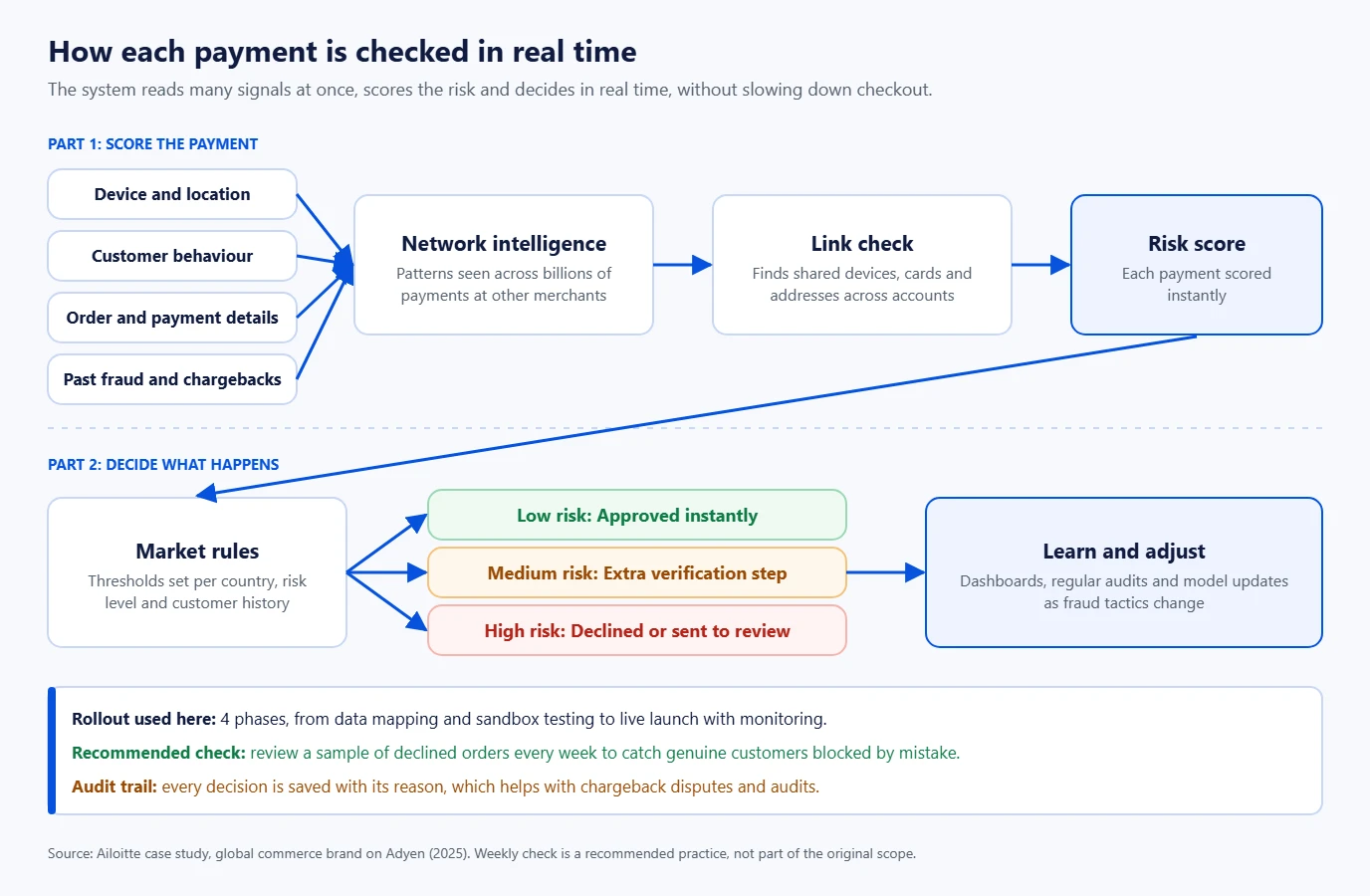
Ailoitte implemented Adyen’s real-time fraud detection engine and built a tailored layer of rules, integrations and monitoring around it. In plain terms, every payment now passes through five checks:
- Network-wide intelligence: Adyen’s global network provided insights from billions of transactions, helping the client stay ahead of fraud patterns already seen at other merchants and in other regions.
- Graph-based machine learning: the system uses deep learning to find hidden links between accounts, such as shared devices, unusual locations and behaviour that does not match the customer, that manual checks would have missed.
- Real-time decisions: transactions were scored in real time, allowing instant approvals or declines without adding latency.
- Fraud controls per market: we helped the client set rules by market risk level, customer behaviour and past fraud signals, all within Adyen’s configurable policy layer.
- Fewer manual reviews: high-risk transactions were automatically routed to an extra verification step or declined, significantly reducing the manual review workload for the internal team.

How We Rolled It Out in Four Phases
The rollout moved from understanding the client’s fraud history to a monitored live launch, with sandbox testing in between so checkout speed and experience were never put at risk.
| Phase | What happened |
|---|---|
| 1. Data mapping | Data mapping and pattern analysis: we worked with the client’s data and Adyen logs to identify fraud hotspots, seasonal trends, and past failure points. |
| 2. Integration | Integration and sandbox testing: Adyen’s API and dashboard were integrated with the client’s backend system for seamless data exchange. Extensive testing ensured transaction speed and user experience were unaffected. |
| 3. Custom rules | Policy optimisation and custom rules: with Adyen’s support, we co-developed custom policies based on real-world abuse scenarios such as card testing, family plan fraud and refund loops. |
| 4. Go live | Live deployment and continuous optimisation: the system launched with active monitoring dashboards, periodic audits, and model updates in sync with evolving fraud behaviour. |

The Impact: Fewer Losses, Fewer Blocked Customers
The client reported these results after go-live:
- 65% reduction in fraud losses: real-time detection and network-based insights significantly curbed direct losses due to fraud.
- 30% fewer false positives: better separation of legitimate and suspicious activity improved approval rates, especially for returning customers.
- 80% drop in manual review volume: risk scoring and automation drastically reduced the dependency on human analysts.
- Increased customer trust and retention: users experienced faster checkouts and fewer unnecessary verifications, leading to improved trust and loyalty.
Client-reported outcomes. Actual results depend on transaction mix, markets and how rules are tuned.

Technology Behind the System
| Component | What it does |
|---|---|
| Adyen risk engine (RevenueProtect, now Protect) | Combines global network signals, graph-based models, and AI-driven policies for dynamic fraud prevention. |
| Custom rule layer | Rules for edge-case scenarios and market-specific thresholds to address local differences. |
| Integration and monitoring | Real-time dashboards let stakeholders monitor fraud trends and adjust controls without coding changes. |
| Collaborative expertise | Our fraud consultants worked directly with Adyen’s team and the client’s risk managers to ensure alignment, speed, and precision throughout the rollout. |

Common Types of Ecommerce Fraud and How They Are Caught
Each type of fraud leaves different traces. A good system watches for all of them at once:
| Fraud type | What it looks like | Signals that give it away |
|---|---|---|
| Stolen card payments | A fraudster buys with card details stolen in a data breach. | New device, mismatched billing and delivery country, unusual order size. |
| Card testing | Bots try thousands of small payments to find which stolen cards still work. | Bursts of tiny payments, many cards from one device or IP address. |
| Account takeover | A criminal logs in to a real customer’s account and spends stored value or saved cards. | Login from a new device or country, password reset followed by a quick order. |
| First-party fraud | Also called friendly fraud: a real customer buys, receives the goods, then claims the order never arrived to get a chargeback. | Repeat disputes, delivery confirmed by the courier, history across linked accounts. |
| Refund and policy abuse | Repeated refund claims, or sharing a family plan far beyond its rules. | Refund loops, many accounts on one payment method or address. |
| Social engineering | Customers or staff are tricked into approving payments or changing account details. | Sudden changes to contact details or payout accounts before large orders. |
Rules vs Machine Learning: Why Static Rules Fall Short
| Rules only | Machine learning plus rules | |
|---|---|---|
| How it decides | Fixed thresholds written by analysts. | A risk score learned from millions of past payments, with rules on top for business policy. |
| New fraud patterns | Caught only after someone notices and writes a new rule. | Picked up as the model sees new patterns, often first at other merchants on the network. |
| Genuine customers | Often blocked by broad rules, especially at peak season. | Fewer false declines, because the model weighs many signals together. |
| Team workload | Rule lists grow and need constant upkeep. | Most payments are decided automatically; people review only the unclear cases. |
The strongest setups use both, as this client did: machine learning for the score, and a clear rule layer for each market’s policy, so the business keeps control over what gets approved.
What Industry Data Says About Ecommerce Fraud
| Source | Finding |
|---|---|
| Juniper Research, Global Merchant Fraud Prevention 2024 to 2029 | Global ecommerce fraud is expected to grow from $44 billion in 2024 to $107 billion in 2029, a 141% rise, driven by AI-powered attacks and deepfakes used to beat identity checks. |
| LexisNexis True Cost of Fraud Study, 2025 | Every $1 of fraud costs US ecommerce and retail merchants $4.61 once fees, labour, lost goods and recovery are counted. |
| LexisNexis True Cost of Fraud Study, 2025 | 41% of North American merchants still rely on manual fraud prevention, and only 6% of US ecommerce businesses fully automate it. 64% say fraud hurts conversion rates. |
| Adyen Protect documentation | Adyen’s machine learning is trained on its global transaction data, which lets it recognise up to 80% of shoppers who are new to a given merchant. |
The pattern is clear: fraud is growing faster than manual teams can scale, and the hidden costs are several times the fraud itself. Automating the routine decisions and keeping people for the hard cases is where the savings come from, and process automation can take over the rest of the review work.
How to Measure a Fraud Detection System
Fraud losses alone do not tell you whether a system works. Track these together, every month and by market:
| Metric | What it tells you |
|---|---|
| Fraud loss rate | How much money is lost to fraud as a share of sales. |
| Chargeback rate | How many payments end in disputes; card networks penalise merchants above their thresholds. |
| Approval rate | How many genuine payments go through; the number false declines quietly reduce. |
| False positive rate | How many blocked payments were actually genuine, found by reviewing a sample of declines. |
| Manual review rate and time | How many orders need a person to check them, and how long customers wait. |
Compliance: PCI DSS, GDPR, PSD2 and the EU AI Act
A fraud system handles card data and personal data, so compliance shapes the design from the start:
- PCI DSS: card numbers are handled by the payment provider and never stored in your own systems.
- GDPR: customers have the right to human review of automated decisions that affect them, so declined customers need a clear route to support.
- PSD2 in Europe: strong customer authentication applies to most online card payments; low-risk payments can qualify for exemptions, which is where accurate risk scores pay off.
- EU AI Act: credit scoring is listed as high-risk, but AI used to detect financial fraud is explicitly excluded from that category. Good governance still applies.
- Audit trail: every decision is logged with its score and reasons, which supports chargeback disputes and internal audits.
How Ailoitte Builds Fraud Detection Systems
Ailoitte builds fraud detection and risk systems for commerce, fintech and insurance businesses, either on top of a payment provider’s engine, through AI workflow automation, as in this case, or as custom fraud detection software built on machine learning models trained on your own data. Every engagement starts with a discovery workshop to map fraud types, data sources and the markets where losses are highest.
- Discover and baseline (2 to 4 weeks): we map fraud losses, chargebacks, false declines and review workload today, so every later result can be measured.
- Pilot (4 to 8 weeks, fixed price): one market or channel, real transactions, and success and stop criteria agreed upfront.
- Build and run: rollout across markets with dashboards, regular audits and model updates, human review by design and 100% IP transfer to you.
- Security built in: Ailoitte is ISO 27001 and ISO 9001 certified, and card data stays with your payment provider.
- Speed: our AI Velocity Pods deliver production-ready AI 3x faster than traditional teams, with the first commit on day 5.
For an early budget view, our AI cost calculator gives an indicative estimate in minutes.
Common Failure Modes and How to Avoid Them
| Failure mode | What goes wrong | How to prevent it |
|---|---|---|
| Blocking good customers silently | Declined customers simply leave, so the cost never shows up in fraud reports. | Review a sample of declines every week and track approval rate next to fraud losses. |
| Rules pile up | Hundreds of old rules overlap and nobody knows which still help. | Test each rule against past data and retire the ones that no longer add value. |
| Model goes stale | Fraud tactics change and the model keeps scoring on old patterns. | Schedule model updates and watch for sudden changes in scores. |
| Peak season spikes | Rules tuned for normal weeks block genuine shoppers on sale days. | Set seasonal thresholds and add review capacity before peak periods. |
| Channels not connected | A fraudster blocked on the website succeeds in the app. | Share signals and decisions across every channel and platform. |
| No feedback from disputes | Chargeback outcomes never reach the model, so it cannot learn from them. | Feed dispute results back into the system as new training data. |
Conclusion
Real-time machine learning turns fraud prevention from a growing list of rules into a system that learns. For this global commerce brand, that meant 65% lower fraud losses, 30% fewer genuine customers blocked and 80% fewer manual reviews. The lesson for any merchant: score every payment with all the signals you have, keep clear rules for business policy, and measure approval rates as carefully as fraud losses.

Sunil Kumar is CEO of Ailoitte, an AI-native engineering company building intelligent applications for startups and enterprises. He created the AI Velocity Pods model, delivering production-ready AI products 3x faster than traditional teams. Sunil writes about agentic AI, GenAI strategy, and outcome-based engineering.
About Ailoitte









 India
 Job Portal