On this page
Are you a firm that is still stuck on manual processes for managing purchase orders- relying on spreadsheets, emails, or paper trails? If so, you are not alone. But with time and advancement, these outdated methods had to evolve. Growing companies in the US need scalable, efficient, and transparent systems to keep up with increasing procurement demands and vendor complexity.
For this, purchase order software can be a transformative tool for businesses looking to modernize their procurement processes. According to the 2024 PwC Digital Procurement Survey, 70% of organizations identified improved efficiency as the main driver behind their shift to digital procurement solutions. Notably, 62% of those who adopted such systems experienced measurable gains in operational efficiency.
Let’s move further and explore purchase order management software- what it offers, how it works, and why it is essential for growing businesses.
Understanding Purchase Order System
A Purchase Order (PO) system is software that helps businesses automate and manage the entire procurement process. From creating purchase orders to tracking deliveries and reconciling invoices, purchase order management software handles every step with precision and efficiency. It replaces manual methods like spreadsheets and email chains with a centralized, digital workflow that improves accuracy, transparency, and efficiency.
Key components of purchase order software and how does its System work:

- Requisition & Creation
The purchasing process starts when a user submits a request through the system, detailing the required items, quantities, estimated costs, and relevant project or departmental details. - Approval Workflow
The system then directs the request to a predefined chain of approvers based on organizational rules and spending limits. This ensures that purchases adhere to company policies and spending thresholds. - Purchase Order Issuance
As soon as the request is approved, the system generates a formal PO document, which is sent to the supplier. This includes order details with supplier information, reducing manual entry errors. - Tracking & Documentation
To promote transparency, everything- from order creation to approval, modifications, and fulfillment, is auto logged within the system. - Integration with Other Systems
Leading purchase order management system easily syncs with accounting, inventory, or ERP platforms. This ensures data flows across financial, inventory, and operational modules with minimal manual intervention. - Legal & Financial Safeguards
Along with simplifying purchasing, purchase order software systems provide legal protection in disputes and consistently enforce budget control and procurement guidelines.
Key Advantages of Using Purchase Order Management System
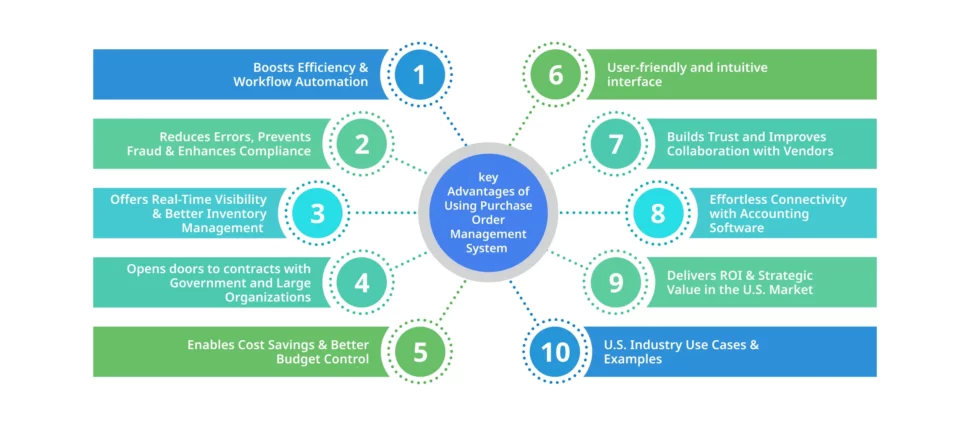
Today’s business environment needs agility and accuracy — and manual procurement processes simply can’t keep up. Here is how:
1. Boosts Efficiency & Workflow Automation
U.S businesses that are working with manual methods- chasing approvals via emails, wrestling with physical documents, or tracking POs across spreadsheets are not only wasting valuable time but also exposing themselves to costly errors and delays. Purchase order system for small business offers practical and scalable solutions to these challenges. Even for large firms, the benefits are clear—but for small businesses, the impact can be transformative.
PO automates key procurement tasks such as purchase request creation, approval routing, order tracking, and invoice matching. This automation eliminates repetitive tasks, reduces approval bottlenecks, and accelerates turnaround time.
Consider this workflow:
- A requester fills out a PO via a digital template.
- The system auto-routes it to the appropriate approver.
- Upon approval, the PO is sent directly to the vendor, with all details standardized.
- The tool tracks every status update—from creation to fulfillment.
2. Reduces Errors, Prevents Fraud & Enhances Compliance
Manual purchase order systems are often filled with human error- mis keyed data, duplicate orders, misplaced documents, missing approvals, or unauthorized spending. These slip-ups then cost time and expose businesses to audit risks and compliance issues.
Purchase order software addresses these weaknesses head-on:
- Built-in templates and auto-filled data eliminate common order mistakes.
- Systems can detect mismatches—like incorrect item codes or price discrepancies—and flag them for correction before errors occur.
- Every modification, approval, or note is logged for transparency and legal protection.
- Digital workflows reduce the risk of fraudulent or duplicate orders by enforcing approval hierarchies and structured processes.
3. Offers Real-Time Visibility & Better Inventory Management
To maintain the operational efficiency, firms must have accurate information, like what is received, what has been ordered, what has been received, and current stock levels across locations. A purchase order system for small businesses provides this visibility by automatically syncing procurement data with inventory records, eliminating guesswork and manual tracking.
In U.S. sectors like retail, especially e-commerce and multi-location stores, accurate inventory data leads to sales and customer satisfaction, which makes effective PO management a competitive advantage.
4. Opens doors to contracts with Government and Large Organizations
Purchase order management software helps businesses generate formal POs which is an essential requirement for many government agencies, local authorities, and large corporations. Businesses that fail to meet this standard often miss lucrative contracts due to non-compliance with procurement protocols.
With purchase order software, companies can present themselves as reliable and professional partners, capable of meeting the documentation, approval, and audit requirements that large institutions demand.
5. Enables Cost Savings & Better Budget Control
For a business to grow, strategic financial control is essential, not just tracking expenses, but proactively managing them. A PO system delivers:
- Clear Spending Overview: Businesses can see where money is going, by department, project, or vendor, making it easier to spot patterns and stick to budgets.
- Live Budget Updates: Teams can instantly track how each order affects the budget, helping avoid last-minute surprises or overspending.
- Lower Hidden Costs: By cutting out paperwork and manual tasks, companies save time and reduce errors, leading to cleaner, more efficient spending.
- Growing Market Demand: As the procurement software market grows (expected to reach $9.5 billion by 2028), more U.S. businesses are investing in tools that improve long-term savings and performance.
6. User-friendly and intuitive interface
Since adopting new software can be challenging, leading purchase order software Development is built with user-friendly interfaces that minimize complexity and maximize usability. These intuitive platforms help users to navigate effortlessly through tasks like creating purchase orders, tracking approvals, and managing inventory.
With clean layouts, guided workflows, and helpful prompts, even non-technical team members can get up to speed quickly.
7. Builds Trust and Improves Collaboration with Vendors
Apart from internal efficiency, a reliable PO system strengthens supplier relationships. Yes, it offers communication with transparency, ensuring that vendors receive clear, consistent purchase orders with accurate details. This includes quantities, delivery dates, and payment terms, reducing misunderstandings, minimizing delays, and promoting a sense of professionalism.
8. Effortless Connectivity with Accounting Software
With modern purchase order software integration with accounting platforms is smooth, eliminating the need for manual data entry and reducing the risk of errors. Purchase orders, invoices, and payment records can be automatically synced with tools like QuickBooks, Xero, or Zoho Books. This makes sure that financial data stays accurate and up to date.
This effortless connectivity allows small firms to maintain clean books, reconcile transactions faster, and generate reports with confidence.
9. Delivers ROI & Strategic Value in the U.S. Market
Investing in procurement technology is never a waste of resources. In fact, it is a strategic move that delivers measurable returns. Through Purchase order management software, U.S businesses benefit from:
- Reduced Operational Costs – Automation cuts down on manual tasks, paperwork, and errors, saving time and money across departments.
- Improved Budget Control – Real-time tracking of purchases and spending helps businesses stay within budget and avoid financial surprises.
- Faster Procurement Cycles – Streamlined workflows accelerate approvals and order processing, reducing delays and improving delivery timelines.
- Enhanced Compliance & Audit Readiness – Digital records and approval trails ensure transparency and simplify audits, especially for government or enterprise contracts.
10. U.S. Industry Use Cases & Examples
Retail & E-Commerce
By leveraging PO software, a major U.S retailer cut stock-outs by 20%, a clear win in sales and customer experience. E-commerce firms can similarly benefit from real-time tracking and automatic reordering to meet customer experience.
SMB & Manufacturing
Small manufacturers and fabrications shops deal with multiple suppliers and a variety of parts. Purchase order software with mobile requisition, job tagging, and accounting integration allows them to stay organized, avoid mistakes, and keep a clear view of what’s being ordered, spent, and used.
Healthcare & Construction
These are the major sectors handling high-value projects, strict regulations, and varied suppliers. A purchase order management system plays an important role in helping organizations.
In healthcare, PO systems not only ensure regulatory standards are met but also help track medical supplies, manage vendor contracts, and maintain accurate records for audits and reporting. In construction, PO systems simplify the procurement of materials, subcontractor services, and job-specific purchases.
Common Challenges & How to Overcome Them
Firms with the best-designed purchase order (PO) systems still face challenges. But, with the right strategies, these obstacles can easily turn into opportunities for improvement and growth.
1. Resistance to Change & User Adoption
Using manual processes or older tools for a long time can leave employees with a strong attachment to familiar routines. This comfort with legacy systems often leads to hesitation or resistance when new software is introduced.
Solution:
- Involve staff early in selection and rollout to foster ownership.
- Designate internal champions to guide colleagues.
- Provide thorough training and clarify benefits—saving time, reducing errors, and simplifying approvals.
2. Inefficient Approval Workflows
Too many approvals can slow down the PO processing, especially when approvers are unavailable or unclear on authority limits.
Solution:
- Automate approval routing with fallback options.
- Set up mobile or email push notifications to accelerate actions.
- Clarify hierarchy to maintain swift and seamless approvals.
3. Lack of System Integration
When PO systems don’t connect with accounting or inventory tools, it often results in mismatched data and inefficient workflows.
Solution:
- Choose PO systems with built-in or API-driven integrations.
- Conduct integration testing before launch to prevent disruptions.
4. Data Quality & Integrity Issues
Outdated, duplicate, or inaccurate records often result in financial errors and reporting challenges.
Solution:
- Clean up and standardize existing data.
- Implement validation rules in the PO system.
- Conduct routine audits for ongoing accuracy.
5. Vendor Communication Gaps
Using scattered communication methods like emails, phone calls, and PDFs may lead to confusion, mistakes, and projects delays.
Solution:
- Use centralized PO platforms with supplier portals.
- Employ EDI or dedicated messaging channels.
- Standardize order formats and confirmation procedures.
6. Scalability Constraints & Large Order Volumes
As order volumes increase, relying on manual tracking can slow down operations and raise the chances of fulfillment delays.
Solution:
- Automated batch PO processing.
- Use dashboards or alerts to oversee order volume spikes and flag exceptions.
7. Budget Overruns & Integration Costs
Hidden costs in software licensing, customization, training, and support can disrupt budget planning and inflate the total cost of ownership.
Solution:
- Conduct a full cost-benefit analysis before committing.
- Choose transparent pricing models.
- Employ tiered rollout to spread cost and impact.
Let’s Map Your Procurement Path
Contact UsPurchase Order Management System vs. Order Management System
While both systems have their own importance and roles in business operations, they serve distinct, yet complementary, purposes:
A Purchase Order Management System works on company’s inbound procurement processes. It helps procurements go smoothly by simplifying the creation of purchase orders, automating approval workflows, and tracking supplier deliveries. This system ensures that businesses acquire the right goods and services at the right time, from the right vendors, and at agreed-upon prices. In contrast, an Order Management System (OMS) focuses on the outbound sales and fulfillment processes. OMS makes sure that customer orders are captured accurately, processed efficiently, and delivered promptly.
In short, POMS manages what your firm buys, while OMS manages what your organization sells or delivers.
A Quick Overview
| Feature | Purchase Order Management System | Order Management System (OMS) |
| Purpose | Manages internal procurement flow—PO creation, approvals, supplier invoicing | Handles customer orders—processing, fulfillment, shipping, returns |
| Users | Procurement, finance, supply chain teams | Sales, logistics, fulfillment, customer support teams |
| Core Features | PO workflows, audit trails, spend tracking, approval routing | Order entry, inventory allocation, shipping coordination, returns handling |
| Integration Focus | Integrates with accounting, ERP, inventory systems for budgetary alignment | Syncs with ERP, inventory, CRM, shipping providers to streamline fulfillment office-wide |
| Common Use Cases | Procurement teams in manufacturing, retail, and supply chain operations | E-commerce, retail, logistics, and customer order processing |
Why Choose Ailoitte to Develop a Purchase Order System?
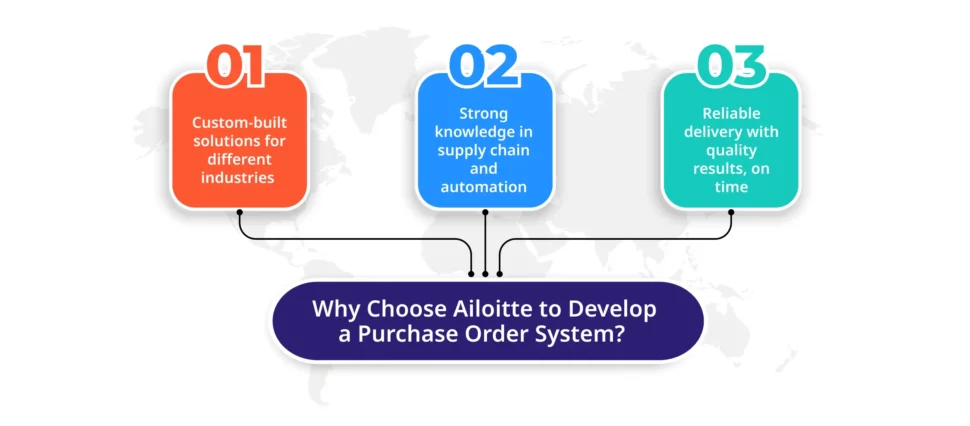
Selecting the right software development partner is as important as choosing the right technology. Ailoitte is the leading purchase software development company that stands out as an excellent choice for developing you purchase order management system:
- Custom-built solutions for different industries
Ailoitte is a custom software development company that specializes in creating solutions designed to fit the specific needs of different industries, such as finance, retail, and supply chain. Their expertise ensures that your purchase order system aligns with your business processes and meets all necessary compliance requirements. - Strong knowledge in supply chain and automation
With strong experience in manufacturing and supply chain software—such as ERP, SCM, and inventory tools—Ailoitte has a clear understanding of the key data processes and automation requirements that an effective purchase order system should support. - Reliable delivery with quality results, on time
Many clients from industries like fintech and edutech have shared positive feedback about Ailoitte’s ability to understand project needs quickly, deliver work on schedule, and maintain high standards of quality throughout the development process.
Final Thoughts
As aforementioned, it is quite clear that a purchase order software is more than just an upgrade for businesses. It is that strategic asset that empowers organizations to streamline procurement, enhance financial control, and build stronger supplier relationships. Whether a small manufacturer, a healthcare provider, or a growing e-commerce firm, businesses across sectors can benefit from the precision, transparency, and scalability that modern PO systems offer.
After all this, relying on manual processes will not just be outdated but a missed opportunity. If you also find your business juggling spreadsheets, chasing approvals through emails, or struggling with vendor coordination, it’s time to consider the shift. Implementing a modern purchase order management system will completely transform how your business handle procurement.
Curious how Ailoitte Can Build Your PO System?
Contact Us
Sunil Kumar is CEO of Ailoitte, an AI-native engineering company building intelligent applications for startups and enterprises. He created the AI Velocity Pods model, delivering production-ready AI products 5× faster than traditional teams. Sunil writes about agentic AI, GenAI strategy, and outcome-based engineering.
About Ailoitte