On this page
Choosing an AI consulting partner is one of the biggest calls a company makes on its AI roadmap. Most organizations now use AI somewhere, but far fewer turn it into measurable profit, and the partner you pick often decides which group you land in. This guide covers what an AI consultant should do, the eight criteria that matter, the questions to ask, and the red flags to avoid.
What does an AI consulting partner do?
Choosing an AI consulting partner starts with knowing what one does. An AI consulting partner helps a company decide where AI will pay off, prepares the data and systems it needs, and builds or guides the solution into production. Good partners cover five areas:
- Strategy and use-case prioritization. They rank AI ideas by value, feasibility, and risk, often starting with an AI maturity assessment of your data, skills, and processes.
- Data readiness and data engineering. They audit, clean, and connect the data a model will depend on.
- Model development and MLOps. They build, test, deploy, and monitor models, including machine learning, generative AI, and AI agents.
- Governance and compliance. They set rules for privacy, security, bias, and regulation from day one.
- Change management and training. They help your teams adopt the solution and run it without the consultant.
A partner that only offers the first area writes strategy decks. A partner that only offers the third builds models nobody uses. Look for one that covers all five, or that is honest about which ones it hands to others.
Why does choosing the right AI consulting partner matter in 2026?
Choosing the right AI consulting partner matters because AI adoption is now common, but AI results are not. McKinsey’s State of AI survey, fielded in mid-2026 with 1,719 participants, found that nearly nine in ten organizations use AI regularly in at least one business function. Only 44% say they are scaling AI across the enterprise, and only 37% report an enterprise-level impact on EBIT.
The gap between pilots and profit is wide. MIT’s “GenAI Divide” research, as reported by Fortune, found that 95% of generative AI pilots delivered no measurable financial return. The same research found that buying AI tools from specialized vendors succeeded 67% of the time, while internal builds succeeded far less often.
Gartner had already warned that at least 30% of generative AI projects would be abandoned after proof of concept by the end of 2025. The reasons it gave were poor data quality, weak risk controls, rising costs, and unclear business value. A good AI consulting partner is hired to prevent exactly those four failures.
Should you hire an AI consultant or build an in-house team?
Before choosing an AI consulting partner, decide on the model. Most companies should start with an AI consultant and build in-house skills over time. AI specialists are hard to hire, and a first project rarely justifies a full team. A hybrid model, where the partner builds and trains your staff, gives speed now and independence later.
AI consulting partner vs in-house team vs hybrid
| Factor | AI consulting partner | In-house team | Hybrid |
|---|---|---|---|
| Time to start | Weeks | Months of hiring | Weeks |
| Upfront cost | Project or retainer fees | Salaries, tools, training | Fees plus a small core team |
| Breadth of skills | Wide, across many projects | Limited to who you hire | Wide, with growing internal depth |
| Long-term control | Lower unless knowledge is transferred | Full | High once handover is done |
| Best for | First projects and specialist needs | AI as a core product | Most mid-size and large companies |
External help also improves the odds of success. A BCG survey of more than 280 finance executives found that working with vendors for their expertise raised the odds of AI success by 5 percentage points. The same survey found that the median reported ROI from AI was just 10%, and only about one in five finance functions reported ROI of 20% or more.
If you are weighing a custom solution against a ready-made product, this guide on build vs buy AI agent decisions walks through the trade-offs.
What types of AI consulting partners are there?
When choosing an AI consulting partner, it helps to know there are four main types of AI consulting partners, and each suits a different company and budget.
Global strategy firms
Global strategy firms advise boards on AI strategy, operating models and transformation roadmaps. They are strong on business cases but often hand the build to another firm.
Best for: board-level strategy in large enterprises.
Big 4 and global systems integrators
Big 4 firms and global systems integrators run large, multi-year programs across ERP, cloud, and AI. They offer scale and governance, but smaller projects can get junior teams.
Best for: enterprise-wide programs with many systems.
Specialist AI boutiques
Specialist AI boutiques focus on AI engineering, such as machine learning, generative AI, and agents. They usually move faster and put senior engineers on the work.
Best for: a defined use case that must reach production.
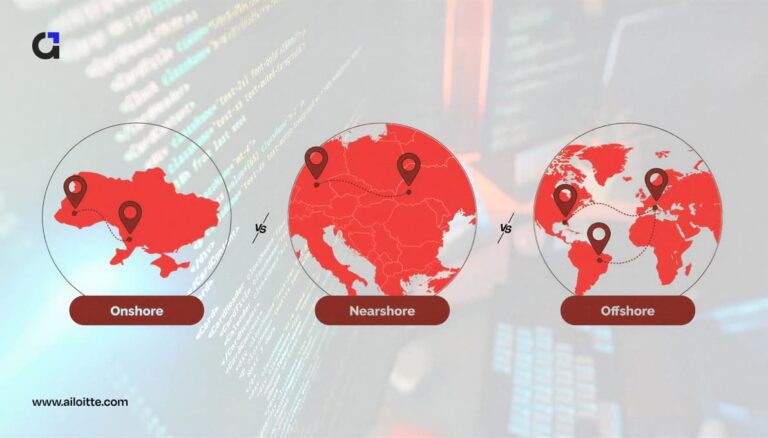
Offshore and nearshore delivery partners
Offshore and nearshore partners combine AI consulting with lower-cost engineering teams in another country. They suit companies that need both advice and a sustained build.
Best for: cost-conscious teams that need consulting and delivery together.
8 criteria for choosing an AI consulting partner
When choosing an AI consulting partner, the eight criteria below separate a partner that delivers production AI from one that delivers slides. Score each shortlisted firm against all eight.
1. Industry experience and case studies
Industry experience means the partner has solved similar problems under the same rules and data limits you face. A healthcare partner should know patient data and compliance, and an ecommerce partner should know recommendations and inventory. If you work in healthcare, see how to find the right AI healthcare companies for that sector.
Ask for case studies that show the starting problem, the solution built, measurable outcomes, and who on the team did the work.
2. Production evidence, not demo evidence
Production evidence means AI systems that real users rely on today, not prototypes. Ask how many of the partner’s projects are live, how long they have run, and how they are monitored. A polished demo proves little about delivery.
3. Technical depth across AI platforms
Technical depth means the team has hands-on skill in the methods and tools your use case needs. Check for experience in machine learning, generative AI and large language models, natural language processing (NLP) and computer vision. Also check cloud platforms such as AWS, Microsoft Azure, and Google Cloud, and frameworks such as PyTorch and TensorFlow.
4. Data engineering before model talk
Data engineering is the work of collecting, cleaning, and connecting data so a model can use it. A strong partner asks about your data before it talks about models, because poor data quality is one of the top reasons AI projects are abandoned.
5. Honest advice on custom vs off-the-shelf
A good partner tells you when an off-the-shelf tool is enough and when custom AI is worth the extra cost. Custom models fit specialized cases such as diagnostics, risk modeling, or supply chain planning. Partners offering AI development services should be able to explain that choice in terms of cost and expected return.
6. Team composition and cross-functional skills
When choosing an AI consulting partner, look closely at team composition: the mix of roles the partner puts on your project. A balanced AI consulting team usually includes:
- Data scientists for modeling and experiments.
- Machine learning engineers for scalable systems.
- An AI architect for fit with your infrastructure.
- A business analyst to turn goals into use cases.
- A domain expert for industry context.
Confirm that the people in the pitch are the people who will do the work.
7. Governance, security and compliance
Governance is the set of rules that keeps an AI system safe, fair, and legal. Ask how the partner handles encryption at rest and in transit, role-based access control, and laws such as GDPR, CCPA, and HIPAA. If you operate in Europe, ask how the partner meets the EU AI Act’s risk-based rules, including the transparency duties in force since August 2026.
8. Commercial model, knowledge transfer and IP ownership
When choosing an AI consulting partner, the commercial model should tie fees to outcomes where possible, not only to hours or documents. The contract should also include a plan to train your team, and it should state that you own the code, models and data built for you. A clear exit clause protects you if the partnership ends.
What questions should you ask before hiring an AI consultant?
Ask these eight questions before choosing an AI consulting partner and signing a contract. A strong partner answers each one with specifics, not promises.
- What similar problems have you solved in our industry, and can we speak to those clients?
- How many of your AI projects are in production today?
- Who exactly will work on our project, and how senior are they?
- How will you assess our data before you propose a solution?
- How do you handle data privacy, security, and regulations such as GDPR and the EU AI Act?
- What measurable ROI did your past projects deliver, and how was it measured?
- What support do you offer after launch, and what are your response times?
- Who owns the code, models, and data at the end of the engagement?
Red flags to watch out for when choosing an AI consulting partner
The biggest red flag when choosing an AI consulting partner is a firm that promises results before it understands your business. Watch for these six warning signs.
Overpromising without evidence
Be wary of firms that guarantee large ROI figures without data to back them. Regulators take these claims seriously: the US Federal Trade Commission launched Operation AI Comply in September 2024 to act against companies making deceptive AI claims. A credible partner talks about what could go wrong as well as what could go right.
AI washing and agent washing
AI washing is when a vendor labels basic automation as AI. Agent washing is when a basic chatbot is sold as an autonomous AI agent. Ask to see what the system decides on its own and what is hard-coded.
A proposal before a diagnosis
A proposal that names tools and prices before anyone has looked at your data is a sales pitch. Good partners run a short discovery phase first.
No transparency on data use
A partner should state clearly how your data will be used, stored, shared, and deleted. Refuse any arrangement where your data may train models for other clients without your written consent.
A pitch team that disappears
If senior experts sell the work and junior staff or unnamed subcontractors deliver it, quality usually drops. Ask for named team members in the contract.
Vague deliverables and rigid contracts
Unclear timelines and fuzzy outcomes make it hard to hold a partner to account. At the same time, a contract with no room to change scope will not survive what you learn in the first months.
How to choose an AI consulting partner in 5 steps
Choosing an AI consulting partner works best as a short, structured process. Follow these five steps.
- Define one business goal and how you will measure it, such as hours saved or revenue gained.
- Shortlist three to five partners that match your industry and use case.
- Score each partner on the eight criteria and the eight questions above.
- Run a paid pilot of four to eight weeks on one high-value use case before a long contract. Many teams scope this pilot like an MVP, and MVP development services can help keep it small and testable.
- Check references, then sign a contract with agreed KPIs, named team members, IP ownership, and exit terms.
How much does AI consulting cost?
The cost of choosing an AI consulting partner depends on scope, team seniority, location, and the pricing model. Most partners use one of four models:
- Fixed-price projects for a defined scope, such as a discovery phase or pilot.
- Time and materials, billed by hour or day.
- Monthly retainers for ongoing advice and support.
- Outcome-based fees tied to agreed results.
Rates vary widely between global strategy firms, systems integrators, boutiques, and offshore teams, so compare full project quotes rather than hourly rates. If your first project is an AI agent, this breakdown of AI agent development cost shows what drives the budget.
How Ailoitte approaches AI consulting
When choosing an AI consulting partner, Ailoitte is one option to consider if you need a partner that combines advice with delivery. As an AI consulting company, Ailoitte works with startups and enterprises on AI strategy, generative AI, AI agents, computer vision, NLP, and predictive analytics. Its focus is moving from use-case selection to production-ready applications.
For companies planning wider change, Ailoitte also supports AI transformation programs. Like any partner on your shortlist, test it against the criteria and questions in this guide.
Summing up
Choosing an AI consulting partner is about evidence: live AI systems in your industry, strong data engineering, a named senior team and clear governance. Start with a short paid pilot, tie the contract to measurable outcomes, and make sure you own the IP. The right partner leaves your team able to run AI on its own.

Sunil Kumar is CEO of Ailoitte, an AI-native engineering company building intelligent applications for startups and enterprises. He created the AI Velocity Pods model, delivering production-ready AI products 5× faster than traditional teams. Sunil writes about agentic AI, GenAI strategy, and outcome-based engineering.
About Ailoitte