



Every app starts with a great vision and idea, but while every entrepreneur finds their app idea perfect, it is not always practical. While some run a hypothesis, most business people put their entire life savings into a product only to discover that it has no market.
Do you know what successful apps like Spotify, Uber, and Instagram have in common?
They all have used a Minimum Viable Product (MVP) process to test the viability of their respective products and have gradually evolved to become the mature app they are today. Creating an MVP is a popular strategy that has worked wonders for many big names in the market.
In this blog, we will walk you through:
- What is a Minimum Viable Product (MVP)
- What an important tool it can be for business
- The benefits of a minimum viable product
- How to build a minimum Viable Product (MVP)
- How to measure the success of an MVP, and some examples.
What is an MVP?
A Minimum Viable Product (MVP) is the most basic version of the digital product with a minimum set of core features that would solve the user’s needs and deliver value.
The idea of developing an MVP app is to quickly get the early version of the product built from scratch with key features. It aims to appeal to users, earn revenue, and get feedback to improve the product in time.
Also read: PoC vs Prototype vs MVP: The key differences
Why Go for the MVP Approach
An MVP can help a business build a better-performing product after customer feedback. Let us look at how adopting the approach can help companies and product managers.
Hypothesis validation
CEOs and product managers make assumptions about a target segment and market need based on the data they gather. After the MVP launch, the hypotheses about the target market get validated. In addition, product managers can gain invaluable insights into customer feedback and metrics that can help them determine the next steps for the product strategy.
Fast release
An MVP contains all the necessary features built using fewer resources and less time. This enables product managers to introduce the product or app to the market in the least turnaround time and test if core features meet the target audience and market needs.
UX Validation and Focuses Functionality
Developing an MVP focuses on minimal key features, leading to higher-quality results and a better user experience. It helps validate user flow, create MVP documentation, and adopt core features. By analyzing the user journey, product managers can establish an MVP scope for improvement to smooth the user experience. Any feedback can help iterate the MVP app development process.
Funding
It is easier to impress investors/investment firms and onboard them if an MVP is developed and already on the market with active users. Also, if the users are paying to use those core features- it becomes easier to impress the investors.
Reduces Risk
Since minimal effort is involved in focusing on core features, the risk involved in developing and launching the MVP is also low. Spending a huge chunk of money on unnecessary features and checking if the market needs exist later on can lead to losses. By focusing on the core features, product development teams can work on a fail-fast approach, thus reducing risks.
Better Customer Relationships
Adopting core features in MVP website development and the value they can deliver can help the business build a good relationship with the early adopters. For example, if users find a deal in your product, they are more likely to proactively share feedback with you to help improve the product and share the word about your app amongst their circle.
How to Build a Minimum Viable Product (MVP)
When building an MVP app, the most important thing to focus on is highlighting essential product features and leaving the complicated ones behind that require a lot of resources.
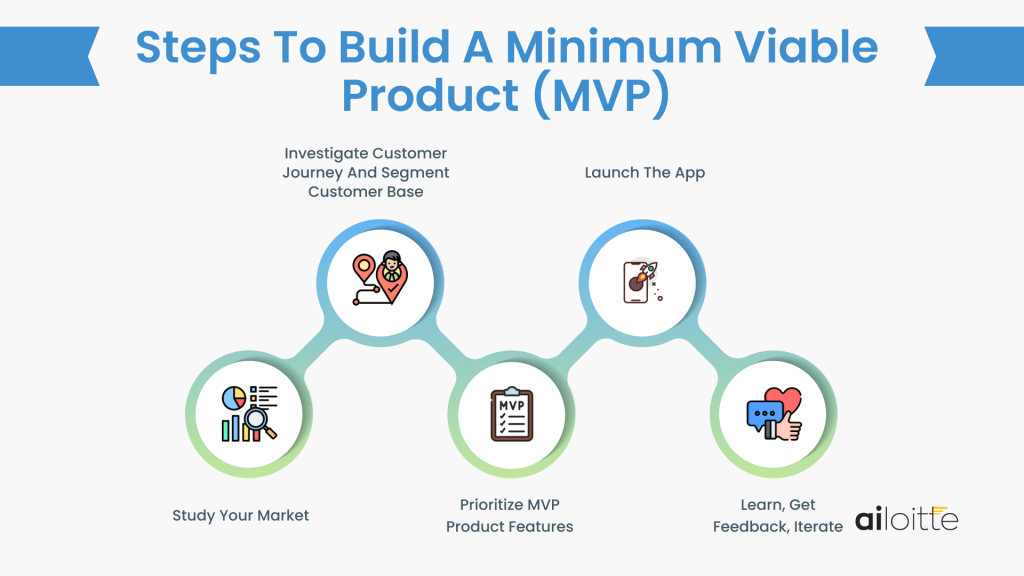
Here are the steps to build a Minimum Viable Product (MVP).
1) Study Your Market
Understanding people’s problems and needs can go a long way in building a successful MVP app. By deeply analyzing the market and competitors, MVP developers and businesses will know if there is a need for your product, pain points that haven’t been satisfied yet, and what competitor products lack. All this information will help you fill in the gaps to transform them into your competitive advantage.
2) Know Your Customers’ Journey
To evaluate your app, you must look at it from the user’s perspective. First, find out what attracts them and make them choose your app. Next, detect their problems and learn why they are abandoning your competitors. Lastly, analyze the queries that lead them to your platform.
Once you know what moves them from being a browser to a user, you can speed up the process through content like tips, instructions, lead magnet reviews, and demos.
3) Prioritize MVP Product Features
Since an MVP for mobile apps offers a limited number of features, you must prioritize them to avoid distractions. Therefore, you should ensure what your client needs and the features that would help address those needs. Additionally, categorize all the product features as per priority and the characteristics and outcomes they will have.
Finally, keep a few features as a backlog for future product development. This would help startups scale their product on limited budgets.
4) Launch the App
Once a business decides on its main features and learns about the market needs, it is time to create an MVP. An MVP that is easy to use, engaging, and suitable for users is a must without lowering the quality of the final product.
5) Learn, get feedback, and iterate
The first step when a product gets released after MVP software development is to get feedback from clients and determine the acceptance and competitiveness of the app in the market based on comments received. Then, analyze each answer, add new tasks to the backlog, and iterate till the product is ready for a broader user base.
How to Measure Success after Developing an MVP
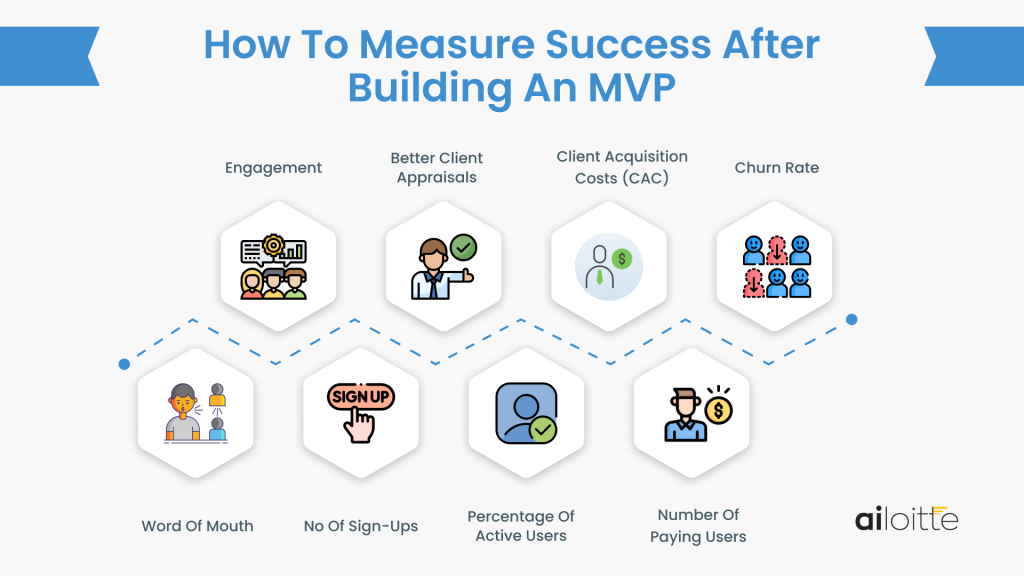
Here are a few common, effective, and proven ways by which you can predict a product’s future.
1) Word of Mouth
Traffic can be a valuable metric to measure success. Interview potential customers and list their problems or what they are likely facing.
2) Engagement
It enables you to measure the app’s current and future value. Again, an insight that helps improve user experience based on feedback.
3) Number of Sign-ups
It is the most feasible way to gauge user interest. The number of sign-ups gives businesses an idea of users’ interest and helps anticipate the revenue that the companies will be able to get. Then, based on the response, it can help companies to convert.
4) Better Client Appraisals
The number of downloads and launch rate show user interest in the app. Moreover, it is typically seen that lighter apps get more downloads; thus, when you build an MVP, you get that advantage as well.
5) Percentage of Active Users
Download and launch rates are not the only factors to measure your MVP’s success. In addition, it is essential to study user behavior and check active users’ ratings.
6) Client Acquisition Costs (CAC)
Knowing how much it costs to get a paying customer is essential. The CAC is usually calculated based on the money spent on the channel divided by the number of customers acquired through the channel. While on an ideal level, they should be as low as possible, it is a good number to track for knowing if your mobile app development and marketing efforts are practical or require change.
7) Number of Paying Users
Keep track of the revenue that your product is bringing in by knowing the average revenue per user. It is the total income for the day and age divided by the number of active users.
8) Churn Rate
The churn rate shows the level or percentage of people who have stopped using the app or uninstalled it. This would help businesses to know what to improve.
Six Apps that began as MVPs and Became Huge Successes
The beginning of any startup is a business idea validation which is why it cannot skip MVP in the software development stage. However, here are a few apps that started off as MVP projects.
1) Amazon
One of the most successful MVP examples is Amazon which began in 1990 as an online book store by Jeff Bezos. After brainstorming a vast list of ideas to sell on the internet, he went from 5 products that included videos, books, software, computer, and compact disks to millions of other products to become a Number 1 eCommerce platform.
2) Airbnb
Airbnb began with an air mattress, bed, and breakfast in 2007 when the founders struggled to find an apartment and ended up renting extra space. So they launched an MVP for a room-exchanging platform right from within their home, which has now become an $85 million company.
3) Dropbox
Dropbox had a revolutionary idea to create online file storage. However, instead of spending a fortune on building a complex app, they began with a simple explanatory video showing how Dropbox worked and its functions. The Minimum Viable Product (MVP) strategy was adequate, as the number of signups increased five times overnight with no actual product yet. The experience of seeing the product was enough for the people to get convinced about its effects.
4) Facebook
Mark Zuckerberg’s initial idea was to connect with everyone at Harvard. He started with Facemash, which students used to compare two pictures and decide who was “Hot” and “Not.”
It evolved into a website called Thefacebook, which was the MVP of social networks and was rolled out in 4 top American universities – Yale, Columbia, Stanford, and Harvard.
After a year of testing on audiences and proper MVP product design, they opened access to everyone, which is how Facebook started.
5) Zappos
Zappos was introduced in 1999 by Nick Swinmurn, who wanted to test customers’ ready-to-buy shoes on the Internet. So he went to local stores in the San Francisco area, took pictures of the shoes they sold, and uploaded them online. Once a user places an order, he will head to the store and buy and ship it. He did this for some time and understood that people were ready to engage in shopping retail online.
After proper MVP planning and launching the minimum viable product, Swinmurn found partners and finally released a fully-functioning solution that earned over 1 billion in sales and was purchased in 2008 by Amazon.
6) Groupon
The app began as a platform that helped people gather together and run crowdfunding. Then, users began to help each other and share special deals and promo codes they found in the area.
The team evolved and began manually posting information about sales and sending an email with all information when someone subscribed. The MVP stage helped the company modify the current version, which is the go-to coupon and discount listing website.
Summing Up
Regardless of the MVP product development starting point, the end goal should be a maximum valuable product that stands out from the competition, satisfies customers thoroughly, and creates value for everyone involved.
Many well-known organizations have started with an MVP and created a billion-dollar business after several iterations. These success stories prove that an MVP can launch your product before moving toward a robust, well-tested mobile app development strategy.
Accelerate your time to market with the right expertise to meet your company’s goals and product needs. Contact us if you need a reliable full-cycle software development company to guide you through how to create an MVP, the costs of an MVP, and avail high-quality MVP development services.
With 20+ projects under our belt, we have helped organizations maximize the odds of success, keeping in mind their business goals. With careful planning, our practical solutions have helped explore their idea’s potential by sticking to the schedule within the tightest timeframes. We have provided MVP Development in under 45 days in various verticals, which have turned into full-featured projects such as Apna, Stargaze, SupDup, etc.
FAQ
A minimum viable product or MVP is a version of a product with features just enough to be used by early customers who can provide feedback for future development and evaluate its potential.
A Minimum Viable Product (MVP) is a software product that works on the minimum requirements to solve a problem or satisfy a need.
The primary purpose of an MVP is to collect feedback and get early data that confirms users’ interest in the app before releasing a full-fledged product.
A Minimum Marketable Product (MMP) is the next step after an MVP. It is the version of your MVP that can finally be released/presented to the market. While the MVP helps you understand customer needs, the MMP lets you determine how to make the product more marketable.
An MVP (minimum viable product) allows businesses to start small and iterate quickly to produce a better app. With every release, it evolves to maximize ROI and helps the business make better decisions.

Share this article:
Leave a Comment
Leave a Reply







100+
Project Launched

80+
Happy Clients

18+
Countries Served

91%
Returning client base




.png)
.png)
.png)



Thanks for sharing.
I read many of your blog posts, cool, your blog is very good.