



Analyzing different Internet of Things (IoT) ideas for business can be a long and tiresome process. The only way to do it quickly and effectively is by getting familiar with all its aspects which would help you understand what you are getting into and which IoT business ideas are most suitable for the resources you have.
The Internet of Things has made a lasting impact on technology with connected devices like smart watches, smart homes, and biometric systems becoming increasingly popular.
The Internet of Things is a network of devices connected over the Internet with capabilities like sensors, software, and processing systems to exchange data with similar devices and cloud servers. It means everyday devices like smartphones, cars, and smartwatches can use sensors and data collection to provide a personalized experience for users.
IoT solutions have the futuristic potential to improve the lifestyle of regular people and the business operations of various companies. For example, a CCTV camera integrated with software you can access from anywhere and any device is an IoT device that helps you monitor your business place in real time.
According to the State of IoT Spring 2022 report by IoT Analytics, the number of IoT connections worldwide was 12 billion in 2021 and the number may grow to 14 billion by the end of 2022.
Types of IoT
IoT solutions play contributory roles in different sectors and activities. You can analyze their roles in every industry to determine the best alignment with your business. Coming up with technology business ideas for the Internet of Things will also become easier once you know your niche.
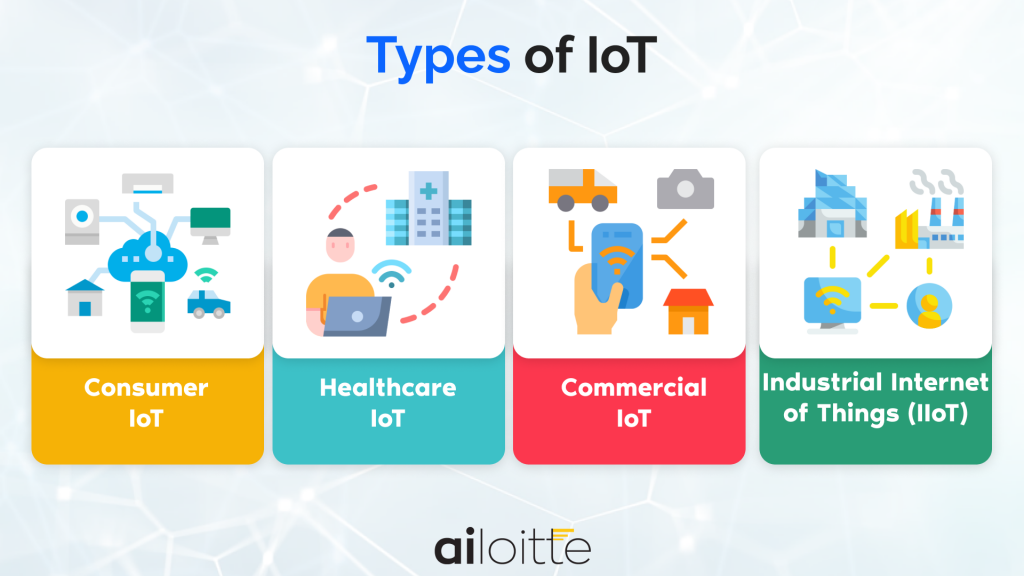
1. Consumer IoT
Consumer IoT involves devices regular people get for personal use like wearables, smartphones, smart toothbrushes, and home appliances. According to the market analysis of Statista, the world now has more than six billion smartphone users in 2022 and the number of smartwatch users worldwide has grown around 216 million. It is why consumer IoT devices are a lucrative option to choose in this business.
2. Healthcare IoT
Healthcare IoT includes devices like heart-rate monitoring devices and ingestible sensors. A report by Fortune Business Insights indicates that the value of the IoT healthcare market may reach $446 billion by 2028 compared to $89 billion in 2021.
3. Commercial IoT
Commercial establishments such as shopping malls, government organizations, etc. use IoT devices like barcode scanners, QR code scanners, CCTV, and thermal sensors. The demand for commercial IoT devices keeps increasing.
4. Industrial Internet of Things (IIoT)
Various industrial operations need IoT devices for automation, predictive maintenance, and to remove the possibility of human errors. Some examples are building management systems (BMS), Augmented reality (AR), asset monitoring systems, and robots.
Benefits of IoT for Businesses
The IoT business benefits should give you a better idea of what you can expect from it for your business.
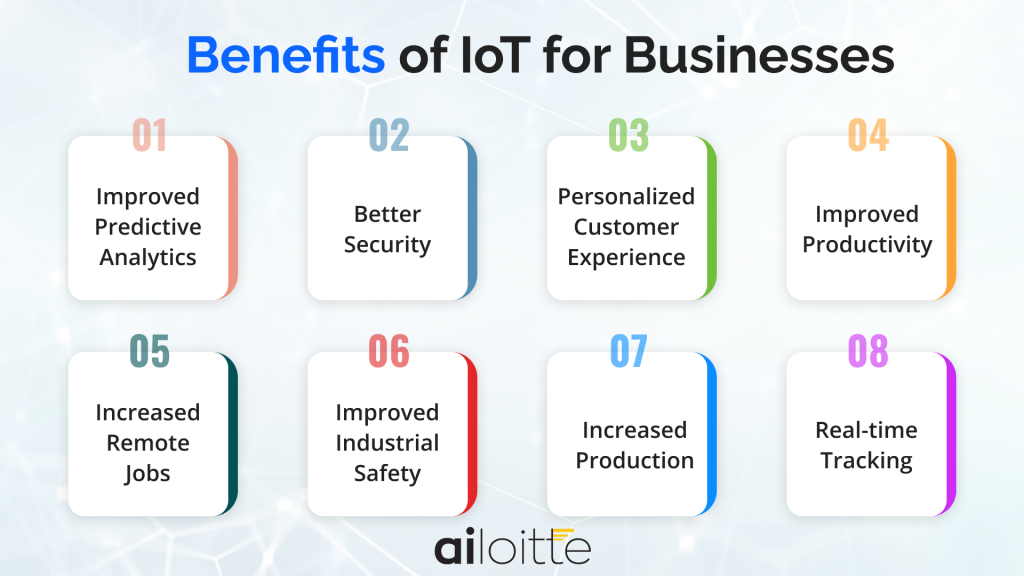
1. Improved Predictive Analytics
AI and ML-integrated IoT devices help predict and prevent damaging outcomes for businesses. For example, AI-integrated CCTV cameras may analyze and report suspicious behavior based on security protocols or similar past incidents. For example, healthcare and industrial operations benefit significantly from AI and ML-integrated IoT systems as they remove the chances of human errors altogether.
The improved analytics by AI and ML also provides a better understanding of the market. It can help create a business and marketing strategy that leads to growth.
2. Better Security
IoT devices like thermal sensors, CCTV, and automated systems improve security in many commercial and industrial sectors. For example, a smart temperature sensor can detect harmful levels and warn the concerned parties before it is too late.
Business owners can monitor every process and location of the business 24/7 with IoT cloud and CCTV cameras.
3. Personalized Customer Experience
IoT connectivity can analyze consumer usage of various devices to identify their browsing and spending behavior patterns. Such a process helps improve the efficiency of IoT apps and devices like smartphones, smartwatches, and home automation systems.
Personalized customer service leads to a satisfactory experience and improves the image of any business.
4. Improved Productivity
IoT devices bring every easy and complex aspect of a business into a single or collective platform. It improves the collaboration and productivity of various business operations. AI and ML-integrated devices also provide analytics reports that help make complex business decisions quickly. It saves time, removes human errors, and promises growth.
For example, a business owner can track a sale of a single product with barcode scanning, electronic records, and the cloud. They can do this even if a customer buys the product on a different continent.
5. Increased Remote Job Operations
The aftermath of the COVID pandemic has increased the demand for remote job operations and IoT devices make that a lot easier for employees working virtually. For example, doctors can help patients 24/7 through telemedicine apps. They can also recommend medicines that the patients can buy on the app itself. On the other hand, HRs can onboard new employees virtually by combining IoT capabilities with AR/VR technology.
6. Improved Industrial Safety
IoT-integrated automation increases the accuracy and safety of various industrial operations. It protects everyone present at the location from dangerous incidents.
For example, AI-integrated automation devices prevent the misuse or overuse of material/equipment, which is one of the primary causes of deadly incidents in industrial operations.
7. Increased Production
IoT improves the efficiency of production lines with automation, equipment failure detection, and the removal of human errors. The production of food products, electronic products, and automobiles can increase significantly with IoT.
8. Real-time Tracking
All commercial and industrial transport operations require timely delivery and real-time tracking of shipments. Such transportation can become safer and more reliable with weather and temperature monitoring systems.
Real-time tracking also benefits healthcare institutions as medical professionals can easily track patients from any part of the hospital.
IoT Ideas for Business Opportunities
The business opportunities for IoT are as countless as its benefits. Choosing IoT for business can open doors for lucrative opportunities in many sectors like healthcare, retail, banking, and agriculture.
You can get more familiar with them to understand which IoT business opportunity is best for you.
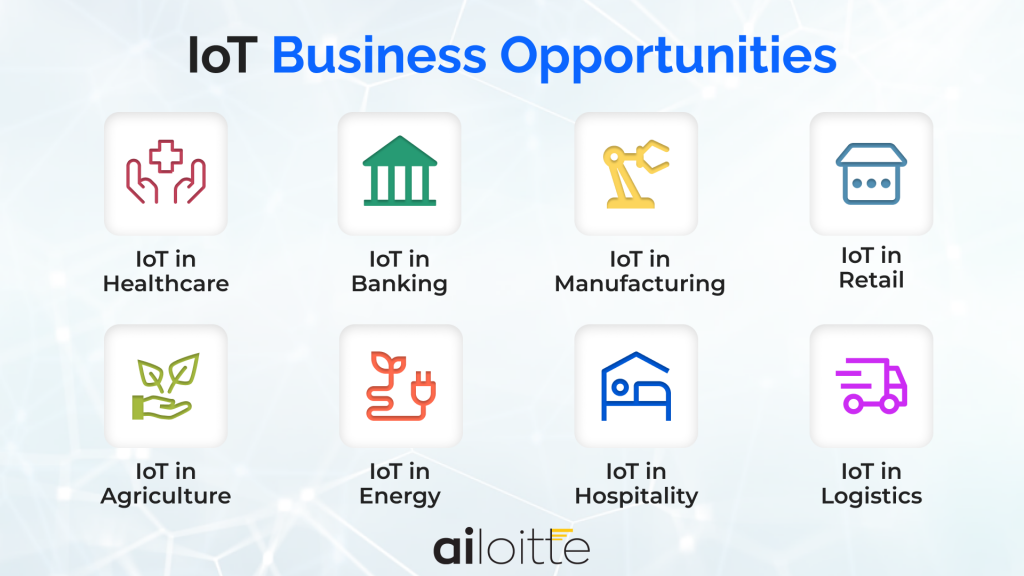
IoT in Healthcare
Healthcare institutions can always benefit from quick diagnosis and treatment to save as many lives as possible. Technology like heartbeat monitors, blood pressure monitors, breathing rate monitors, patient tracking systems, AI diagnosis, electronic health records, and predictive analysis can improve the operations of many healthcare institutions.
Read more – Healthcare Industry Trends
IoT helps create an architecture where all these devices can be connected to aid complex medical operations and research by improving the collaboration between medical professionals. It improves the productivity and effectiveness of many healthcare institutions.
Building a highly connected system is one of the most popular Internet of Things opportunities in the digital world.
IoT in Banking
The Internet of Things has the potential to reshape the banking sector as well. Smartphone banking apps and ATMs are already making banking operations more convenient. In addition to this, IoT devices backed by AI and ML can collect and analyze real-time customer data to assess their needs.
For example, a better analysis of the customer’s banking behavior may reveal whether they may need a credit card or a loan. The bank uses this data to offer customers personalized credit card/loan plans. Creating a business in banking IoT may be one of the most promising choices for Internet of Things startups. Your business will become the go-to brand making banking processes digital, secure, and convenient.
Read more – Top Fintech App Development Trends
IoT in Manufacturing
An IoT network of connected devices and systems can make it easy to analyze and control the manufacturing process efficiently. For example, AI-integrated automation technology can quickly detect a flaw in the operational condition of any machinery and report the same to the maintenance department.
Interconnected devices throughout the factory assist businesses in ensuring the top-tier quality of the products and help decrease production delays while helping regular employees and managers make informed decisions that benefit the product quality and business.
Some benefits of IoT in manufacturing can be seen in instant market demand analysis, quality control, predictive maintenance, product improvement, and inventory management. Owing to these benefits, the demand for IoT devices in manufacturing will keep increasing in the future, and creating an IoT business in this sector will surely lead your business toward lasting growth.
IoT in Retail
IoT devices help the retail industry analyze customer needs and improve product/shipment tracking with GPS technology. Moreover, they may remove the need for cashiers at many retail stores by providing do-it-yourself digital payments. It makes things more convenient for the customers and helps analyze their buyer behavior.
For example, a smart IoT device can keep track of customers’ buying behavior with digital payments and receipts and this data can determine the type of products that are most popular among the target audience of the retail store. It will help the store increase the demand/supply of that product.
The benefits of IoT in retail are personalized customer service, product shipment/delivery tracking, automated checkouts, better inventory and supply chain management, and foot-traffic monitoring.
IoT in Agriculture
Constant improvements in agriculture are necessary to meet global food requirements. And the interconnected network of IoT devices can help with that. IoT technology like moisture, light, and temperature sensors can monitor the crop field 24/7 to ensure better yield while using automated agriculture equipment to help with planting, fertilizing, harvesting, and irrigation systems.
IoT improves agriculture with 24/7 surveillance, prediction through data collection, prevention of wasteful production, and sensors (temperature, humidity, and air quality). Building an IoT business in Agriculture is one of the most untapped yet lucrative choices.
IoT in Energy
IoT in energy involves the management of energy consumption and processes with data collection and transmission automated by using technology like smart grids. Creating an IoT business in the energy sector is one of the best options for top IoT startups looking into predetermined protocols for outages or disasters, energy resource optimization, microgrids, and smart meters.
A report by Mordor Intelligence indicates that the market value of the Internet of Things in the energy market will reach $298 billion by 2026 compared to $168 billion in 2020.
IoT in Hospitality
The Internet of Things can revolutionize the hospitality sector by creating a single digital system for hotels, casinos, resorts, tourism, nightclubs, and spas. A single system that will be accessible through multiple interconnected devices.
The automated AI-integrated process can effectively collect user data to predict and suggest alternatives that may improve customer experience. The AI-integrated IoT system could also prove useful for authentication. For example, cruise ships can use voice, facial, or fingerprint scanning for ship entry and access to their private rooms.
Building the IoT business in the hospitality sector will lead to continuous growth and profit. It is because the hospitality industry has been coming up with multiple use cases for the technology like smart room locks, voice-controlled authentications, asset tracking, effective data collection and analysis, personalized customer experience, and better security.
IoT in Logistics
The timely delivery of good condition products or services is always a concern in transportation and logistics. IoT devices simplify this process with remote tracking of shipments, drivers, vehicles, storage conditions, and instant data transmissions.
IoT in logistics saves time and resources by providing remote systems to manage or track assets in various locations or transport. It improves inventory management, transportation, and storage/warehouse maintenance.
The top benefits of IoT in logistics include secure and faster transportation, real-time storage and transportation monitoring, remote warehouse management, lower costs, and improved operational performance.
Trending Topic – 24 Innovative Mobile App Design Trends in 2023
Top IoT Trends
IoT is an integral part of the future as it can revolutionize the entire healthcare and industrial sector in the coming years. The new developments in AI and automation will keep improving the effectiveness of various industrial operations.
The ability of IoT to connect billions of devices in order to serve single or multiple purposes will reshape the future. Here are some IoT trends to understand its contribution to the future:
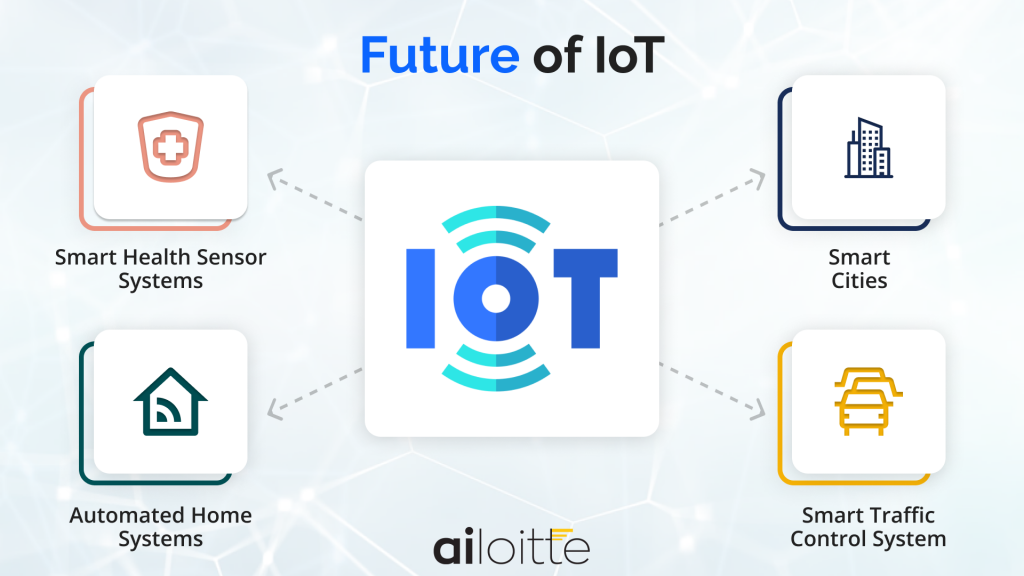
Smart Health Sensor Systems
Smart sensor devices can detect changes in blood pressure, heart rate, and pulse in seconds. This system then quickly shares the data with the concerned medical professionals for further diagnosis and treatment. Such IoT devices save and will save countless lives in the future.
New developments in health sensor systems may also help us monitor other aspects of health. For example, an AI-integrated heart health sensor could analyze past information about a person’s health and monitor it to predict the possibility of heart attacks or other diseases.
Smart Cities
Most cities in the future will have technology like smart traffic control systems, quick online payments, and smart buildings. Such IoT systems will bring the operations of the whole city to one server.
- Smart traffic lights and buildings will ensure better security for everyone.
- Online payments everywhere improve the convenience of payments and prevent the risk of diseases spread through physical contact.
- Technology like QR code scanning, face detection, and fingerprint scanning will improve the accessibility/security of the whole city and its residents.
More and more IoT trends and innovations will keep improving the smart city experience for its residents now and in the future.
Also See – Top 10 Software Development Trends For 2023
Automated Home Systems
Home automation helps a person control all aspects of the home such as lights, temperature, dishwasher, silent alarms, and lawn sprinkler systems. It gives total and remote control of the house to homeowners.
The automated system simplifies every activity the residents perform in the home. You can expect a significant rise in people installing automated home systems as it offers top-notch security and convenience for the residents.
According to a report by Statista, the global smart home market may reach 53 billion by the end of 2022. It also makes automated home systems one of the smart business ideas for IoT you can consider.
Smart Traffic Control System
Smart traffic control systems can effectively analyze road traffic and accordingly manage lights to clear up the roads quickly.
For example, the smart traffic system can increase/decrease the time limit for vehicle traffic on different lanes to keep the roads clear if it identifies the possibility of heavy traffic. Such systems can warn other vehicles about the arrival of emergency vehicles like ambulances or fire brigades.
Smart traffic control systems may use CCTV systems to detect and report traffic violations, criminals on the run, and other suspicious activity. The new developments in deep scanning and camera monitoring may also help detect a damaged bridge or a road that needs immediate maintenance to avoid serious incidents.
Final Note
The Internet of Things is a door to the bleeding-edge technologies of the future. Technologies that will simplify almost every business and personal activity for billions of people. Doing business in this industry with the right strategy will generate considerable revenue for your company.
Technology like Artificial intelligence, cloud computing, a variety of sensors and scanners, and smart devices provide convenience for many businesses and people. It provides many business opportunities and different ways to increase company growth.
You can also choose many innovative ideas for your IoT startup. But the best approach will be to choose a specific niche and analyze the target audience. It will help you come up with IoT product ideas that can exceed expectations.
Consulting an IoT development company like Ailoitte may help you turn your IoT ideas into reality.
Frequently Asked Questions
Business opportunities for IoT are available in many sectors like healthcare, banking, agriculture, and hospitality. Determine whether your target audience is regular consumers, commercial users, or industrial areas. On the basis of this, you can choose the IoT products and services for your business.
Analyze the market to determine which IoT devices are most popular among people and commercial establishments and then consult with IoT technology experts to determine the products and services that may stand out in the competitive market.
Then all you will need is an IoT business plan designed to provide value to users and generate revenue.
IoT is a network of devices connected to the internet that exchange data in order to provide accurate and personalized results for the end users. For example, a retail store can provide customers with a digital voucher for discounts. Customers can use this voucher at any branch of the retail store from any location.
It also improves the efficiency of business operations which in turn, improves the convenience of their customers. Technology like home automation systems has made many people’s lives easier with better security and convenience.
Such technology is futuristic and inevitable whether you or do not choose it for your business. Many sectors like healthcare, banking, and manufacturing are already using IoT to improve the efficiency of their business. And almost every business and regular person will soon adopt this technology to increase the convenience of their operations and lives.
IoT is a system interconnected through multiple devices and apps on the internet. It helps provide similar or better services to customers with data collection and analysis. For example, if you integrate an IoT system with your food delivery app, you can provide customers with personalized recommendations no matter which location or device they use to access your app.
In short, IoT improves the end-user experience of apps which leads to you generating more revenue and growth for your business.

Share this article:
Leave a Comment
Leave a Reply







100+
Project Launched

80+
Happy Clients

18+
Countries Served

91%
Returning client base




.png)
.png)
.png)



Thanks for sharing. I read many of your blog posts, cool, your blog is very good.