



Choosing between Android or iOS app development for startups can determine whether your app stands out, attracts customers, increases business revenue, and creates a lasting impression with a unique brand image. Therefore, you should know why picking one has more benefits for your startup than the other.
For example, the global revenue of the Apple app store had reached $21.2 billion by the third quarter of 2022. In comparison, Google Play had only $10.4 billion, even though it makes up 70.96% of the global mobile operating system market share.
As a startup, such revenue should explain the value and long-term benefits of choosing iOS app development. Even if you keep revenue on the sideline for some time, choosing iOS guarantees better user data/privacy security, enhanced user experience, higher revenue, and top-tier application quality.

However, the budget of mobile app startups can often seem like a restraint when choosing to build a profit and value-oriented operating system that promises the most lucrative outcomes. You must understand why such a budget will not be an obstacle when you know what your startup can gain by choosing iOS app development for business growth.
iOS App Development Benefits
Choosing iOS app development for startups (over Android) is cost-effective and improves the value you can provide to target users.
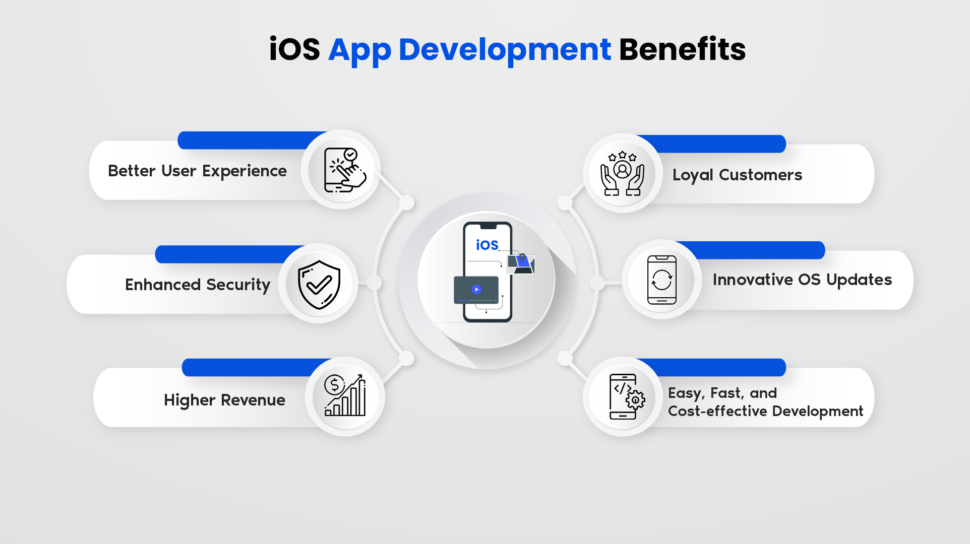
Better User Experience
The native development of an iOS mobile application can create a memorable and highly convenient user experience inside your app. To make that a little easier, Apple has some explanatory Dos and Don’ts for UI design that help designers ensure its enhanced quality and performance.
The closed ecosystem and the unique software development kit enable an iOS app to be distinctive in UI/UX design and functionality while helping startups build a simple yet attractive user interface that can improve the user experience of your application.
Key Takeaway: iOS app development allows startups to provide a significantly better user experience to target customers (compared to Android development).
Enhanced Security
iOS is generally a more secure operating system than Android, especially for user data security and privacy. Why? Apple platform security includes guidelines to secure every iOS app from unauthorized access, viruses, malware, data leaks, and man-in-the-middle attacks(MITM). The primary reason for such security is that iOS is a closed ecosystem, while Android is an open-source operating system.
When you submit an app to the Apple store, the curators evaluate its UI/UX design and security protocols to identify any flaws that could lead to security threats in the app or compromise the security of the OS itself. It forces you to ensure that your application meets all security requirements before launch.
The iOS app security also includes Data Protection (encryption), secure boot (with hardware and software), malware protection, operating system kernels, application sandboxing (protects user data from unauthorized access), cloud storage security, and a dedicated AES engine (for better encryption and decryption).
It comes with multiple robust security and testing tools like TestFlight, which are all available to use once you create an Apple Developer Program account for $99 per year, a highly reasonable and generous fee considering the multiple benefits of the platform. Providing enhanced application security becomes a lot easier when you choose iOS app development.
Key Takeaway: Mobile app startups can guarantee highly advanced and reliable security in their app with iOS while saving costs.
Higher Revenue
As mentioned above, the Apple app store reached a global revenue of $21.2 billion by the third quarter of 2022 (Google Play Store – $10.4 billion).
How does iOS generate this much revenue even though it only makes up 28.43% of the global mobile operating market share?
Answer: the target user base of Apple is more likely to spend money on in-app purchases and subscriptions. It is why spending on subscription apps from the Apple app store reached $6 billion in 2021, compared to $2.5 billion on apps from the Google Play Store. In addition, consumer spending on iOS mobile apps is estimated to reach $161 billion by 2026.
Making your mobile app startup a part of such a profitable platform is the right choice for your business and budget.
Key Takeaway: Mobile app startups have a better chance of generating considerable revenue from building an iOS app than Android.
Loyal Customers
iOS apps and Apple have a loyal customer base due to the security and user experience the Apple devices offer. A Statista Global Consumer Survey found that 92% of iOS users are satisfied with the brand, while 48% are loyal to it as they confirmed that they would not change brands. As a mobile app startup, you can use such loyalty to increase the user base and generate better revenue.
You can also consider the Net Promoter Score of iOS, which measures the customer base loyalty toward the brand. Higher than zero is a good NPS score, and any above 50 is exceptionally impressive. Apple iPhone has an above-average net promoter score (NPS) of 72 as of 2022.
As a startup that needs to compete with many giants in the mobile app industry, you need the support of such a loyal customer base if you want your app to succeed in the market.
Key Takeaway: Choosing iOS app development provides your app with an incredibly loyal customer base, making it easy to increase the user base and revenue.
Innovative OS Updates
To deal with bugs and improve platform security, Apple releases OS updates frequently, making it easy for your developers to increase the application security. For example, Apple introduced some exciting new features with iOS 16 – home screen page suggestions, focus mode (can allow notification from chosen apps even in Do Not Disturb mode), Messages Collaboration API, and Easy Shortcuts setup for apps with Siri.
You can use such iOS updates and feature releases to improve the application user experience further. The best part is that those updates will keep coming, so iOS app development will bring your business/brand and app lasting benefits by providing new technology that keeps improving the application user interface and experience. It will help you as app owners to keep your users interested in the app (user retention), get new users every day, and increase business revenue.
Key Takeaway: Innovative and frequent iOS updates will make it easy for your startup to enhance the user experience, interface, and overall application functionality.
Easy, Fast, and Cost-effective Development
Java (the popular Android programming language) includes coding work that generally takes longer than the coding work of Swift, the standard programming language of Apple for iOS, iPadOS, macOS, tvOS, and watchOS. Time-consuming coding means longer development and the longer the development, the more money you will have to spend on UI/UX designers, QA engineers/testers, required resources/third-party tools, and developers. It is not a viable option for a mobile app startup that needs to be extra careful with its budget and spending.
Therefore, choosing iOS proves helpful here since its primary programming language, Swift, is powerful, easy to use, write, and read, and includes less coding than Android programming languages like Java.
Swift is responsible for building the iOS versions of apps like WhatsApp, Facebook, Uber, and Lyft. In addition, a recent survey by Statista found that 50% of iOS apps on the app store are Swift apps.
Swift accelerates the development process and reduces costs while making the development process easier for the whole team with interactive coding experience, along with the iOS app development stack that further simplifies the process with testing tools like TestFlight.
Key Takeaway: iOS app development cost is generally more affordable/reasonable, while its development process is faster (than Android development), making it the ideal choice for mobile app startups.

Final Takeaway
Any mobile app startup survives and thrives on creative innovation that the startup can sustain with a limited budget, the iOS platform can provide your startup with exactly that and more. It provides benefits like enhanced application security, lower/reasonable costs, easy coding, app testing tools, and a great user experience and interface.
Therefore, choosing iOS app development for startups is undoubtedly the most cost-efficient and innovative option to introduce your business in the app market industry. It will allow you to test the potential of your startup through an application without spending a fortune.
Still, trying to decide between iOS and Android? Talk to an iOS app development company that has famously established itself as an Android development company as well. Our team will help you decide which platform is most lucrative for your startup in terms of product quality and project budget.
Frequently Asked Questions
Building an iOS app can guarantee better revenue and a loyal customer base, which can allow you to grow your business much faster.
Unlike Android, iOS app development provides your business access to a user base that is more likely to spend money on your product, services, and other in-app purchases, which can increase the revenue of your business significantly.
iOS app development comes with tools provided by the Apple developer program which allows developers to test the application according to Apple standards and ensure it has a good UI/UX and functionality. These elements can attract user attention, increase the user base, make it easy for you to sell your products/services through the app, and increase the overall business revenue.
Because, unlike Android, iOS offers better data security, a loyal customer base, and target users that are more likely to spend money on your product, services, or in-app purchases.

Share this article:
Leave a Reply







100+
Project Launched

80+
Happy Clients

18+
Countries Served

91%
Returning client base




.png)
.png)
.png)



Leave a Comment