



React Native: Meet the future of Cross-platform Apps
React Native has been adopted by businesses worldwide and can be used across a whole range of industries ranging from social media to travel-based apps. Some well-known React native app examples include Uber, Microsoft, Instagram, and Facebook.
React Native comes closely behind Flutter as the most preferred cross-platform software mobile framework used by software developers worldwide from 2019 to 2021, as per Statista.
As per the Stack Overflow Developer Survey conducted in 2021, React Native takes the 6th spot in ranking with 14.51% of all respondent’s votes.
Before we delve more into the blog, let’s get a brief introduction to React Native and what is react native used for its benefits, advantages, and disadvantages.
Last but not least, why use React Native for mobile app development, and what do developers need to be aware of before businesses embark on the React Native journey?
Let’s dive right in to help you make an educated choice if React Native is ideal for your business or not.
What is React Native?
React Native is an open-source JavaScript framework designed for building apps on multiple smartphones and desktop platforms like iOS, Android, and web applications.
The framework was initially developed by Facebook only for iOS, and it quickly followed it up with Android Support and went public in 2015. It utilizes the same code base and is based on React, which is one of the widely used platforms for React Native mobile app development.
React Native offers better quality than Hybrid apps, is said to be cheaper than Native apps, and gives you the experience of having a Native app without developing one.
It uses Native components, renders, and executes the app much faster, and you can even run new features while maintaining your application state. A few apps that use react native such as Facebook, Walmart, Skype, and Airbnb, are a testament to that.
React Native has its pros and cons, and we suggest you take a wise decision after considering them in detail.
Benefits of React Native
The following is a snapshot of the benefits of using React Native for your business.
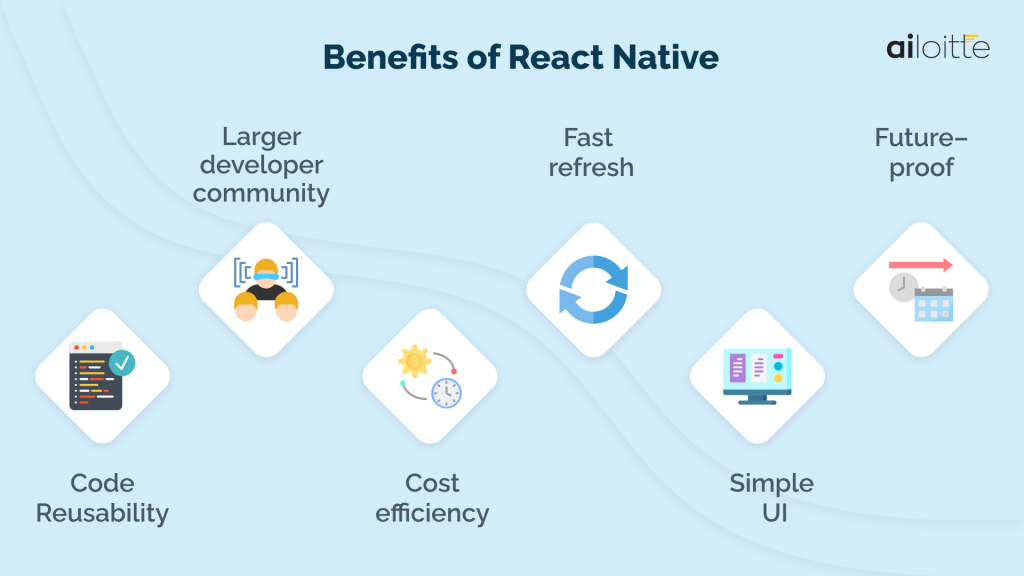
1. Code Reusability
Apps can run effectively on multiple platforms, which CEOs and Product Managers across businesses widely appreciate. They can integrate 90% of the native framework by reusing the code for both platforms by building a standard, comprehensive app.
2. Larger developer community
React Native is an open-source JavaScript platform that allows developers to contribute knowledge to developing a software framework that is accessible to all.
Anyone facing an issue while developing the app can contact the community for support. As of mid – 2020, there are nearly 50,000 contributors to React Native tag in Stack Overflow.
3. Cost efficiency
The cost of developing apps in React Native is much lower than apps built using platforms and frameworks that don’t allow cross-platform development. Hiring two development teams is unnecessary as a small team is enough to build both iOS and Android.
4. Fast refresh
Developers can easily update a React native app to the new versions and modify its UI easily. Changes are made visible immediately, and rebuilding the entire app from scratch is spared. This saves time on compilation and increases productivity as they do not lose their state while incorporating changes to the app.
5. Simple UI
React Native applications are built in React JavaScript which is responsive and faster with reduced load time, resulting in a better User Experience (UX). The software framework is perfect for creating simple/complex designs thanks to a reactive UI and a component-based approach.
6. Future–proof
Considering the pace at which the framework has taken over the market and its approach to resolving development problems, the future looks bright for React Native.
Things Developers Should Know Before Using React Native
React developers who are new in the space, will be required to increase their understanding of how to use react native and level up their skills per the library. Having the right skills is what matters. Let’s see what they should know and why.
1. Have a solid understanding of JavaScript
Knowledge of JavaScript is crucial to building new components and creating application logic and services.
2. Great command over native iOS and Android development
Good React developers must know the basics of other languages, like Swift and Objective-C, as it may be necessary to use tools from the native side too.
3. Knowledge of all tools and technologies
Know the essential tools and technologies to manage the application, increase automation, fix crashes, and write code that complies with JavaScript patterns. Examples include –
- Sentry which is used for real-time monitoring and patching cracks
- App center for testing and beta distribution, Redux for managing the app’s state
- Jest is a zero-configuration and ready-to-use framework used to test JS Code.
4. Write clear and elegant code
Writing readable, consistent source code makes it easier to develop and maintain the app in the present and future. Some rules are included in the style guides like Airbnb JS Style Guide and Google JS Style Guide.
5. Performance optimization skills
The success of an app does not finish at its launch or just smooth and fast running. Optimization is not about only coding but seeing the bigger picture and having a deeply analytical mindset. A solid understanding of the framework and finding the best feasible solution are essential for the project’s success.
Why use React Native
React Native development does have a lot of unique benefits, which makes it your choice of technology stack irrespective of whatever business idea you may have.

It has become the top choice for developers owing to a lot of benefits such as saving a lot of work hours, resulting in a faster development process, and being cost-effective.
It gives you access to a larger audience at once as Android, and iOS users can use the app.
React Native can be a preferred choice when
- Projects with easy functionality
- Apps based on JavaScript
- Budget is limited
- Rapid app development in short iterations
- Attractive UI and design interfaces
React Native comes with the above benefits, but there are certain instances where investing in it won’t make business sense.
React Native might not be a solution for
- Complex visualization
- Platform-specific apps
- Feature-heavy gaming
- Building rich multimedia apps with plenty of background processes
Summing Up
React Native is a cost-effective multi-platform approach that can be used by businesses worldwide and offers good quality in terms of user experience. Over and beyond the benefits, the sheer adaptability and the potential of reusing code make it the ideal choice for mobile app development.
If you would like to develop an app like Facebook, Skype, Twitter, or WhatsApp and are looking for a React native mobile app development company that provides custom app services, get in touch with us today. Our team of react native app developers will assist you in developing your app with the latest frameworks and technologies for different platforms.
FAQs
React Native is an excellent choice for long-term mobile app development. It provides a smooth and responsive user interface while significantly lowering load time. It is also much cheaper and faster to build apps in React Native when compared to building native ones.
React Native is an open-source front-end framework based on JavaScript developed by Facebook.
If you need to develop an app for both iOS and Android, React Native can be the best framework to build react native applications. It can reduce the codebase by about 95%, saving you time and money.
The key benefits of React Native for Mobile app development:
• Cost and Time Efficient
• Community-driven
• Code reusability
• Flexible framework
• UI focused
• Native look and feel
• Reduced time to market

Share this article:
Leave a Reply







100+
Project Launched

80+
Happy Clients

18+
Countries Served

91%
Returning client base




.png)
.png)
.png)



Leave a Comment