On this page
- What do you need before submitting an iOS app?
- iOS App Store submission checklist
- How to submit an app to the App Store: step by step
- How long does App Store review take?
- Why do apps get rejected from the App Store?
- What should you do if your app is rejected?
- What happens after your app is approved?
- Summing up
- FAQ
What do you need before submitting an iOS app?
Before submitting an iOS app, you need an Apple Developer Program membership, a finished and tested build made with Xcode 26, and your product page assets ready: screenshots, description, keywords, a privacy policy and support contact details. Preparing these first avoids many delays at the review stage.
Submission is the last step of a longer launch plan. For marketing and growth around launch day, see our successful mobile app launch checklist. If you are publishing on Google Play too, use our Android app release checklist.
iOS App Store submission checklist
Use this iOS App Store submission checklist to confirm you are ready before you click Submit for Review.
Account and legal
- Apple Developer Program membership active ($99 a year)
- Two-factor authentication turned on for your Apple Account
- Organizations: a legal entity and D-U-N-S number registered with Apple
- Latest Apple Developer Program License Agreement accepted
- Paid apps or in-app purchases: agreements, tax and banking set up in App Store Connect
Build
- Built with Xcode 26 or later and the iOS 26 SDK
- Bundle ID, version and build number set correctly
- Signing certificates and provisioning profiles valid
- Tested on real devices, with no crashes or placeholder content
- Tested with TestFlight by internal or external testers
Privacy
- Privacy policy URL live and complete
- App privacy details (privacy labels) completed for your app and all SDKs
- Privacy manifest included where required
- Clear purpose strings for every permission, such as camera or location
- Account deletion available in the app if users can create an account
Product page
- App name, subtitle, description, keywords and promotional text
- Screenshots for the required iPhone and iPad sizes
- App icon, category and age rating questionnaire
- Support URL with current contact details
Review
- Demo account and notes for the reviewer
- All links in the app work
- Release option chosen: manual, automatic or scheduled
How to submit an app to the App Store: step by step
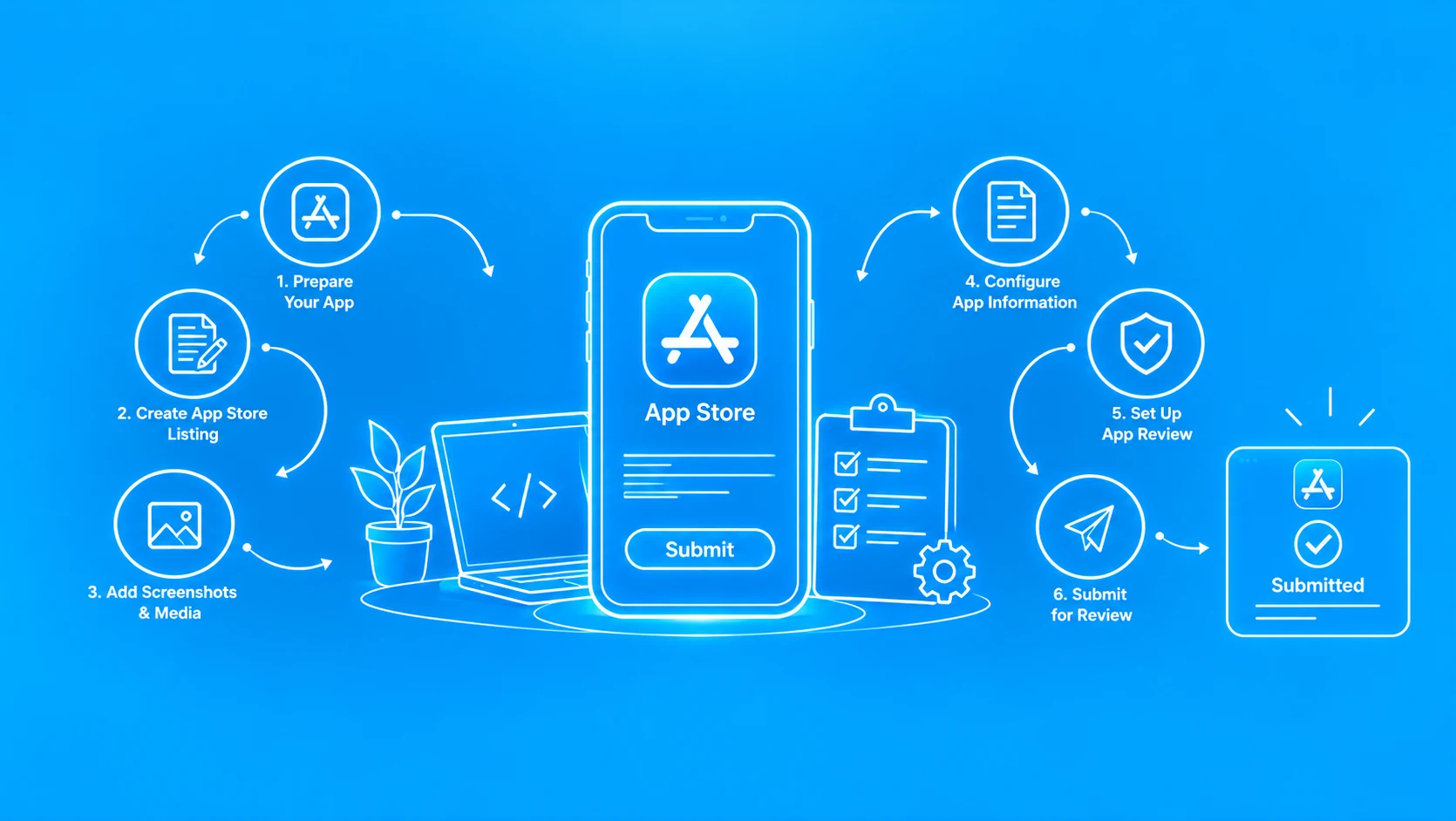
Submitting an iOS app takes eight steps, from enrolling as a developer to choosing when the app goes live. Each step below opens with what to do, then the details.
Step 1. Enroll in the Apple Developer Program
Sign in with your Apple Account, turn on two-factor authentication and enroll in the Apple Developer Program as an individual or an organization. Membership costs $99 a year. Organizations must enroll as a legal entity and provide a D-U-N-S number, so start early, as verification can take time.
Step 2. Set up certificates, identifiers and profiles
In your developer account, register a unique bundle ID for the app, then create the signing certificate and provisioning profile needed for distribution. If you let Xcode manage signing automatically, it creates and updates most of these for you. Make sure team members have the right roles in App Store Connect.
Step 3. Build with the required Xcode and SDK
Since April 28, 2026, Apple requires apps uploaded to App Store Connect to be built with Xcode 26 or later and the iOS 26 SDK. Set the version number (for example 1.0 for a first release) and a unique build number, then archive the app in Xcode with Product, then Archive.
Step 4. Create the app record in App Store Connect
In App Store Connect, open Apps and add a new app. Enter the platform, app name, primary language, bundle ID and an SKU, which is an internal reference only you see. This creates the record that your builds and product page attach to.
Step 5. Upload the build and test it with TestFlight
From the Xcode Organizer, choose Distribute App and upload the build to App Store Connect. Once it finishes processing, add internal testers in TestFlight, and invite external testers if you want wider feedback. The first build you share with external testers goes through a lighter Beta App Review. Fix crashes and bugs before you go further; our mobile app quality assurance checklist helps.
Step 6. Complete the product page and metadata
The product page is what users see on the App Store, so every field matters for both review and downloads. Apple’s product page guidance sets these limits:
| Field | Limit or requirement |
|---|---|
| App name | Up to 30 characters |
| Subtitle | Up to 30 characters |
| Promotional text | Up to 170 characters; can be updated without a new app version |
| Description | Up to 4,000 characters |
| Keywords | Up to 100 characters, separated by commas |
| Screenshots | Up to 10 per device size; JPEG or PNG, no transparency |
| App previews | Up to 3 videos, each up to 30 seconds |
| App icon | 1024 x 1024 pixels for the App Store |
For screenshots, App Store Connect lists the accepted pixel sizes for each iPhone and iPad display. If your interface is the same across sizes, you can upload the highest required resolution and App Store Connect scales it down, and 13-inch iPad screenshots are required if your app runs on iPad. Also add a support URL, privacy policy URL, category and copyright. For tips on standing out, read how to get featured on the Apple App Store.
Step 7. Complete privacy details and the age rating
In App Store Connect, fill in the app privacy details, which appear as privacy labels on your product page and must cover data collected by your app and any third-party SDKs. Then complete the age rating questionnaire; Apple assigns the rating from your answers. Answer export compliance questions about encryption, and, if you distribute in the EU, provide your trader status information.
Step 8. Submit for review and choose a release option
Select the tested build, add a demo account and notes for the reviewer, and choose how the app goes live once approved: manually, automatically or automatically after a date you set. Then click Submit for Review. You will get email updates as the status changes.
How long does App Store review take?
App Store review usually takes one to two days. Apple’s App Review page says it typically reviews at least 50% of submissions in under 24 hours and 90% in under 48 hours. Incomplete submissions take longer, so check every field before you submit.
If you have a critical bug fix or an app tied to an upcoming event, you can request an expedited review in App Store Connect. Approval of that request is not guaranteed, so do not plan a launch around it.
Why do apps get rejected from the App Store?
Apps are most often rejected because they are incomplete, crash or have missing information. Apple reports that over 40% of unresolved issues relate to Guideline 2.1, App Completeness. The table lists common reasons from Apple’s App Review guidance and how to avoid them.
| Rejection reason | Guideline | How to avoid it |
|---|---|---|
| Crashes, bugs or placeholder content | 2.1 App Completeness | Test on real devices with the latest iOS; remove all placeholder text and images |
| Missing demo account or review notes | 2.1 | Give working login details and explain any hidden features |
| Broken links or missing support contact | 2.1, 5.1 | Check every link; add a support URL and a privacy policy |
| Incomplete privacy policy or unclear permissions | 5.1, 5.1.1 | Explain what data you collect and why, with clear purpose strings |
| Screenshots that do not show the real app | 2.3.3 | Use screenshots of actual functionality |
| Too little functionality, or a wrapped website | 4.2 Minimum Functionality | Offer real native value beyond a website |
| Copycat or repeated similar apps | 4.1, 4.3 | Build an original app and avoid near-duplicate submissions |
| Regulated app submitted by the wrong entity | 3, 5.1.1 | Banking, health, crypto and similar apps must come from the legal entity providing the service |
What should you do if your app is rejected?
If your app is rejected, read Apple’s message in App Store Connect, fix the issue and resubmit. You can reply to App Review in App Store Connect to ask questions or clarify how a feature works. If you believe Apple misunderstood your app or treated it unfairly, you can appeal to the App Review Board, with one appeal per rejected submission.
What happens after your app is approved?
Once your app is approved, it goes live based on the release option you chose, and it can take some time to appear in App Store search. Track downloads, ratings, crashes and sales in App Store Connect, reply to reviews and plan regular updates. Each update goes through App Review again, so keep the same checklist for every release, and budget for ongoing mobile app maintenance.
If you also want a broader overview of publishing, including first-time setup, see our guide on how to publish an app to the App Store. Ailoitte is one option if you want help: as a mobile app development company, its team builds and publishes iOS apps for clients, using the client’s own developer account.
Summing up
An iOS App Store submission goes smoothly when you prepare in order: enroll in the Apple Developer Program, build with Xcode 26, set up App Store Connect, complete the product page and privacy details, test with TestFlight and then submit. Most reviews finish within a day or two, and many rejections come from incomplete apps or missing information, so a careful final check pays off.

Sunil Kumar is CEO of Ailoitte, an AI-native engineering company building intelligent applications for startups and enterprises. He created the AI Velocity Pods model, delivering production-ready AI products 5× faster than traditional teams. Sunil writes about agentic AI, GenAI strategy, and outcome-based engineering.
About Ailoitte