



Electronic Medical Records (EMR) software has been revolutionizing the healthcare industry by providing a seamless way for medical professionals to manage patient data and streamline clinical processes. Compared to paper-based records, it allows healthcare professionals to keep track of their patient’s health information, provide accurate treatment plans, and remain up-to-date about their needs.
According to a recent study by Globe News Wire, the global Electronic Medical Records (EMR) market was valued at $29 million in 2021 and is expected to reach USD 47 million by 2029, growing at a CAGR of 7.30% during the forecast period.
However, the transition to EMR has been challenging since it requires healthcare providers to keep up with the ever-evolving software development landscape. Therefore, we will dispel all your doubts in this guide and explore EMR technology, its benefits, features to include, and how to implement an EMR. But before that, let us first see what EMR in healthcare is all about and how to create EMR software.
What is EMR Software and the Benefits of Custom EMR in Healthcare?
Electronic Medical Record (EMR) software is a digital system healthcare providers use to manage patient health information. It allows for the electronic storage and retrieval of patient medical records, reducing the need for paper-based records. The software enables healthcare providers to access patient information quickly, thus streamlining the care process and improving overall efficiency.
Electronic Medical Records (EMR) systems have revolutionized the healthcare industry and offer a range of benefits like the ones listed below, making them a valuable investment for healthcare providers.
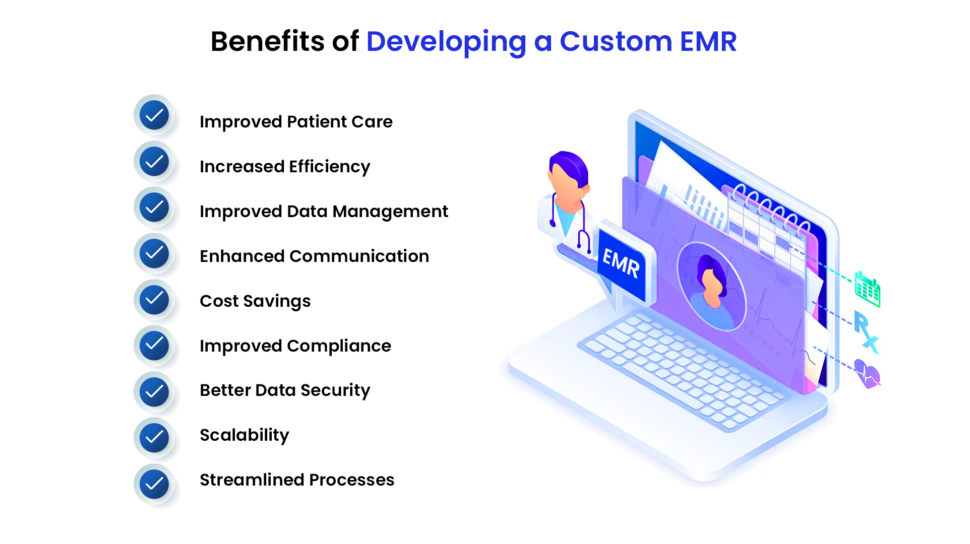
Improved Patient Care
Custom EMR systems allow healthcare providers to access patient’s medical history, treatment history, and other relevant information in real time. This helps in providing better and more efficient care to patients.
Providers can also view patients’ test results, imaging scans, and other patient medical records quickly and easily, allowing faster and more accurate diagnoses.
Increased Efficiency
Custom EMR in healthcare automates many routine tasks, such as appointment scheduling, prescription management, and patient follow-up. This reduces the workload on healthcare providers and increases efficiency, freeing up time for other essential tasks. Moreover, healthcare providers can access all the necessary information quickly, reducing the time it takes to complete each patient visit.
Improved Data Management
Custom EMR systems provide a centralized repository for all patient data, including medical history, lab results, imaging scans, and other records. This eliminates the need for paper-based systems and makes it easier for healthcare providers to access and share information with other healthcare providers. It also gets easier to manage and analyze data to identify patterns and trends in patient care.
Enhanced Communication
Custom EMR systems facilitate communication between healthcare providers, allowing for more efficient and effective collaboration. Providers can access and share patient information quickly and easily, reducing the risk of errors and improving patient care.
Cost Savings
Custom EMR systems can save healthcare providers money by reducing the cost of paper, printing, and storage. EMR systems can also reduce the efforts and costs associated with administrative tasks, freeing up time for more critical tasks. Ultimately, healthcare providers can reduce the cost of healthcare delivery, improve patient care, and increase efficiency.
Improved Compliance
Custom EMR systems help healthcare providers meet regulatory requirements and improve patient privacy and security. EMR systems store sensitive patient information securely, ensuring it’s only accessible to authorized users. Healthcare providers can stay compliant with regulations and maintain the privacy of patient information.
Better Data Security
To protect sensitive information, custom EMR solutions ensure that patient data is secure and comply with the latest industry standards, including HIPAA and HITECH.
Scalability
Custom EMR solutions are designed to meet the changing needs of the healthcare facility and can be easily scaled to accommodate growth and changes in patient volume.
Streamlined Processes
Custom EMR solutions streamline clinical documentation and automate administrative tasks, freeing up time and energy for healthcare providers to focus on patient care.
EHR vs EMR
Electronic Health Records (EHR) and Electronic Medical Records (EMR) are two digital tools healthcare providers use to manage patient information. While these terms are sometimes used interchangeably, they have some distinct differences.
An EMR is a comprehensive digital record of a patient’s medical history, which includes all their clinical data, demographic information, diagnostic test results, and treatment plans. Whereas the EHRs are designed to be a patient’s central repository of medical information that can be accessed by all healthcare providers involved in the patient’s care, regardless of the location or time of care.
Secondly, an EMR is a digital version of a patient’s paper-based medical record. It is a limited form of an EHR and primarily focuses on a patient’s clinical data and treatment information. EMRs are primarily used by individual healthcare providers or practices to manage patient information within a specific location and time of care.
Finally, an EHR is a more comprehensive tool designed to provide a complete view of a patient’s medical history. At the same time, an EMR in healthcare is a more limited tool focusing on the patient’s clinical data and treatment information within a specific practice or location.
Key Features of Custom EMR Software
Custom EMR (Electronic Medical Record) software is a tailored solution that meets the specific needs of a healthcare organization. Here are some key features of custom EMR software that can help healthcare organizations achieve their goals.
User-Friendly Interface: Custom EMR software has a user-friendly interface that is easy to navigate and use. This makes it simple for healthcare providers to access patient information and perform necessary tasks quickly and efficiently.
Data Management: The software allows healthcare organizations to store and manage patient information, including demographic data, medical history, lab results, and medication information. Authorized personnel can easily access this information, ensuring patients receive the best care possible.
Clinical Documentation: Custom EMR software includes templates for clinical documentation, making it easier for healthcare providers to document patient encounters. This eliminates the need for paper-based records, streamlining the documentation process and reducing the risk of errors.
Reporting and Analytics: The software provides real-time data and analytics, allowing healthcare organizations to make informed decisions. Reports can be customized to meet specific needs and can be used to track patient outcomes, monitor the quality of care, and identify areas for improvement.
Medication Management: Custom EMR software includes features for managing medication information, including prescription and refill management, drug-drug interaction checks, and medication reconciliation. This helps to ensure that patients receive the correct medications and reduces the risk of medication errors.
Order Management: The software includes an order management system that allows healthcare providers to place and track orders for tests, procedures, and other treatments. This streamlines the ordering process and ensures patients promptly receive the care they need.
Secure Access: Custom EMR software includes security measures to protect patient information. This includes role-based access control, data encryption, and secure authentication processes.
Integration: Custom EMR software can be integrated with other healthcare systems, such as laboratory information systems and radiology information systems. This allows for a seamless exchange of information and eliminates the need for manual data entry.
Customization: EMR software can be customized to meet the specific needs of a healthcare organization. This allows for integrating unique processes and workflows, improving efficiency, and enhancing patient care.
Types of EMR systems
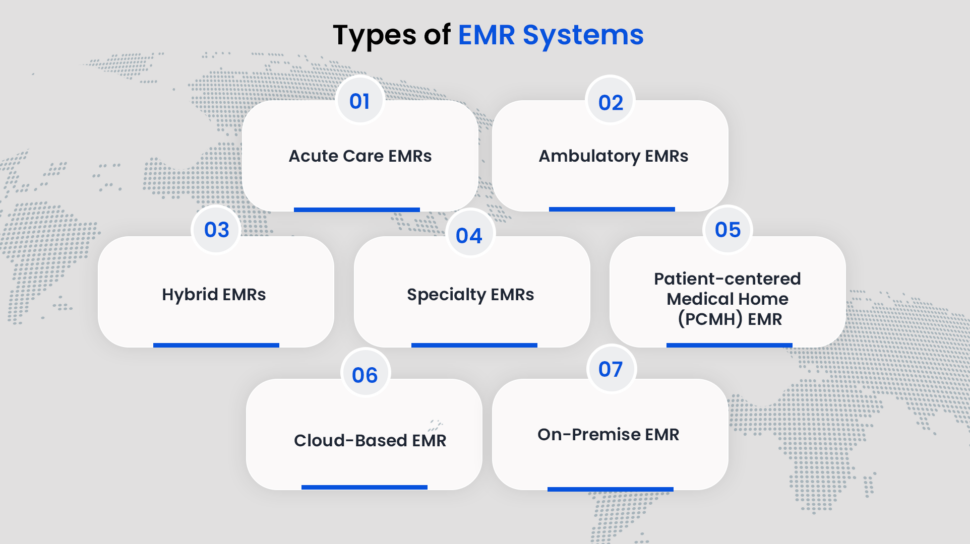
Electronic Medical Record (EMR) systems are a generic term used to define software applications healthcare providers use to manage and store patient information electronically. However, there are various types of EMR systems available, which you must know before building one.
Acute Care EMRs
These are designed specifically for hospitals and emergency departments and are equipped to handle high-volume patient information. They provide real-time access to patient data and allow healthcare providers to collaborate and communicate efficiently.
Ambulatory EMRs
These are designed for outpatient settings such as clinics and private practices. They offer a streamlined workflow, customizable templates, and patient self-service portals.
Hybrid EMRs
As the name suggests, these systems combine the features of acute care and ambulatory EMRs, making them suitable for inpatient and outpatient settings.
Specialty EMRs
These systems are designed specifically for a particular medical specialty, such as dermatology, ophthalmology, or cardiology. They come equipped with pre-built templates and optimized workflows for that specialty.
Patient-centered Medical Home (PCMH) EMRs
These systems are designed for primary care providers and help them manage patient information, health maintenance, and chronic care.
Cloud-Based EMRs
These systems store patient information in the cloud, making it accessible anywhere with an internet connection. They offer cost-effective solutions and easy scalability for growing practices.
On-Premise EMRs
These systems are installed and maintained on the provider’s computer servers, offering greater data security and privacy control.
Each type of EMR system has advantages and disadvantages, and the choice of an EMR system depends on a healthcare organization’s specific needs and requirements. However, regardless of the type of EMR system, all healthcare providers must ensure that the system complies with the regulations set forth by the Health Insurance Portability and Accountability Act (HIPAA).
Next, let us see how to create EMR software in a step-by-step guide.
EMR Software Development Process
Electronic Medical Record (EMR) software development is a complex process that requires a thorough understanding of healthcare industry regulations, patient data privacy, and the unique needs of medical professionals, which is why you need to seek the help of experts for EMR software development. Here is a step-by-step guide on how to create an Electronic Medical Record (EMR) system.
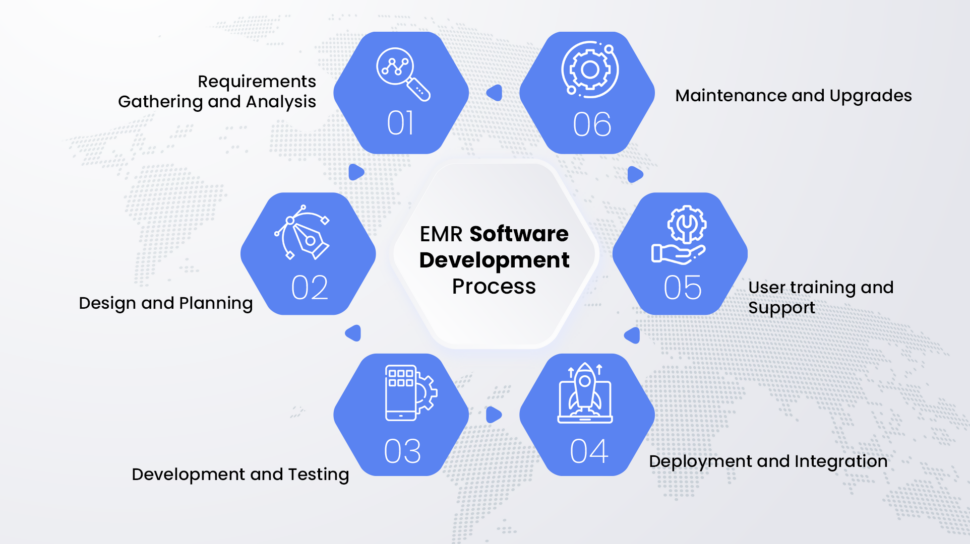
Requirements Gathering and Analysis
This is the first and most important step in the development process. In this phase, the development team works closely with healthcare professionals and stakeholders to understand the specific requirements and needs of the end users. This helps in defining the scope, and objectives of the project and determining the key features and functionalities required in the EMR software.
Design and Planning
The development team begins the design and planning phase based on the requirements gathered. This involves creating detailed specifications for the software, including the user interface, data storage, and security measures. The design and planning phase also involves defining the project schedule and resource allocation to ensure the project is completed on time and within budget.
Development and Testing
The software development begins once the design and planning phase is complete. This involves writing code to implement the features and functionalities defined in the previous phase. During the development phase, the team conducts regular testing to ensure that the software works as expected and meets the requirements set out in the design and planning phase.
Throughout the EMR software development process, it is essential to comply with relevant regulations and standards, such as HIPAA (Health Insurance Portability and Accountability Act) and HITECH (Health Information Technology for Economic and Clinical Health Act), which outline the requirements for protecting patient data privacy and security.
Deployment and Integration
After the software has been developed and tested; it is deployed into the production environment. This involves installing the software on the appropriate servers and integrating it with other systems and applications in the healthcare environment, such as laboratory and imaging systems.
User training and Support
Once the software is deployed, the development team trains end-users to ensure they can effectively use it. This may include online training sessions, in-person training, and user manuals. The team also provides ongoing support to users to help them resolve any issues and ensure that the software continues to meet their needs.
Maintenance and Upgrades
EMR software is a critical component of the healthcare system and must be maintained to ensure it continues functioning correctly. The development team provides ongoing maintenance and support, including bug fixes, security updates, and software upgrades, to ensure that the software remains up-to-date and meets the evolving healthcare industry needs.
By following a structured development process and working closely with stakeholders, it is possible to develop a successful EMR software solution that meets the needs of healthcare providers.
Now that we know the development process, let us know the technology stack that makes the EMR software development efforts successful.
Technology Stack For EMR Software
Before choosing the technology stack, weigh the pros and cons of each technology, evaluate your team’s strengths, and identify potential talent gaps if they exist. Regardless of which technology you choose, it is best to choose based on team capabilities or outsource it to experts.
Outsourced teams may have used the technologies before, and they might suggest the best to go for based on your requirements. Develop and deploy a solution that can scale, adapt, and be resilient to change when choosing the technology.
With great options, we suggest you opt for the following frameworks and technologies to develop an EMR in healthcare with a large enough ecosystem and vibrant community support.
Let’s talk to Software Experts
The following is the technology stack for EMR software.
| Languages Python Java Swift Kotlin JavaScript | Frameworks and Libraries Angular jQuery Django Node.js |
| Databases MySQL PostgreSQL | Analytics Amazon EMR Google Analytics |
| Utilities Amazon S3 Cloudflare Microsoft Azure | Web Servers Apache Nginx |
Cost Of EMR Software Development
Electronic Medical Records (EMR) software development costs can vary greatly depending on several factors. Some of the most critical factors that can impact the cost of EMR software development include the scope of the project, the type of software being developed, the number of developers needed, and the amount of time required to complete the project.
For example, basic EMR software that includes basic patient information, appointment scheduling, and prescription management may cost significantly less than comprehensive EMR software that provides detailed patient information, medical imaging, and advanced analytical tools.
Another critical factor impacting the cost of EMR software development is the software being developed. For example, custom EMR software developed specifically for a single healthcare organization will typically cost more than pre-packaged EMR software designed for multiple organizations. Custom EMR software may also require a higher level of customization, which can add to the project’s overall cost. In some cases, the cost of EMR software development may also be impacted by unexpected delays or changes in project scope.
The number of developers needed to complete the project is another critical factor influencing the cost of EMR software development. Larger projects may require more developers, increasing the project’s overall cost.
Additionally, the price of developers can vary depending on their location, experience, and skill level. For example, developers in a high-cost region such as San Francisco or New York City may charge more per hour than developers in a lower-cost region.
The following is a rough estimate of the time and cost of creating EMR Software.
| Task | Hours | Eastern Europe ($50/hour) | Western Europe ($70/hour) | USA($100/hour) |
| Business Analysis | 60 | 3000 | 4200 | 6000 |
| Design & Development | 45 | 2250 | 3150 | 4500 |
| Backend Development | 142 | 7100 | 9940 | 14200 |
| Frontend Development | 155 | 7750 | 10850 | 15500 |
| Roles Implementation | 33 | 1650 | 2310 | 3300 |
| Database Design | 30 | 1500 | 2100 | 3000 |
| HIPAA Compliance | 100 | 5000 | 7000 | 10,000 |
| Product Testing | 140 | 7000 | 9800 | 14,000 |
| Project Management | 95 | 4750 | 6650 | 9500 |
| Total | 800 | 40,000 | 56,000 | 80,000 |
Ready to develop an EMR system for your hospital?
Contact us today for a quote
How Ailoitte Can Be Your Partner for EMR Software Development?
Electronic Medical Records (EMR) are currently the most popular automation solution being used by healthcare providers. With consistent procedures, workflows, and specialty-specific templates, they help in the automation of various patient documentation processes.
Whether you are a healthcare provider looking to adopt EMR software or exploring your options, this guide gives you a comprehensive understanding of how EMR in healthcare works. From design and architecture to testing and deployment, we hope you understand how to ensure your EMR software project succeeds.
If you are looking for custom EMR healthcare software development services, you are at the right place. Ailoitte understands what it takes to build robust health tech platforms as we are a leading healthcare software development company specializing in serving various healthcare clients globally. Our solutions help address various highly scalable and software development requirements and are HIPAA and GDPR-compliant, helping you deliver a better patient experience at lowered costs and optimizing workflow.
- EMR/EHR Development/Integration Services
- Develop Compliant Healthcare Services
- E-Prescribing System Development
- EMR/EHR Mobile App Development Services
- Healthcare Data Analytics Services
So, if you want to stay ahead of the curve in this rapidly evolving industry, contact us today for an EMR software solution that can enable you to provide exceptional healthcare services to your patients.
FAQ
Electronic medical record (EMR) systems are electronic records of health-related information like medical history, diagnosis, medications, immunization dates, lab results, and treatment history of patients.
The cost to implement an EMR system ranges from $40,000 to $70,000, depending on the provider. An EMR with advanced features and complexities may begin at $150,000 to cost up to $600,000.
Electronic Medical Records (EMRs) are instrumental in streamlining the operations of hospitals. They enhance the accessibility of patient data, thereby enhancing the quality of care delivered. EMRs lead to better-informed decision-making, improved communication, increased efficiency, and reduced safety risks.

Share this article:
Leave a Reply







100+
Project Launched

80+
Happy Clients

18+
Countries Served

91%
Returning client base




.png)
.png)
.png)



Leave a Comment