



According to a report by Globe News Wire, the Electronic Health Records software market valued at $14.2 billion in 2022 is estimated to grow at a CAGR of 9.1% during the 2023-2030 period. North America dominated the global electronic health record software market and held the biggest revenue share, closely followed by Europe per the same report.
The growing demand for EHR systems stems from the fact that transporting patient medical records requires time and a greater focus on security as the crucial document may get damaged or lost. Therefore, there is a need for applications facilitating data exchange between healthcare and patients that can improve service without compromise and increase medical assistance’s efficiency, and productivity by automating regular tasks and providing better-quality medical services.
But before learning how to build an EHR system, let us first understand the basics and know mobile EHR applications, their types, and their benefits.
What is an EHR System in Healthcare
Electronic Health Records (EHRs) are a summary of a patient’s medical records that are collected, stored, and shared electronically thereby increasing the accuracy and timeliness of the documentation. It allows physicians and healthcare professionals to accurately and conveniently exchange documentation and patient records through a secure application.
Although many EHR web portals are present in the market, mobile apps make medical information more accessible, portable, and handy, thus increasing usability among providers and patients. With almost everyone owning a smartphone, healthcare providers have understood its significance, and apps related to medication, caregiving, and record maintenance have become extremely popular.
Doctors and patients can access critical medical records whenever they want while mobile EHR applications can handle various tasks ranging from managing emergency care to prescriptions. For example, if a doctor is stuck in some work and wants to access information about one of their patients immediately, with an EHR on their smartphone, they can quickly attend to the task as it is handy.
Mobile EHR apps are portable; health records can be generated, edited, and amended on the fly hassle-free. It also facilitates better coordination and safety, thus enabling healthcare providers to handle critical cases easily and increasing the timeliness, and accuracy of documentation.

EHR vs EMR? How do they Differ
EHR (Electronic Health Records) and EMR (Electronic Medical Records) are two words used by plenty of healthcare professionals that you may find confusing or are used interchangeably. Both these terms refer to a digital record with patient data that stores, uses, and maintains patient information such as name, demography, visit details, diagnoses, test results, reports, allergies, etc.
But the terms have differences in meaning, which we will detail out for you.
| Criteria | EHR | EMR |
| End User | Patients and Healthcare specialists | Healthcare specialists in an organization/department |
| Information Type | Electronic records of patient’s state of health | Medical history, prescription, the current state of health |
| Information Management | Authorized personnel such as clinicians, staff among various organizations | Authorized personnel such as clinicians, staff of the same organizations |
| Fields | Information related to various medical fields | Information related to specific medical field |
| Data Sharing | Various organizations | Within same organization |
| Security Policy | Strict | Lenient |
| Patient Access | Unlimited | Limited |
Types of EHR systems
Before choosing how to develop EHR, it is necessary to know the types of them as the EHR system development process may vary depending on them.
- Physician Hosted
The EHR containing patient data is hosted on the physician’s server, the traditional hosting model. Organizations must churn out capital to buy the software and hardware. In addition, the EHR development company will install the product on a computer or server on location and be responsible for data maintenance and security.
- Remotely Hosted
The EHR data is hosted on a third-party server, which means the server maintenance and security are the responsibility of the third-party owner. They are further categorized into three groups as the following.
- Dedicated: The vendor stores the EHR data on a dedicated server.
- Cloud: The EHR data is stored on the cloud and not installed physically on the computer, which can be accessed through the vendor’s website.
- Subsidized: The financing is subsidized by the third-party entity with whom the physician enters into a legally binding contract.
Why is EHR important and the Benefits of Mobile EHR Applications
Implementing an EHR system in a hospital is a massive step towards improving the existing process and transforming healthcare. EHR ensures several advantages for patients and medical practitioners, as listed below.
1) With quick access to patient care, EHR makes healthcare more convenient for patients and providers. Processes are efficient and coordinated as authorized personnel can get reliable access to up-to-date, accurate, and complete information about patients anytime.
2) Better integration of multiple processes leads to better clinical decision-making. Practitioners can access patient medical history, diagnosis, treatment plans, medication, reports, images, and test results. They can diagnose patients and provide better care, reducing medical errors.
3) Effective communication between patient and healthcare provider increases participation and enhances healthcare convenience. Managing chronic conditions and follow-up information after an appointment or hospital stay is easy.
4) Accurate document processing that is automated and streamlined, promotes legible and complete documentation.
5) EHR systems help providers improve productivity as information is easier to find, coordination is less cumbersome, and productivity increases automatically. Moreover, medical errors get reduced due to better patient information availability. Lastly, patients seeing multiple specialists or making the transition between care settings find performing these events easy.
6) Streamlined processes lead to improved efficiency. Health records contain all information needed to provide care, thus helping save time and educating patients for their good. This leads to better structural integrity and cohesion of information, allowing efficient centralized management.
7) Lower healthcare costs due to improved safety and health, decreased paperwork, and reduced duplication of testing. Since the EHR user needs fewer resources and time for manual entry, it results in accurate billing and reduces charges overall.
8) Enhanced security measures are in place as EHR development ensures stakeholders can access medical records securely. Also, it makes it safer and more reliable to prescribe medication and manage prescriptions.
If you want to develop a new EHR system or add important collaborative components like medical record systems to existing EMR systems, our specialist at Ailoitte can help you.
Now that you know the benefits of EHR, let us move on to how to build a custom EHR system
How to Build an EHR System
Developing an EHR is challenging, considering many technical factors. You might need the help of a competent healthcare development company with extensive knowledge of EHR software development to fulfill all purposes and satisfy all stakeholders’ needs. The following are the steps on how to implement EHR.
1. Idea Validation
Before you begin EHR system development, begin with an understanding of client requirements and make a list of potential questions you need to ask before the process begins. Having a list ready helps you get a fair idea of what the client is expecting and clears any doubts they may have about the EHR system.
Understanding and addressing the pain points that users, doctors, and nurses face is also crucial. For example, how is the communication between patients and doctors, and how long does it take for users or doctors to fill out forms? Once developers get clarity of the requirements, they get a fair idea of how to develop EHR.
2. Discovery and Prototype
This is the next development phase, where a flowchart of the processes and procedures is developed. It involves identifying the essential features needed for EHR development.
Also, figuring out which technology stack is used is essential, as the cost depends on the technologies used and who will work on the project. Once business estimation and analysis are complete, you can begin development.
It will also help to create a prototype to get clarity on how the software would work – something that would help both developers and designers.
3. EHR Design and Development
The next stage of the software development life cycle is the design of the EHR, where you need to figure out the first design. The best approach here would be to keep the design minimal with dedicated sections for each user event. Moreover, it would help to know individual user journeys to finalize the design system.
Once the EHR system design is fixed, the next step comes in the frontend and backend development where all the necessary APIs, integrations, and security factors are added and the system is made to be intuitive and scalable.
At Ailoitte, when we work on an EHR based healthcare app development, we always ensure that the architecture and modules of the major segments are built first to streamline tasks and fast-track the development process.
4. Testing and Debugging
Once development is done, the quality assurance team identifies the bugs in the next stage. They go through all the features, check EHR design, and monitor operations to identify gaps and ensure that all stakeholders’ needs are met through the EHR software.
5. Launch and Maintenance
The process to create EHR software is based on user and EHR system requirements, many of which are urgent in nature. Thus, launching the product at the right time in the market becomes essential. At Ailoitte, we ensure that the EHR system gets integrated into your healthcare system at the appropriate time and your team gets onboarded on the solution at the appropriate time in a way that you get maximum value out of the implementation.
Must-Have Features of Fully Developed EHR Systems
Getting the most out of an EHR system would require the integration of intuitive, value-offering features. The following are some must-have features that you can include for a fully-functional EHR.
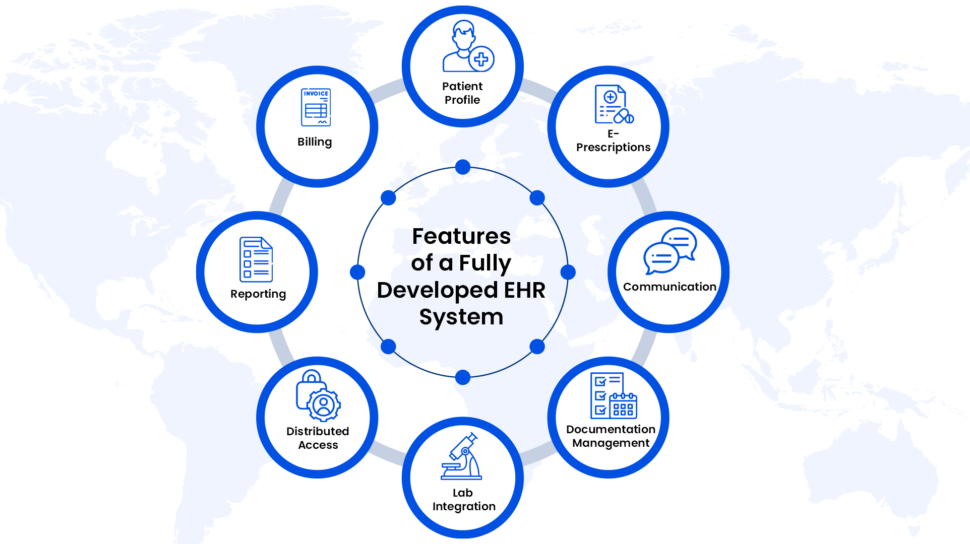
1. Patient Profile
A patient portal can be a stand-alone app or an extension of the EHR system. In the feature, patients set up their accounts by updating their contact and personal information. Following this, the portal allows them to keep updated and access their personal health data as entered by the healthcare facility.
This feature or app section can also be used to build functionalities for scheduling in-house or virtual doctor appointments, viewing appointments, and rescheduling or canceling any future ones. Also, through the app, patients can access and download diagnostics test results, documents, prescriptions, bills, and medical reports online anytime.
2. E-Prescriptions
This is another feature supported by EHR software systems where patients who seek treatment with the doctor get an e-prescription which can be shown to the pharmacist to get the medicines. Users can request a refill by showing this each time when medication is needed.
Medical professionals also can use them to construct and make better decisions.
3. Communication
Patients can use their portal to communicate efficiently with healthcare specialists/providers and vice versa. Using the portal to fix appointments is a quick way to ask queries and receive replies from healthcare providers in one’s inbox. The ability to securely message and enquire with the healthcare team is one of the best features that make EHR appealing.
4. Documentation Management
Hospitals opt for EHR mainly to manage vast amounts of medical documentation. Detailed information about patient interaction, conditions, care, and treatment can be documented extensively through the feature, which can lead to better management of claims and insurance.
Some of the in-built sub-features of this functionality can be viewing medical appointments, history, medical prescription data, patient tracking, safe storage of test results, speech-to-text conversion of transcriptions, medical guidelines, and protocols, customizable EHR templates, data storage, and exchange with other modules, etc.
5. Lab Integration
A lab system can be added as part of the EHR system as it allows easy tracking of the test results. It helps medical labs address many issues, such as human errors, the slow turnaround time for receiving test reports, inventory management, etc. Through the feature, patients are better informed about their health, and labs are empowered to handle and manage processes easily.
6. Distributed Access
Health-related information is sensitive and must be protected against leakage or hacks. Access control must be configured carefully so health practitioners can easily get the data needed to make better decisions.
Role-based access control can help handle the situation and ensure that only authorized users can access resources in a system. Therefore, extra effort must be made to make proper access control rules and delegate who can create and manage records properly for any data type.
7. Reporting
Reporting is a must-have feature for any EHR system. A detailed report of valuable clinical and financial data plays a vital role in getting proper insights on what to focus on to improve the quality of the application. The data can also give insights into ongoing processes, measure results, estimate services, and improve the quality of services.
8. Billing
A medical billing management module must be integrated with the EHR for efficient medical scheduling and practice management. Users can use this feature to access payment methods and store their bank details for future payments. Moreover, billing history and medical payment records can be viewed easily.
Tech Stack for Building an EHR System
With plenty of technologies to use in EHR software development, the tech stack to implement should be based on individual healthcare needs and the result you wish to achieve. We at Ailoitte follow a case-by-case approach. We suggest the tech stack and deployment platform based on budget, availability, fault tolerance, compliance, and security of EHR software.
However, irrespective of the tech stack we are using, our development team ensures complete compliance with existing healthcare regulations like HIPAA, GPDR, PIPEDA, and PCI-DSS.
The following is the tech stack recommended for building an EHR app.
| Languages Python Java Swift Kotlin JavaScript | Frameworks and Libraries Angularjs Query Django Node.js |
| Databases MySQL PostgreSQL | Analytics Amazon EMR Google Analytics |
| Utilities Amazon S3 Cloudflare Microsoft Azure | Web Servers Apache Nginx |
EHR Software System Development Cost
How much does it cost to create EHR software? This is one of the biggest concerns in developing EHR, which you can address in three different ways.
- Employ an in-house team
- Hire a local agency or development company
- Outsource development to a software development company.
The difference lies in output quality and cost, and we suggest you opt for outsourcing as it is a pocket-friendly version that gives you the right mix of pricing and quality.
Depending on the features and tech stack chosen, the following team of at least 5-10 will be needed to build EHR software. The rates may vary depending on their expertise and the features to be implemented.
- Web Developers
- Android Developers
- iOS Developers
- QA and Testing
- Project Managers
If we assume the average rate to develop an EHR via outsourcing is $40 per hour, we have tabulated the following EHR software system development cost estimation, which includes research, development, and project management.
| Task | Hours | Cost Per Hour | Total Cost |
| Business Analysis | 60 | $40 | $2400 |
| Design | 45 | $40 | $1800 |
| Backed | 140 | $40 | $5600 |
| Frontend | 150 | $40 | $6000 |
| Database Design | 30 | $40 | $1200 |
| HIPAA Compliance | 100 | $40 | $4000 |
| Quality Assurance | 140 | $40 | $5600 |
| Project Management | 100 | $40 | $4000 |
| 765 Hours | $30600 |
Therefore the cost to create an EHR system begins at $30,000 and goes up to $150,000 for the first working version of the platform. With separate panels and multiple platforms, a mid-sized EHR begins anywhere from $170,000 to $250,000. A fully-featured project comprising complex functionalities, multiple platforms, and panel begins at $300,000.
The cost of developing an EHR system depends on the following aspects.
- Number of platforms
- Features and Functionality
- Complexity of Design
- Tech Stack
- Purpose of the Application
Mobile App Development Process
Our Experience with EHR in Healthcare
EHRs have become integral to the modern healthcare landscape. User-centric EHR design and custom software development goes a long way to ensure your healthcare organization remains cost-effective, and competitive, and satisfies all stakeholders.
EHR platform helps streamline healthcare services and provide better patient experience by minimizing costs and optimizing workflow. Therefore, you will need a qualified, experienced, and reliable EHR development company like Ailoitte to help achieve this outcome.
Ailoitte has a proven track record of success in providing healthcare software development services and has worked closely with several large and mid-sized healthcare agencies. We specialize in delivering personalized, easily scalable, secure solutions compliant with HIPAA and GDPR.
Our full-cycle software development team builds and develops EMR/EHR systems for you throughout the project lifecycle. If you have any more questions about creating an EMR software platform tailored to your needs, get in touch for a free consultation!
What we offer
- Fast team deployment
- Full-cycle EMR/EHR software development services
- Compliance with HIPAA-backed safety standards
- Vast experience with multiple domains
- Affordable project costs
- Personalized connection with the team
FAQ
Building an EHR begins at $30,000, and fully-featured advanced EHR costs begin at $300,000+.
An EHR system is a multi-step process involving many team members.
Build a strong EHR implementation team
Determine the hardware and software needs
Migrate necessary data to EHR
Create workflows
Have a training program in place
Decide on the launch approach
Gather feedback for continuous improvement
The three components of a fully developed EHR system are the patient management component, where patient activities and data are stored, the clinical component, where the workflow of staff and clinics are stored and the billing and laboratory component, where results from lab and patient payments and insurance claims are processed.
Implementing an EHR from go-live to full adoption takes four to twelve months.
The most critical stages in EHR development are the selection and implementation plan of EHR that includes tech stack selection, interoperability, confidentiality, availability, GPDR & HIPAA compliance.

Share this article:
Leave a Reply







100+
Project Launched

80+
Happy Clients

18+
Countries Served

91%
Returning client base




.png)
.png)
.png)



Leave a Comment