On this page
What does intelligent call routing do?
Intelligent call routing decides where each call should go before an agent picks up. It weighs who is calling, why they are calling and which agent can help, then sends the call there with no manual transfer.
Smart routing goes further than basic call distribution, which sends calls in order or to the next free agent. It reads caller details, account history and the stated reason for the call, then matches them with agent skills and current workload. For a deeper definition, Ailoitte’s explainer on what intelligent call routing is covers the basics.
How call routing has evolved
| Routing type | How it decides | Main limit |
|---|---|---|
| Basic routing | Next free agent or fixed order | Ignores caller needs and agent skills |
| Rules-based routing | Fixed rules such as menu choice or caller ID | Rules go stale and need manual updates |
| Intelligent routing | Live data, caller intent, and agent skills | Needs clean data and good setup |
| AI predictive routing | Machine learning scores each agent match | Needs enough history to train on |
How does AI call routing work?
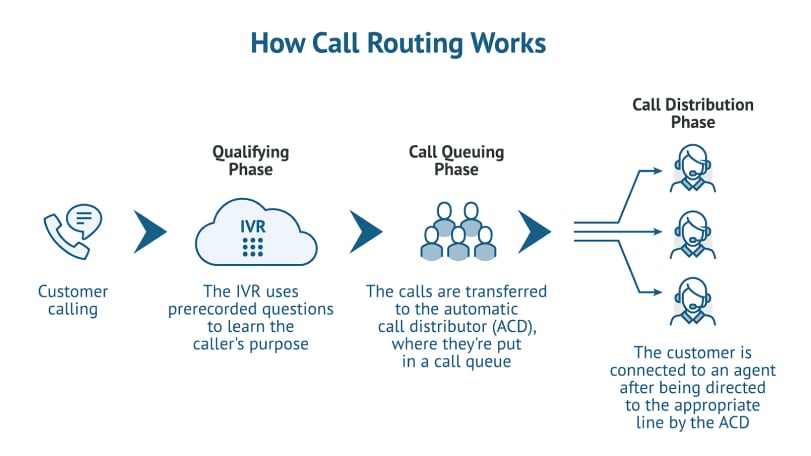
The routing process works in four steps: identify the caller, find the reason for the call, match the call to the best resource, and manage the queue. Most systems then learn from the outcome to improve the next match.
- Identify the caller. The system recognizes the caller from the phone number, account number, or other details and pulls their history from the CRM.
- Find the intent. The IVR asks why the customer is calling, or uses speech recognition to understand a spoken answer.
- Match the resource. The routing engine compares the caller’s needs with agent skills, availability, and priority rules.
- Manage the queue. The system balances workloads, holds the call in the right queue, and offers callbacks when waits run long.
What are the key components of a call routing system?
A smart routing system relies on five components that work together. Each one adds data or logic to the routing decision.
- Automatic call distributor (ACD): the switching system that sends calls to queues and agents based on rules and live conditions.
- Interactive voice response (IVR): the front door that greets callers, collects details, and captures intent, often through conversational AI instead of keypad menus.
- Routing engine: the logic, rules-based or machine learning, that picks the destination.
- CRM integration: customer history, value, and open cases that shape the routing decision.
- Analytics: reports on routing results that show where to change rules or retrain models.
In Amazon Connect, for example, routing profiles link agents to the queues, channels and priorities they handle, so a team’s work can be changed in one place.
What are the main types of intelligent routing?


The main routing types are skills-based, priority, value-based, least-occupied, time and location-based, predictive, and omnichannel routing. Most contact centers combine two or three types.
Skills-based routing
Skills-based routing sends each caller to an agent with the right expertise, language, or product knowledge. It works well when questions need specialist knowledge, such as technical support. SQM Group research on intelligent skill-based routing found that it can improve first-call resolution and customer satisfaction by 5% to 15%.
Best for: technical support, multilingual teams and complex products.
Priority routing
Priority routing moves high-priority callers to the front of the queue or to a dedicated team. Priority can come from account tier, issue urgency, or a service-level agreement.
Best for: premium customers, urgent issues, and SLA-driven support.
Value-based routing
Value-based routing ranks callers by their expected value to the business, such as customer lifetime value or sales potential. High-value callers reach the most experienced agents.
Best for: sales teams, financial services, and subscription businesses.
Least-occupied routing
Least-occupied routing sends each call to the agent who has been idle longest or has handled the fewest calls. It spreads work evenly and reduces agent burnout.
Best for: teams where every agent handles the same type of call.
Time and location-based routing
Time and location-based routing sends calls by the caller’s region, language, or time zone. The “follow-the-sun” model passes calls between centers in different regions as each workday starts and ends, which keeps support running around the clock.
Best for: global businesses with support teams in several time zones.
Predictive routing
Predictive routing uses machine learning to score which available agent is most likely to achieve a chosen KPI on a given call. Genesys explains that its predictive routing scores agents using skills, performance history and customer history, and retrains its models weekly.
Best for: large contact centers with enough call history to train models.
Omnichannel routing
Omnichannel routing applies the same logic to voice, chat, email, social messages, and SMS. It keeps the conversation history with the customer, so they do not repeat themselves when they switch channels. Many teams pair it with AI chat and voice agents, and the trade-offs are covered in AI agent vs chatbot.
Best for: brands that support customers on several channels.
What are the benefits of intelligent call routing?
Smart routing raises first call resolution, cuts wait and handle times, lifts customer satisfaction, and lowers costs. The biggest gain comes from fewer transfers, because callers reach the right agent the first time.
Higher first call resolution
First call resolution (FCR) is the share of issues solved on the first contact. Intelligent routing improves FCR by sending callers to agents who can solve their issue without a transfer. FCR is hard to master: SQM Group reports that only 5% of contact centers reach the world-class benchmark of 80% FCR.
Shorter wait and handle times
Calls that reach the right agent first take less time to handle. Smart queue management spreads volume evenly, offers callbacks, and prevents bottlenecks at peak times.
Better customer satisfaction
Customers are happier when the agent already knows their history and can solve the problem. SQM Group links every 1% gain in FCR to a 1% gain in customer satisfaction, and it finds satisfaction drops by about 15% with each extra contact a customer needs.
Lower operating costs
Smart routing lowers costs by cutting repeat calls, transfers, and escalations. In the same SQM Group research, each 1% gain in FCR reduces operating costs by 1%, and repeat calls make up about 23% of the average contact center’s operating budget.
Better agent experience
Agents handle calls they are trained for and see the customer’s context on screen. That cuts stress, shortens training time for new agents and can reduce turnover.
What are the limitations of AI call routing?
Any routing system is only as good as its data and setup. Poor data, unclear intent capture, and weak agent skill profiles all lead to misrouted calls.
- Misrouting: callers who describe their issue vaguely can still reach the wrong team.
- Data quality: outdated CRM records or skill profiles lead to bad matches.
- Agent buy-in: agents may resist new scoring or skill ratings without clear explanation.
- Privacy: routing on customer data must follow the data protection rules that apply to your business.
- Model drift: predictive models need retraining as products, customers, and teams change.
Cloud vs on-premise call routing: which should you choose?
Cloud call routing suits most businesses because it costs less up front, scales on demand, and updates automatically. On-premise routing still fits companies with strict data residency needs or large existing hardware investments.
Cloud vs on-premise call routing
| Factor | Cloud | On-premise |
|---|---|---|
| Upfront cost | Low, subscription pricing | High, hardware and licenses |
| Setup time | Days to weeks | Weeks to months |
| Scaling | On demand | Needs new hardware |
| Updates and AI features | Automatic from the vendor | Manual upgrades |
| Data control | Shared with the vendor | Full in-house control |
| Best for | Most growing and remote teams | Strict security or legacy setups |
How do you choose an intelligent call routing solution?
Choose a routing solution by matching its routing types, integrations, and AI features to your call volume and goals. A small team needs simple skills-based routing; a large center may need predictive and omnichannel routing.
- Define your goal. Pick the main KPI, such as first call resolution, wait time, or sales conversion.
- Check routing types. Confirm the platform supports the routing strategies you need now and later.
- Check integrations. The system must connect to your CRM, helpdesk, and workforce management tools.
- Review AI features. Look for speech-based IVR, sentiment detection, and predictive routing.
- Check reporting. You need clear dashboards on routing results, transfers, and FCR.
- Compare total cost. Include licenses, setup, integration work, and ongoing support.
CRM integration is often the hardest part. If your customer data lives in a homegrown system, a guide to custom CRM software development explains how to make it routing-ready.
How do you set up smart call routing?
Setting up smart call routing takes six steps, starting with your data and ending with ongoing tuning. Most teams start simple, prove results, and then add AI.
- Map your call types. List the main reasons customers call and how often each comes up.
- Profile agent skills. Rate each agent on products, languages, and issue types.
- Clean your data. Update CRM records and connect caller ID to customer accounts.
- Design routing rules. Start with skills-based and priority routing for your top call types.
- Pilot and measure. Run the rules on one queue and track FCR, transfers, and wait times.
- Add AI and tune. Add speech-based intent detection or predictive routing once you have enough data, and review results monthly.
Speech analytics and sentiment analysis can add another signal, for example by moving an upset caller to a senior agent.
Summing up
Intelligent call routing connects each caller with the agent most likely to solve their issue, using caller data, intent and agent skills. It raises first call resolution, shortens waits and cuts costs, as long as the data behind it is clean. Start with skills-based and priority routing, measure the results, then add AI predictive routing as your call history grows.

Sunil Kumar is CEO of Ailoitte, an AI-native engineering company building intelligent applications for startups and enterprises. He created the AI Velocity Pods model, delivering production-ready AI products 5× faster than traditional teams. Sunil writes about agentic AI, GenAI strategy, and outcome-based engineering.
About Ailoitte