



iOS has the second-largest OS market share worldwide after Android. Additionally, the Apple App Store generated a revenue of $21.2 billion in Q3 of 2022, significantly higher than the Google Play store, which generated $10.4 billion in the same quarter.
Estimating iOS app development costs always depends on your business goals and development approach and since every project has its requirements and limitations, they all have different budget requirements. On a high level, however, the average cost to develop an iOS app for a standard app may range from $25,000 to $70,000.
To estimate how much it cost to make an iPhone app, you must evaluate elements like business goals, development approach, UI/UX design, number and complexity of features, iOS developer costs, and app type. Knowing how to estimate, plan, and manage the cost to develop an iOS app can ultimately bring you one step closer to becoming a part of such a financially beneficial industry.
iOS App Development
A deciding factor in any mobile app development pricing is the type of app you choose to develop. You have two choices when it comes down to it – Native or Cross-platform.
Native iOS Development
Building a native iOS app means it will be specifically for iOS and only be compatible with iOS devices. A native iOS app is typically built to be user-friendly and has high security and effective performance. So if you only need to target the iOS user base, native app development can be your ideal choice.
The average iPhone app development costs with native ranges from $45,000 and $80,000, but it may vary based on your app type, complexity, and features.

Cross-platform Apps
When building a cross-platform app, you are not only creating an iOS app, but you are also creating an all-in-one app that can function on multiple platforms such as iOS, Android, Web, and macOS. From a financial standpoint, a cross-platform app proves more beneficial as it is easy to develop, takes less time, costs less money, and gives you access to a large target audience. It is easy and faster to build because you only need a single reusable code for the whole project. Such development shortens development time and overall iPhone app development costs.
The cost to develop a cross-platform app ranges from $25,000 to $40,000 for a standard version.
iOS App Development Cost by Type
| App Type | Costs |
| Native Development | $45,000 and $80,000 |
| Cross-platform Development | $25,000 to $40,000 |
How Much Does it Cost to Build an iOS App?
Since you must have a good idea about iOS app development costs by now, you can look into how various factors affect the final project cost.
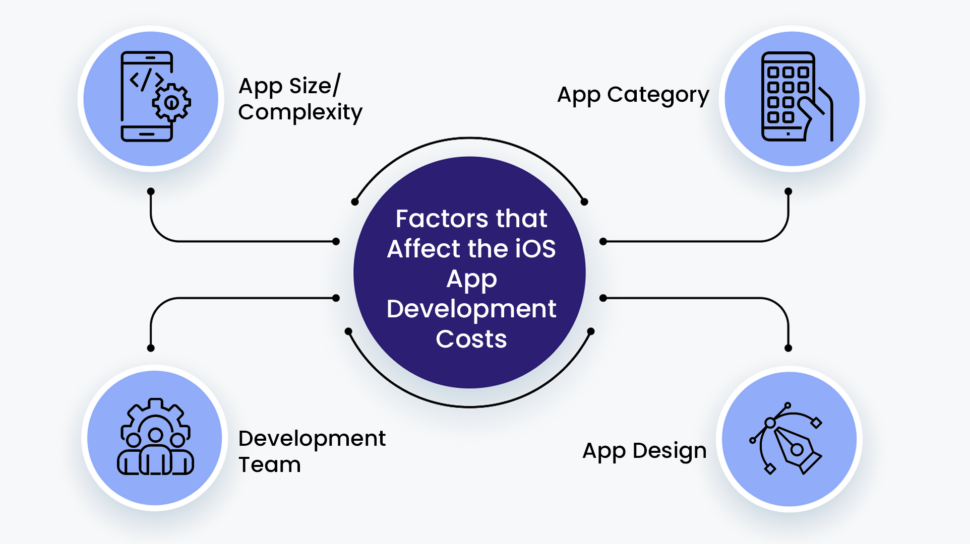
Factors that Affect the iOS App Development Costs
- App Size/Complexity
- App Category
- Development Team
- App Design
App Size/Complexity
The number of features, APIs, and development hours increases when you increase your app size, which leads to higher development costs. Conduct thorough research and analysis to determine the elements you want in your app before you develop the iOS application.
How many and what type of features you want, how many and which APIs you need, and which cloud storage you plan to use for your app are just some things you need to evaluate before the project begins. It is because they can significantly increase or decrease the cost to develop an iPhone app.
The table below should give an average estimate of how app size/complexity can affect Apple app development costs.
iOS App Development Costs by Complexity
| App Complexity | USA | Duration |
| Basic App | $20,000 to $25,000 | 2 to 4 Months |
| Standard App | $45,000 to $75,000 | 3 to 6 months |
| Complex App | $80,000 to $150,000 | 5 to 10 months |
App Category
App categories are another driving factor in your iOS development project. There are many categories of iOS apps, like gaming, business, e-learning, video streaming, travel, e-commerce, social networking, and health and fitness apps.
Each app has a different demographic, security standards, storage requirements, API requirements, UI/UX design standards, and functionality requirements. Therefore, the cost to develop an iPhone app will differ based on which type of app you are developing.
The tables below provide an average estimation of Apple app development cost for different categories of iOS apps.
iOS App Development Costs by Category
| App Category | Costs |
| Food Delivery App | $20,000 to $40,000 |
| eLearning App | $25,000 to $50,000 |
| Social Media App | $20,000 to $35,000 |
| Ride-hailing App | $20,000 to $45,000 |
| Fintech App | $25,000 to $50,000 |
| Healthtech App | $25,000 to $60,000 |
| eCommerce App | $20,000 to $55,000 |
| Live Streaming App | $20,000 to $45,000 |
| Gaming App | $15,000 to $45,000 |
| Tourism App | $20,000 to $45,000 |
Development Team
The type and location of your team is essentially the primary factor determining the initial and final cost to develop an iPhone app. Depending on the type of iOS you are building, you can hire an in-house team, freelance developers, or outsource to onshore, nearshore, or offshore developers. Every option would include a different development cost and outcome.
While every development team can have different rates, the table below contains an average cost of iOS app development with various teams.
iOS App Development Cost Based on Team
| Inhouse Team | $150,000 to $200,000 PA |
| Freelance Developers | $50,000 to $80,000 |
| Onshore Outsourcing | $80,000 to $140,000 |
| Nearshore Outsourcing | $72,000 to $100,000 |
| Offshore Outsourcing | $45,000 to $80,000 |
Industry experts recommend the offshore outsourcing option since it is much safer than freelancers and provides access to skilled developers at much lower costs.

App Design
App design determines the user interface and experience of your iOS mobile app, which are driving factors of user acquisition and retention in any mobile app. If users do not have a visually appealing and comfortable ease of use in your app, they will uninstall it right after installation. Therefore, you must carefully plan and manage the UI/UX design costs.
You are also required to meet the design standards of the Apple app store if you want your app to get approved for deployment. It is another factor that could further increase the iPhone app development costs.
The table gives an average iOS app development cost breakdown for UI/UX design based on the complexity of the design.
iOS App Design Cost
| iOS Design | iOS | Duration |
| Basic App Design | $5000 to $8,000 | 20 to 160 hours |
| Standard App Design | $10,000 to $15,000 | 150 to 350 hours |
| Complex App Design | $18,000 to $22,000 | 500 to 600 hours |
The costs will vary for your UI/UX design since the requirements, approach, and iOS developer fee will determine the exact cost.
Conclusion
Ultimately, knowing the cost to develop an iOS app depends on your project and business requirements. Once you determine the UI/UX design approach, number and complexity of features, developers, app type, and development approach, you should be able to estimate the exact Apple app development costs and prepare for any unexpected spending required during the development process.
You can also get some assistance from an iOS App development company to better estimate, plan, and manage the costs for your iOS mobile application.
Frequently Asked Questions
The Apple Developer Program account costs $99 per year. Once you pay for it, you can publish your app on the Apple App Store.
However, there are charges such as the commission fee on in-app purchases and subscriptions. There is a 30% commission fee on any in-app purchases and subscriptions purchased in your app. The commission fee for subscriptions drops to 15% after the first year of deployment.
Choose a popular niche, research the market, create a development plan, choose an effective strategy, hire the right team, and test the iOS app until it meets all the performance, design, and security standards.
No, you cannot. To publish an iOS app, you need to create an Apple Developer Program account, which costs $99 per year.
No, it entirely depends on your business goals, app category, developer fees, app complexity, number and type of features, and UI/UX design. iOS and Android app development projects can be more costly or inexpensive/affordable than the others depending on the application project requirements and goals.

Share this article:
Leave a Reply







100+
Project Launched

80+
Happy Clients

18+
Countries Served

91%
Returning client base




.png)
.png)
.png)



Leave a Comment