On this page
- The Industry Numbers Are Damning
- The Time and Materials Trap
- The Fixed Price Illusion
- Why Both Models Are Pre-AI Relics
- The Third Model: Outcome-Based Engineering Pods
- The Math
- How It Works: The Velocity Pod Architecture
- Zero to Full Velocity in 7 Days
- Proof: What Outcome-Based Delivery Looks Like at Scale
- Who Should Choose Outcome-Based Engineering?
- The Decision Framework
- Related Reading
- The Bottom Line
- FAQ
Every enterprise has been here. You scope a project. You negotiate the contract. You pick one of the two standard models — fixed price or time and materials — and nine months later, you’re explaining to your board why the thing that was supposed to cost $200K is now $340K, three months late, and still not in production.
This is not a vendor problem. It is a structural model problem. Both fixed price and T&M were designed for a world where software development was predictable, linear, and human-bottlenecked. AI engineering is none of those things.
In 2026, a third model has emerged — and it is the only one that actually fits how AI engineering works. This post explains why the first two fail, how the third works, and how to know which model your next engagement should use.
The Industry Numbers Are Damning
The data on enterprise software project failure is not ambiguous. According to McKinsey’s large-scale IT project analysis, 70% of enterprise software projects overrun budget or timeline, and the average cost overrun is 45%. For AI-specific projects, Gartner reports that 85% of AI pilots fail to move from pilot to production.
- 45% average budget overrun on enterprise software projects (McKinsey, 2026)
- 85% of AI pilots never reach production (Gartner, 2026)
- $1.6 trillion lost annually to failed IT projects globally (Standish Group CHAOS Report)
- 40% of T&M AI engagements exceed the original estimate by more than 30%
The Time and Materials Trap
Time and materials (T&M) contracts bill the enterprise for every hour of work, regardless of output. For AI engineering, T&M breaks down completely for three reasons:
- AI workloads are non-linear. A single prompt engineering change can double output quality — or break an entire pipeline. Human hours bear no relationship to AI system performance.
- Model evaluation is unbounded. Testing an AI system for accuracy, edge cases, and hallucination rates can consume as many hours as you allow. T&M incentivises thoroughness without defining done.
- Iteration is the core work. AI development is fundamentally iterative: train, evaluate, adjust, repeat. T&M bills all iteration time equally, whether it produced value or not.
The result: T&M AI engagements routinely run 40–60% over original estimates. The vendor is technically fulfilling the contract while the enterprise pays for unbounded iteration.
The Fixed Price Illusion
Fixed-price contracts assume the scope can be fully specified before work begins. AI systems cannot be fully specified before build — model behaviour, training data quality, latency, and hallucination rates are unknowable until tested.
The consequence: fixed-price AI contracts generate change orders. Anything outside the conservative initial scope becomes a billable change. According to Forrester (2025), change orders average 3.2 per AI engagement, expanding total cost by 28–35%.
- Fixed scope ≠ fixed AI behaviour — outputs change with data and prompts
- 3.2 Change orders per AI project on average (Forrester, 2025)
- +28–35% cost expansion via change orders before delivery
- Vendor incentive: scope conservatively, upsell via changes
Why Both Models Are Pre-AI Relics
Both T&M and fixed-price contracts were designed when software was human-bottlenecked and linearly predictable. AI engineering breaks the hours-to-output relationship entirely. An agentic AI system can generate, test, and deploy a feature in hours that would take a human engineer days.
| Contract Model | Designed For | Vendor Incentive | AI Engineering Fit | Typical Cost Outcome |
|---|---|---|---|---|
| Time & Materials | Human-hour work | Longer project = more revenue | ❌ Poor | 40–60% budget overrun |
| Fixed Price | Predictable scope | Scope conservatively, upsell changes | ❌ Poor | 28–35% expansion via changes |
| Outcome-Based Pod | AI-native delivery | Earns by delivering outcomes | ✅ Built for this | Fixed total cost, no surprises |
The Third Model: Outcome-Based Engineering Pods
The outcome-based AI engineering model prices engagements by deliverable milestones — not hours, not scope documents. The vendor commits to specific, measurable outcomes: a working AI agent in production, a tested integration, a deployed pipeline with defined accuracy benchmarks.
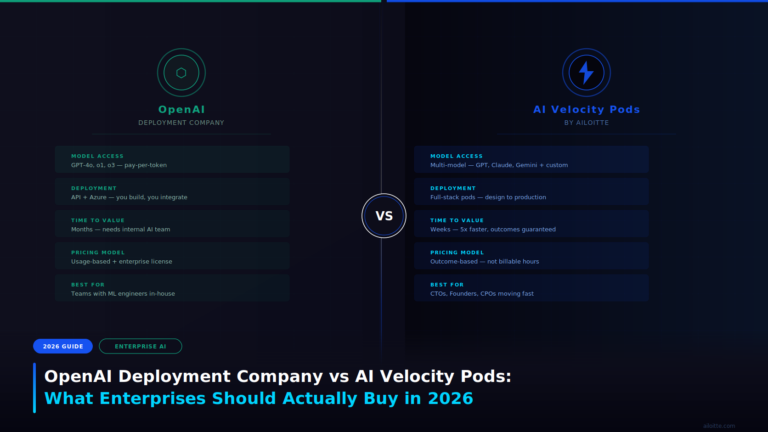
This is the model behind Ailoitte’s AI Velocity Pods: fixed-price milestone contracts built on AI-native engineering infrastructure that makes delivery velocity machine-constrained, not human-hour-constrained. The vendor wins when the AI system works — not when the project runs long.
The Math
Direct cost comparison: production-ready multi-agent workflow system with CRM integration, document processing, and human-in-the-loop escalation.
| Cost Variable | T&M | Fixed-Price | Outcome-Based Pod |
|---|---|---|---|
| Headline estimate | $220K | $190K | $210K |
| Scope changes / overruns | +$95K | +$62K (change orders) | $0 |
| Extended QA phase | +$28K | +$15K | Included |
| Delayed deployment cost | +$40K | +$30K | $0 |
| Actual total cost | $383K | $297K | $210K |
| Time to production | 28 weeks | 22 weeks | 8 weeks |
T&M cost 82% more than outcome-based. Fixed-price cost 41% more. Both took 2–3× longer. The difference is contract structure, not vendor quality.
How It Works: The Velocity Pod Architecture
An AI Velocity Pod is a 3–6 engineer cross-functional unit built around AI-native tooling:
- Agentic QA pipeline — automated test generation, continuous regression via Ailoitte’s Agentic QA system
- LLM-assisted architecture review — every design decision reviewed against production AI patterns before implementation
- Automated documentation — API docs, runbooks generated in real time, not post-sprint
- Outcome gates — defined acceptance criteria the AI system must pass before each milestone is billed
- Fixed-price milestones — enterprise pays per outcome, not per week or engineer
This is the Engine Room methodology — Ailoitte’s AI-native delivery infrastructure. Pods ship 3–5× faster than traditional firms by eliminating the manual overhead consuming 40–60% of traditional development cycles.
Zero to Full Velocity in 7 Days
Traditional engagements require 3–6 weeks of setup before a single line of production code ships. Ailoitte pods reach full delivery velocity in 7 days: Day 1 environment provisioned, Day 3 first agentic pipeline running, Day 7 first outcome milestone in progress.
Start with Ailoitte’s Discovery for Success programme — a 2-week scoped discovery sprint that produces a fixed-price milestone proposal with zero open-ended commitment. Our AI consulting team includes a free contract model assessment for enterprise teams evaluating their next AI transformation engagement.
Proof: What Outcome-Based Delivery Looks Like at Scale
Ailoitte has delivered 300+ products across 22+ countries using outcome-based pod engagements:
- Apna — 50M+ download job platform. AI-native matching engine shipped in 6 weeks. T&M estimate for same scope: 22 weeks.
- AssureCare — healthcare platform serving 53M+ members. HIPAA-compliant AI agent system in 10 weeks. Fixed-price vendor quote: $180K higher, 18-week timeline.
- BankSathi — FinTech platform with 200K+ advisors. Outcome gate: 95%+ automation of manual verification. Delivered: 97.3% automation in 8 weeks.
Who Should Choose Outcome-Based Engineering?
| Scenario | Why Outcome-Based Fits | Wrong Model |
|---|---|---|
| Building a production AI agent system | AI behaviour can’t be fully scoped upfront; outcome gates define “done” | Fixed-price |
| Replacing a failed T&M engagement | Stops billing-for-hours incentive; aligns vendor to delivery | T&M |
| Hard shipping deadline | 7-day ramp vs 6-week ramp; machine-constrained velocity | Either traditional |
| Regulated industry (healthcare, finance) | Outcome gates include compliance checkpoints built in | Fixed-price |
The Decision Framework
- Can you fully specify scope before work begins? Yes → fixed-price may work. No → outcome-based.
- Is delivery speed a competitive factor? Yes → outcome-based (7-day ramp). No → fixed-price acceptable.
- Building AI agents, agentic pipelines, or LLM systems? Yes → outcome-based is the only model designed for this work.
- Hard production deadline? Yes → outcome-based velocity is 3–5× faster than alternatives.
Ailoitte’s AI consulting team runs a free contract model assessment for enterprise teams. Book your assessment →
Related Reading
- What Is Agentic AI? The Definitive Enterprise Guide
- Agentic AI vs AI Agents: What Enterprises Need to Know
- Best AI-Native Engineering Companies in India
- AI Velocity Pods — Outcome-Based AI Engineering
- The Engine Room — Ailoitte’s AI-Native Delivery Infrastructure
The Bottom Line
Fixed price and T&M were the only options for twenty years because software development was human-bottlenecked. AI engineering is not. The outcome-based model exists because AI delivery economics are fundamentally different: machine-constrained velocity, non-linear output, behaviour that cannot be fully specified before build.
Enterprises using T&M or fixed-price contracts for AI system development in 2026 are paying a 30–80% premium over outcome-based alternatives and taking 2–3× longer to reach production. The third model is not experimental. It is in production across 300+ Ailoitte clients in 22+ countries, ISO 27001 and ISO 9001 certified.
Book your confidential AI engineering assessment →

Sunil Kumar is CEO of Ailoitte, an AI-native engineering company building intelligent applications for startups and enterprises. He created the AI Velocity Pods model, delivering production-ready AI products 5× faster than traditional teams. Sunil writes about agentic AI, GenAI strategy, and outcome-based engineering.
About Ailoitte